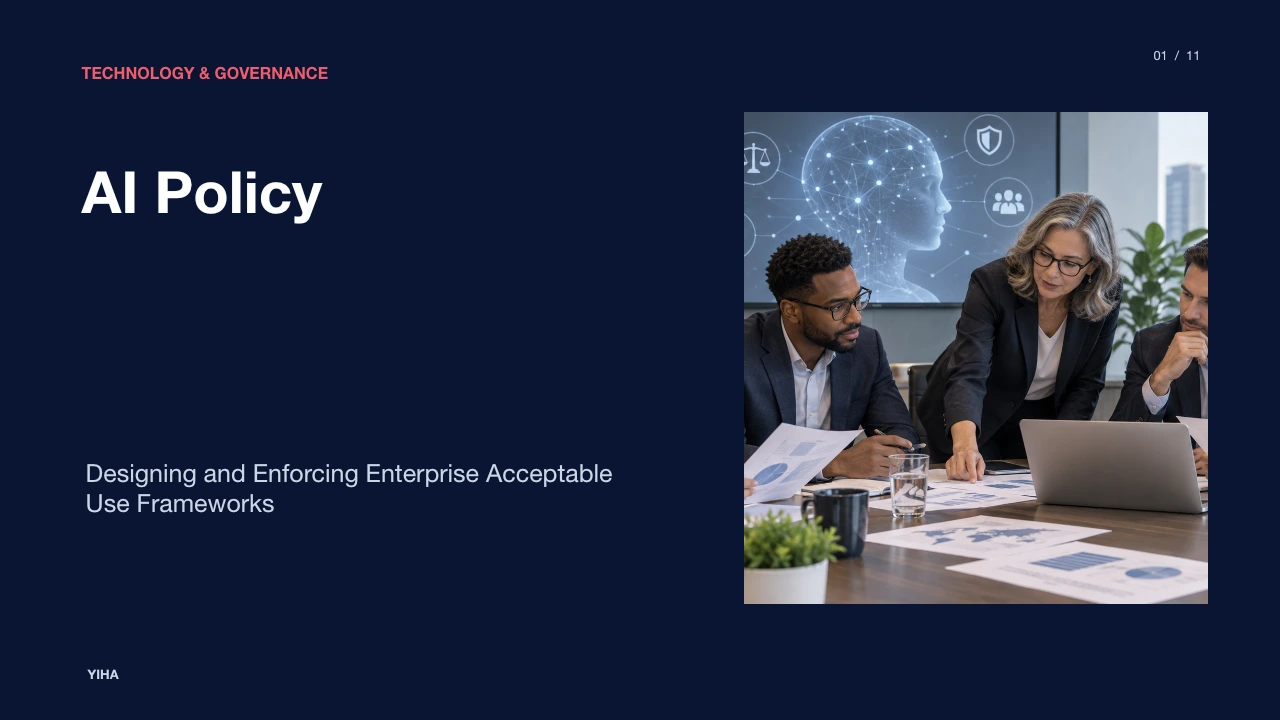
AI Policy
A comprehensive operational guide to designing, structuring, and enforcing an enterprise AI policy that protects corporate data while enabling responsible adoption.
Free download · 4.9 MB11 editable slides · PowerPoint format
Download the editable PPTX
PPTX · 4.9 MB · 11 editable slides · Free to edit and reuse with attribution to Yiha.ai
View every slide
Use ← →, Home/End, or swipe on mobile
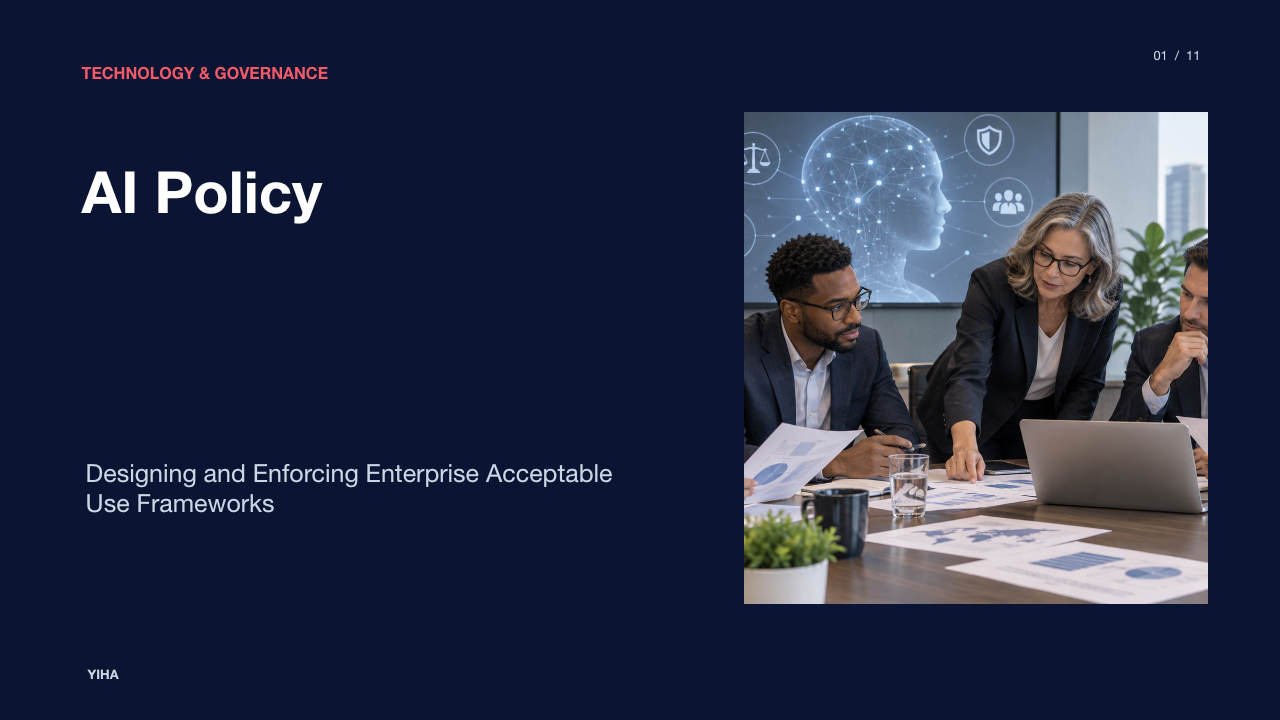
Artificial intelligence tools have moved rapidly from experimental novelties to daily workplace utilities across modern organizations. Without formal governance, enterprises face severe exposures ranging from unmanaged data leaks and regulatory penalties to unmonitored agentic workflows executing autonomous actions. A comprehensive AI acceptable use policy establishes explicit operational rules for how personnel interact with generative models, autonomous agents, and embedded software features, ensuring innovation aligns with legal, technical, and security baselines.
The Business and Legal Need for an AI Policy
Organizations require formal AI governance because unmanaged usage creates immediate legal discovery risks and regulatory vulnerabilities. In early 2026, judicial rulings confirmed that prompt records generated within workplace chatbots do not carry evidentiary privilege and are discoverable during litigation, as detailed by Forcepoint's AI Acceptable Use Policy Guide. When employees input sensitive corporate records, unreleased earnings, customer data, or internal legal assessments into conversational assistants, those prompts become discoverable corporate records subject to subpoena in third-party disputes.
Simultaneously, regulatory frameworks require documented operational oversight. The European Union AI Act mandates clear governance over covered systems, while frameworks such as the NIST AI Risk Management Framework and ISO 42001 treat acceptable use policies as essential organizational controls. External compliance audits under SOC 2, HIPAA, and PCI DSS now routinely assess whether companies maintain documented parameters governing AI use, as outlined in Strac's AI Acceptable Use Policy Template. Leaving AI usage unguided fosters shadow AI environments where sensitive records leak into public models without organizational visibility.
Defining AI Scope Across Tool Categories and Agents
An effective policy must define the technical scope of AI rather than issuing vague guidelines about responsible technology use. Traditional acceptable use policies focus narrowly on hardware assets, network access, and basic software installations, leaving modern generative and autonomous architectures completely unaddressed. According to CTAIO's 9-Section Enterprise Guide, policies fail when employees cannot determine whether specific technical workflows, such as copying script fragments into an assistant, are permitted under corporate guidelines.
Scope definitions must explicitly cover three operational tiers: standalone generative chatbots, embedded AI features inside approved enterprise SaaS platforms like CRM and customer support suites, and autonomous agentic workflows. As explained by Forcepoint's AI Acceptable Use Policy Guide, agentic AI systems perform multi-step tasks without continuous human oversight at every stage, executing system queries, writing records, and generating communications. The governance perimeter must encompass company-issued hardware, virtual desktop environments, and personal devices used under bring-your-own-device arrangements.
Vetting Tools and Managing Enterprise Subscriptions
Organizations cannot treat consumer-grade tools and enterprise subscriptions identically. Free or consumer AI accounts routinely retain user prompts for continuous foundation model training, exposing proprietary prompts to model ingestion. Conversely, enterprise agreements offer explicit zero-retention clauses and comprehensive Data Processing Agreements (DPAs) that legally restrict vendor data reuse, a distinction emphasized in Strac's AI Acceptable Use Policy Template.
Tool vetting must also evaluate software architecture, vendor jurisdiction, and server hosting locations. In 2025, security assessments highlighted foreign data hosting risks when Microsoft prohibited staff from using the DeepSeek application due to overseas data custody obligations, as noted by Forcepoint's AI Acceptable Use Policy Guide. Procurement processes should route AI requests through an evaluation board. For instance, CTAIO's 9-Section Enterprise Guide recommends establishing structured evaluation pipelines with clear turnaround service level agreements so business units receive approved enterprise alternatives instead of defaulting to unapproved tools.
Data Classification Rules for Prompts and Training
Data handling rules must map organizational classification tiers directly to permissible AI environments. According to CTAIO's Enterprise Guide, standard enterprise data structures generally span four levels: public (Tier 1), internal (Tier 2), confidential (Tier 3), and restricted (Tier 4). Public data may be analyzed using approved tools, whereas internal information should only enter enterprise-licensed platforms bound by strict DPAs.
Restricted data, comprising Protected Health Information (PHI), Payment Card Industry (PCI) data, proprietary source code, and trade secrets, must remain entirely barred from commercial cloud models unless protected by specialized on-premises hosting or private infrastructure with explicit authorization. When employees paste internal source code into public models, post-incident investigations frequently highlight the absence of strict classification mappings as the primary failure point, an issue documented by Strac's AI Acceptable Use Policy Template. As a foundational principle highlighted by AI Heroes' AI Policy Guide, personal and confidential customer records must never enter platforms lacking legally binding processing agreements.
Prohibited Use Cases and Boundary Setting
An enterprise policy must delineate clear boundaries that cannot be bypassed by commercial deadlines. These guardrails prevent regulatory infractions and protect individual rights. Under frameworks reviewed in Strac's AI Acceptable Use Policy Template and CTAIO's 9-Section Enterprise Guide, prohibited use cases include:
- Conducting autonomous hiring, performance appraisal, or termination evaluations without human review.
- Implementing continuous biometric tracking or real-time facial surveillance on staff.
- Generating legal, clinical, or medical advice intended for third parties without licensed professional oversight.
- Producing synthetic media that impersonates personnel or corporate executives.
- Drafting exploit code designed to bypass internal authorization controls or evade perimeter firewalls.
- Feeding sensitive customer data into external systems without explicit security board sign-off.
Establishing these bright lines ensures development and operational teams understand what applications remain off-limits regardless of tool capabilities.
Human Oversight and Verification Protocols
AI models are susceptible to factual errors, fabricated citations, and contextual drift. Consequently, an acceptable use framework must establish defined human oversight patterns across risk categories. CTAIO's 9-Section Enterprise Guide details three primary oversight models: human-in-the-loop for high-risk applications where an authorized reviewer must manually validate each individual output; human-on-the-loop for medium-risk tasks where monitors observe throughput and intervene to override anomalies; and human-in-command for low-risk workflows where administrators govern broad system guardrails.
Accountability must rest solely with human operators. As stated by Forcepoint's AI Acceptable Use Policy Guide, the personnel member approving a client deliverable or regulatory disclosure remains strictly responsible for its factual accuracy and legal compliance. Claiming reliance on model output cannot serve as an internal or legal defense against errors.
Managing Third-Party AI and Vendor Risk
Enterprise risk extends beyond internal operations to external vendors and SaaS partners who integrate machine learning components into their platforms. Procurement frameworks must incorporate rigorous third-party AI questionnaires before contract execution. CTAIO's 9-Section Enterprise Guide outlines essential contractual stipulations, including mandatory DPAs that explicitly prohibit vendor use of client data for model pre-training, clear documentation of training provenance, 24-hour incident notification windows, and audit rights.
Vendor risk assessments should also verify third-party certifications, such as SOC 2 Type II reports and ISO 42001 compliance. As noted by Strac's AI Acceptable Use Policy Template, failure to govern vendor AI integrations creates an unmonitored backdoor, allowing external subprocessors to absorb proprietary organizational assets into secondary model iterations without administrative visibility.
Technical Controls for Policy Enforcement
Written policies alone cannot prevent data leakage; governance requires technical enforcement controls to supervise digital egress channels. Forcepoint's AI Acceptable Use Policy Guide emphasizes applying Data Loss Prevention (DLP) classifiers and Cloud Access Security Broker (CASB) policies to AI prompts, blocking unauthorized transfers of customer information and distinguishing consumer accounts from enterprise tenants.
Operational enforcement combines several core technologies, as detailed in Strac's AI Acceptable Use Policy Guide:
- Browser extensions and endpoint agents that discover unapproved applications and local open-source models.
- Real-time prompt inspection mechanisms that mask sensitive patterns like payment data and credentials across text inputs and file attachments.
- Access controls and API gateways that scope permissions for autonomous agents and verify identity before records change.
- Log forwarding to centralized Security Information and Event Management (SIEM) systems for real-time auditability.
These automated safeguards ensure policy directives function as active operational guardrails.
Review Cadence, Literacy Training, and Accountability
Maintaining AI governance requires regular review cycles and workforce training. Regulatory mandates like Article 4 of the European Union AI Act require demonstrable workplace AI literacy, establishing education as a formal legal obligation, as highlighted in AI Heroes' AI Policy Guide.
Policies require scheduled updates. CTAIO's Enterprise Guide recommends formal reviews every six months led by governance officers, alongside event-driven reviews triggered within 30 days of significant regulatory changes or high-severity security incidents. Incident escalation procedures must define response targets, including triage within two hours and root-cause analysis within five business days. Pairing structured technical controls with accountable review rhythms ensures the organization balances technological capabilities with rigorous data protection.
Research sources
- AI Acceptable Use Policy Template & Guide [2026] · www.forcepoint.com
- AI Acceptable Use Policy: Free Template + Enforcement Guide (2026) · www.strac.io
- AI Policy Template: 9-Section Enterprise Guide | CTAIO · ctaio.dev
- How to Write an AI Policy | Step-by-Step Guide + Template (2026) | AI Heroes · aiheroes.io