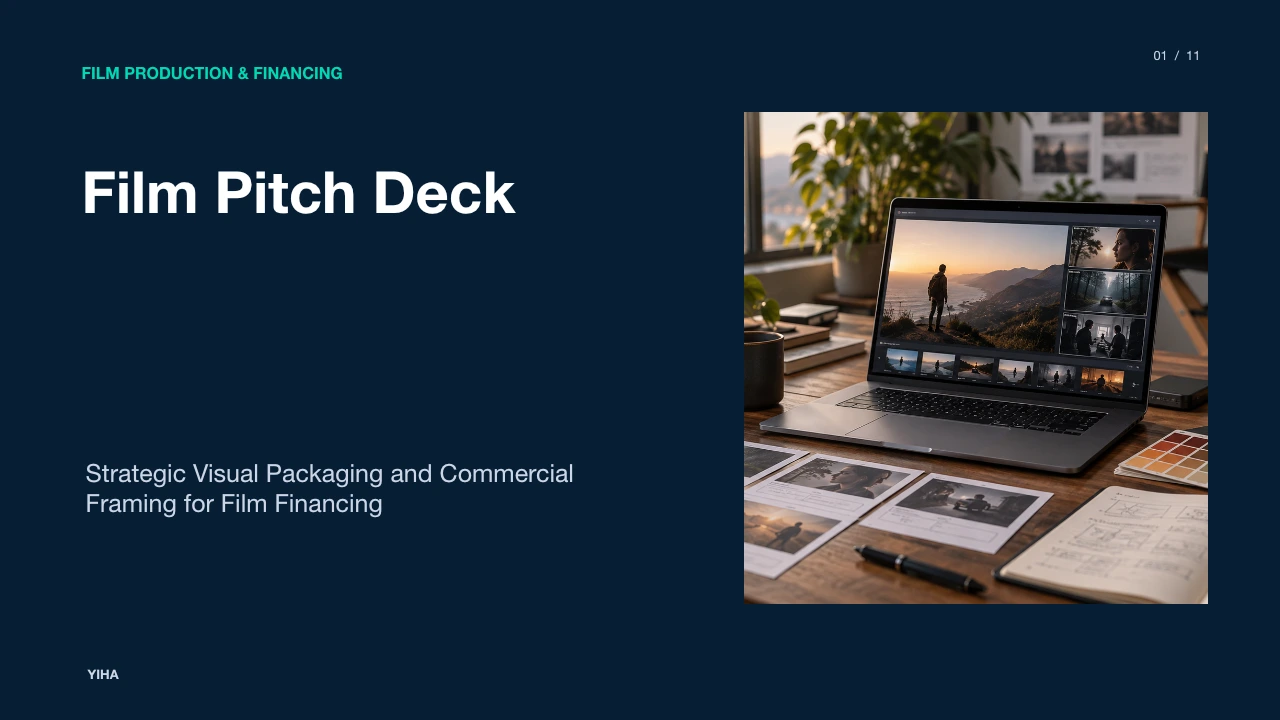
Film Pitch Deck
A comprehensive guide to constructing industry film pitch decks that bridge creative screenplays and investor evaluation through narrative distillation, visual packaging, and financial framing.
Free download · 4.9 MB11 editable slides · PowerPoint format
Download the editable PPTX
PPTX · 4.9 MB · 11 editable slides · Free to edit and reuse with attribution to Yiha.ai
View every slide
Use ← →, Home/End, or swipe on mobile
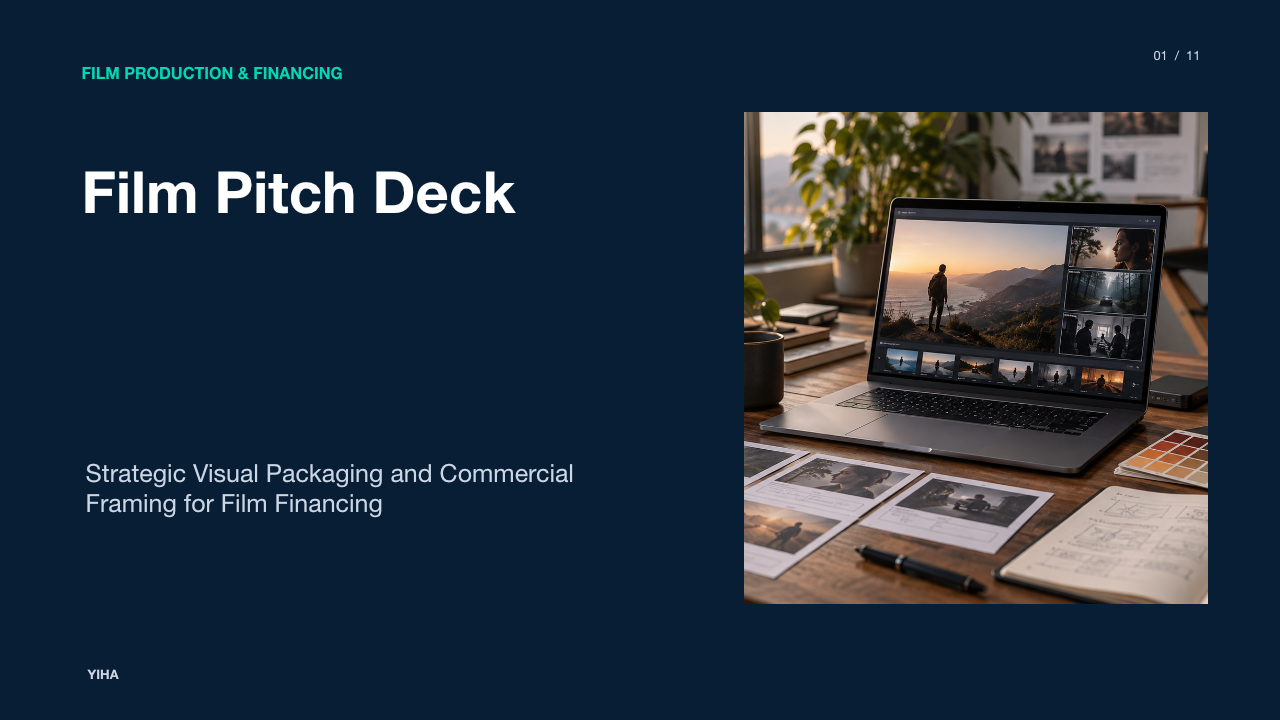
In cinematic development, a completed screenplay is rarely sufficient on its own to initiate physical production or secure capital commitments. Modern financiers, studio executives, sales agents, and distributors evaluate motion pictures not merely as creative literature, but as commercial assets subject to rigorous risk analysis. A professional film pitch deck serves as the decisive analytical and visual bridge between dramatic writing and financial execution, translating story potential into an actionable production package.
The Role of Visual Packaging in Film Financing
Independent and studio film financing has transitioned from speculative creative momentum toward intense early-stage evaluation. Producers, equity financiers, and distribution executives encounter hundreds of submissions each season. In this high-density environment, the pitch deck acts as an essential gatekeeping document designed to verify project viability before an executive commits multiple hours to reading a complete script.
As examined by ciaro.pro, film financing decisions in recent years place immense scrutiny on execution credibility within the opening ten minutes of an initial meeting. Industry evaluators do not review submissions solely for artistic merit; they determine whether the premise has commercial viability, whether the package reads as a realistic business case rather than an ungrounded mood board, and whether the proposed budget aligns with verifiable market comparables. Visual packaging frames creative intent within an operational context. Rather than serving as superficial decoration, the deck demonstrates how tone, casting, visual atmosphere, and logistical scale merge into an executable project.
Furthermore, DeckFlow notes that institutional and private investors view motion pictures as a distinct asset class requiring concrete operational roadmaps alongside artistic vision. A screenplay communicates dialogue, action, and scene structure, but a pitch deck establishes visual proxy and commercial logic, proving that the creative team commands both dramatic storytelling and marketplace reality.
Structural Anatomy of an Industry Pitch Deck
A professional industry pitch deck requires a disciplined structural flow that leads a reader from narrative premise to execution feasibility without cognitive drag. According to The Los Angeles Film School, an impactful deck balances three core pillars: strong imagery, a clear synopsis, and a structured future plan. Decks must orient the reader quickly, moving from the overarching concept into characters, world-building, and commercial potential.
Industry insights from First Draft Filmworks and AiPPT describe common deck components. The order and length depend on the project:
- Cover Slide: Project title, genre, format, and core creative identity.
- Logline & Premise: Single-sentence narrative hook defining protagonist, inciting incident, and core conflict.
- Story Synopsis: Condensed narrative overview revealing structural arcs and dramatic stakes.
- World & Setting: Environmental textures, social context, and atmospheric rules.
- Character Profiles: Primary protagonist, antagonist, and supporting dynamics with emotional arcs.
- Lookbook & Visual Style: Palette swatches, lighting philosophies, camera movement styles, and framing.
- Market Comparables (Comps): Box office benchmarks, streaming equivalents, and budget scale.
- Target Demographics: Core genre audience profile, viewing habits, and psychographics.
- Key Creative Team & Attachments: Director, writer, producer bios, and attached talent.
- Budget Top-Sheet & Finance Plan: High-level production cost allocation, tax credits, and capital ask.
- Production Timeline & Future Potential: Development milestones, distribution pathways, or franchise potential.
- Contact & Next Steps: Official production company contact channels.
This structured sequence prevents narrative meandering while delivering essential financial and logistical data systematically.
Narrative Distillation from Screenplay to Pitch
Condensing a 110-page feature screenplay into two or three presentation slides represents a major storytelling challenge. Filmmakers frequently err by attempting to copy scene descriptions directly from the script. Pitch decks require ruthless narrative distillation—extracting core dramatic engine components without diluting narrative friction.
As explained by GL Coverage, an effective pitch begins with a disciplined logline. The logline introduces the protagonist through a defining trait, introduces the inciting incident that knocks their world off balance, identifies their active goal, and establishes the stakes of failure. Unlike commercial marketing taglines, which are evocative sales slogans aimed at consumers who have already purchased a ticket, a development logline is descriptive and utilitarian, explicitly designed to show an executive how the story operates.
In the deck itself, the synopsis must convey story structure cleanly. GL Coverage emphasizes that a pitch synopsis must disclose the third-act resolution and ending, because an executive or investor cannot evaluate structural storytelling competence without knowing how the narrative resolves. Concealing the ending to preserve suspense undermines professional evaluation. As noted on the Kinolime Podcast, condensing a script into succinct presentation submission materials requires articulating where the story begins, who the central characters are, and how the conflict drives the action, proving that the writer controls the material.
Translating Story Tone into Visual Language
Directorial vision cannot be communicated solely through vague adjectives like "gritty" or "cinematic." The visual tone section translates abstract themes into tangible cinematography references, spatial geometry, and lighting styles. As noted by Celtx, if a beat sheet is the skeleton of a film, the pitch deck represents its skin, color, and atmosphere.
A systematic visual guide incorporates curated reference photography rather than generic stock imagery. As detailed in the DrawStory Film Mood Board Guide, mood boards require deliberate curation, grouping references across distinct parameters:
- Color Palette: Dominant hues, saturation thresholds, and contrast ratios (warm palettes suggesting nostalgia; cold desaturation conveying isolation).
- Lighting and Cinematography: Practical sources versus stylized high-contrast ratios, lens choices (anamorphic widescreen versus shallow spherical optics), and camera movement (handheld kineticism versus locked architectural framing).
- Wardrobe and Production Design: Textures, architectural scale, and authenticity that frame the social and physical universe of the story.
Limiting each visual category to three to five carefully selected references prevents sensory overload and establishes consistent aesthetic execution.
Market Comparables and Audience Demographics
A critical area where creative proposals falter is commercial framing. Producers do not evaluate projects in a vacuum; they position them against historical marketplace performance. Demonstrating commercial viability requires selecting disciplined market comparables (comps) and defining distinct audience psychographics.
According to DeckFlow, market comp slides should feature three to five recent films that align closely in genre, tonal balance, and budget scale. A frequent failure in pitch construction is selecting massive runaway anomalies—such as comparing an indie thriller to a multi-billion-dollar studio franchise. Believable comps pair production budgets against worldwide box office yields or verifiable streaming impact, establishing an active, identifiable market niche.
Complementing comps, audience demographic slides define who will watch the film and why. The Los Angeles Film School emphasizes that pitch decks gain substantial traction when they clearly articulate genre positioning and viewer experience. Producers evaluate whether the film targets a passionate micro-audience (such as elevated horror enthusiasts or arthouse festival patrons) or appeals broadly across age and regional demographics.
Budget Top-Sheets and Financial Framing
Financiers reading a pitch deck need immediate visibility into capital requirements, but they do not want to parse line-by-line accounting ledgers during an introductory presentation. The deck should feature a cleanly formatted budget top-sheet summary that frames production categories and financing mechanisms.
As outlined by GoDigitalTools, filmmakers should present topline numbers rather than sprawling spreadsheets. Granular accounting can be provided in subsequent diligence meetings if requested. Industry resources from FilmProposals highlight that production costs are fundamentally divided across Above-the-Line (talent, director, writer, producers), Below-the-Line (crew, gear, locations, physical production), and Post-Production (editing, color, VFX, sound mix).
An illustrative example of a balanced financial slide includes:
- Target Production Budget Range: Expressed clearly (e.g., $1.5M – $2.0M tier).
- Macro Cost Allocations: Visual breakdown (Above-the-Line, Production/Shooting, Post-Production, Contingency reserve).
- Capital Sources: Soft money contributions (regional tax credits, rebates), equity sought, and presale or distribution advances.
- The Immediate Ask: The exact capital requirement necessary to fund development or trigger principal photography.
Framing these numbers professionally reassures investors that the creative leads understand fiscal realities.
Packaging Attached Talent and Creative Teams
Films are executed by human teams operating under tight production constraints. Investors actively seek proof that the attached personnel possess the operational capability to complete the project on time and within budget. Packaging slides present key attachments and creative credentials.
First Draft Filmworks points out that filmmakers often confront a dilemma when key roles remain uncast. In this scenario, decks can employ clear "casting ideas" or visual archetypes. However, presenters must explicitly label these as suggestions or conceptual targets rather than implying confirmed attachments, which destroys credibility during background vetting.
For confirmed attachments—such as an established cinematographer, seasoned line producer, or bankable lead actor—the deck should feature concise professional bios and notable credits. As GoDigitalTools notes, packaging slides answer whether the team understands production realities and has delivered measurable results before, incorporating awards, festival laurels, and recognized past work.
Comparing Pitch Decks, Lookbooks, and Business Plans
Filmmakers often confuse three related development assets: lookbooks, pitch decks, and business plans. While they share common visual and conceptual roots, each document fulfills a distinct strategic objective and targets a specific stakeholder audience.
As analyzed by First Draft Filmworks and Lone Star Films, the distinctions break down across content and function:
- Lookbook: An impressionistic, visually dominant portfolio focusing primarily on aesthetic world-building, textures, camera language, and mood. It is aimed primarily at cinematographers, production designers, and creative collaborators.
- Pitch Deck: A concise strategic document that synthesizes creative narrative with commercial viability, targeting producers, packaging agents, executive producers, and early-stage financiers.
- Production Business Plan: A comprehensive corporate document detailing waterfall recoupment schedules, revenue projections, detailed line-item budgets, distribution pathways, and corporate structures for private equity compliance.
Lone Star Films highlights that treating a pitch deck merely as an artistic script summary rather than an investor-facing packaging document is a critical misstep. Selecting the right document prevents overwhelming creative collaborators with business data or alienating financial backers with unstructured mood collages.
Delivering the Pitch in Executive Meetings
A pristine pitch deck cannot compensate for disjointed live delivery. When presenting to studio executives, network commissioners, or equity investors, the deck serves as visual accompaniment rather than a script to be read aloud line by line.
According to StudioBinder, live executive pitching requires extensive preparation and strategic pacing. Presenters should conduct advance research into the specific executive's slate, examining the distributor's or studio's current content portfolio to understand where their project fits. In live and virtual meetings alike, presentations should remain conversational, dynamic, and agile.
Furthermore, GoDigitalTools notes that meeting allocations typically cap presentation time at 10 to 20 minutes, leaving remaining time for questions and collaborative dialogue. Presenters must move briskly across slides, elaborating on the human stakes and execution strategy rather than reading slide text verbatim. Following the meeting, the deck should be delivered immediately as a polished, standalone digital package alongside clear next-step asset handoffs.
Research sources
- The Ultimate Guide to Creating Your Film/TV Pitch Deck | The Los Angeles Film School · www.lafilm.edu
- Structuring a Film Pitch Deck: Top Examples and Templates for Filmmakers · deckflow.com
- film pitch deck: Why Investors Fund Some Film Pitches and · ciaro.pro
- The Complete Guide to Creating a Film Pitch Deck: Land Your Project Funding - First Draft Filmworks Blog · firstdraftfilmworks.com
- Film Pitch Deck Templates & Examples to Pitch Your Movie - AiPPT · www.aippt.com
- How to Pitch a Screenplay: From Logline to the Room · glcoverage.com
- How to Write a Logline, Treatment & Pitch Deck That Actually Sells [Podcast] · blog.kinolime.com
- How to Build a Film Pitch Deck (+ Free Checklist) · blog.celtx.com
- Film Mood Board: A Step-by-Step Guide for Filmmakers · www.drawstory.ai
- How to Make a Pitch Deck for Film: 7 Slides Producers Fund · godigitaltools.com
- Film Budget Template for Indie Producers with Free Top Sheet and Budgeting Tips · filmproposals.com
- How to Make a Film Pitch Deck (That Gets Funded) — Lone Star Films · lonestar-films.com
- How to Pitch a TV Show Like a Pro [Free Pitch Template] · www.studiobinder.com