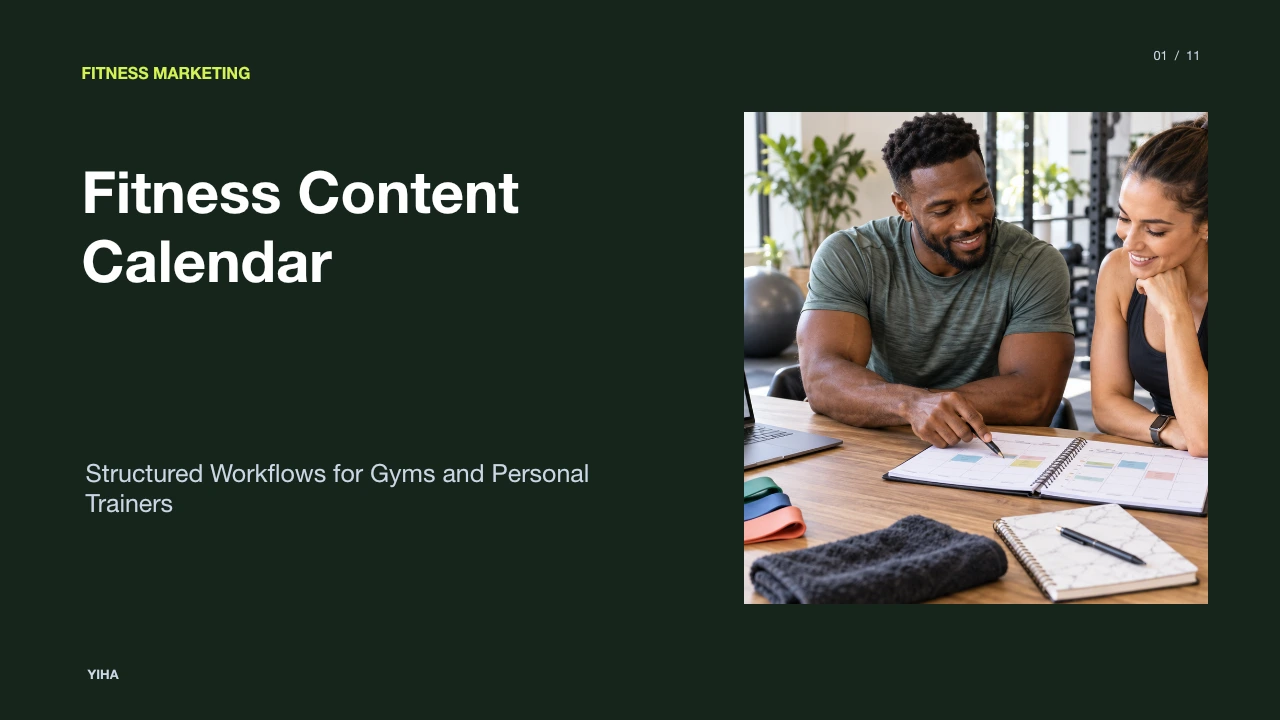
Fitness Content Calendar
A comprehensive operational guide for fitness studios, gym owners, and coaches to organize content pillars, schedule sustainable publishing cycles, and convert followers into members.
Free download · 4.9 MB11 editable slides · PowerPoint format
Download the editable PPTX
PPTX · 4.9 MB · 11 editable slides · Free to edit and reuse with attribution to Yiha.ai
View every slide
Use ← →, Home/End, or swipe on mobile
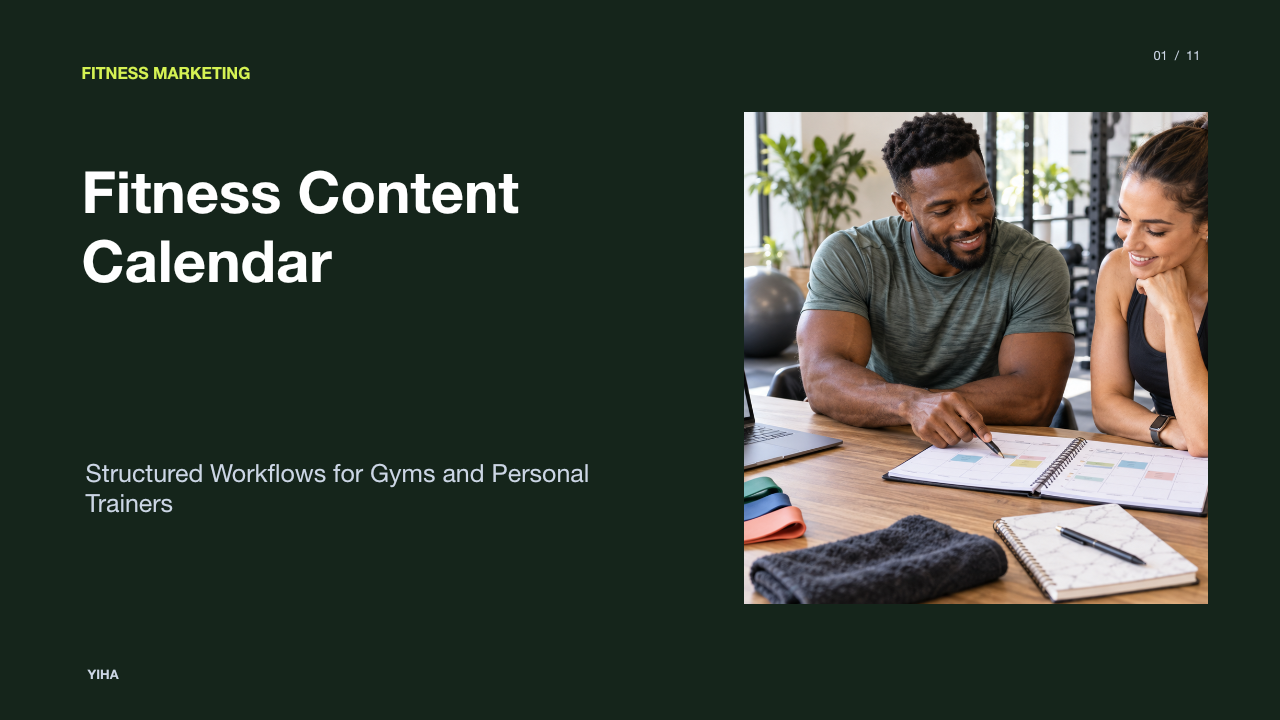
Fitness facilities and independent coaches frequently struggle with irregular marketing. Between managing member onboarding, delivering training sessions, and maintaining gym floors, publishing social media content often turns into an afterthought. When businesses post only when inspiration strikes or during sudden attendance slumps, messaging becomes erratic and transactional. A structured fitness content calendar replaces haphazard updates with an organized operational routine, ensuring every piece of media serves clear business objectives such as awareness, lead generation, and long-term member retention.
The Role of Structured Publishing in Fitness Marketing
Spontaneous, ad-hoc posting rarely generates dependable business growth. When trainers publish content reactively, they frequently default to repetitive self-promotions or disjointed workout snippets that fail to build audience trust. According to research from Pancentric Digital, an editorial calendar shifts marketing teams from reactive tactics to proactive strategy. Centralizing the schedule guarantees brand narrative control, prevents last-minute scrambles, and connects public messaging directly to overarching goals like member acquisition and retention.
Moreover, structured planning prevents content gaps during demanding operational seasons. As highlighted by Robotic Marketer, a structured content calendar acts as a strategic blueprint that coordinates content sequencing, assigns team responsibilities, and tracks performance indicators. Instead of wondering what to share on Monday morning, coaches operate from a documented roadmap where every post targets a specific stage of client engagement.
Establishing Content Pillars Across the Member Journey
Sustainable fitness marketing requires thematic diversity. Publishing only discount offers fatigues followers, while sharing exclusively technical coaching tips fails to prompt membership enrollments. An effective system relies on content pillars mapped directly across the customer lifecycle. As documented by FitBudd, high-performing fitness content serves distinct foundational functions: teaching principles through form breakdowns and myth busting, proving results with client transformations, building connection through behind-the-scenes clips, and converting interest into sign-ups via structured challenges.
Similarly, frameworks outlined by Sendible demonstrate that dividing calendars into structured themes moving from top-of-funnel awareness to bottom-of-funnel conversion protects retention while attracting new inquiries. Top-of-funnel educational topics attract newcomers seeking basic technique guidance. Middle-of-funnel client transformations establish proof of coaching capability. Bottom-of-funnel posts present explicit registration details for bootcamps or seasonal challenges. Group fitness studios can also leverage frameworks detailed by TrendFit, maintaining a sequence where education and community connection precede any direct promotional asks.
Balancing Media Formats and Platform Engagement Mechanics
Different content formats achieve distinct distribution outcomes across digital networks. Video discovery on platforms like Instagram Reels and TikTok provides reach to prospective local members outside an existing follower circle. However, relying entirely on short videos overlooks formats tailored for deeper retention. FitBudd highlights that swipeable multi-slide carousels serve as one of the most effective tools for breaking down complex training movements into digestible steps. Carousels prompt users to save and share posts, which signals content quality to platform algorithms.
In addition, temporary formats like daily stories support direct dialogue with current gym members through polls, schedule reminders, and day-to-day facility updates. As noted by Byter, Instagram effectively hosts video demonstrations, member spotlights, and swipeable tips, whereas Facebook remains suited for event organization and community group discussions. Distributing assets intentionally across formats prevents audience fatigue and maximizes retention across networks.
Determining Sustainable Publishing Frequencies
Establishing an overly ambitious publishing schedule often leads to burnout and abandoned accounts. Gym owners must determine cadences that balance algorithmic visibility with realistic coaching capacity. Planning recommendations from Byter provide a baseline structure of three to five feed posts per week on Instagram, supported by two to three daily stories to maintain community visibility between main publications. For community updates on Facebook, two to three posts per week are typically sufficient for local studios.
Cadence decisions must reflect team production constraints. As discussed by Pancentric Digital, teams must define realistic, sustainable publishing rhythms based on internal resources rather than chasing unmanageable daily quotas. When trainers attempt to post multiple complex videos each day without dedicated media staff, the quality of coaching and customer service inevitably declines. Committing to a predictable three-post weekly structure preserves output quality and prevents operational disruptions.
Structuring Editorial Cycles Around Industry Seasonality
Fitness demand fluctuates heavily throughout the calendar year based on consumer habits. Editorial planning must anticipate these commercial shifts rather than reacting after peaks have already passed. Guidance from seotools.pro emphasizes planning backward from predictable search spikes, noting that consumer interest surges sharply for New Year resolutions in January, climbs again during spring conditioning, and returns during post-summer gym routines. Planning assets four to eight weeks ahead ensures that program landing pages and supportive educational guides are indexed and active before enrollment windows open.
Strategic season planning detailed by Robotic Marketer and Byter aligns monthly themes with seasonal moods. For example, February works well for partner-oriented training challenges, spring months favor outdoor conditioning and mobility, while September mirrors the discipline of January. Structuring calendar themes around these predictable cycles allows facilities to launch promotional campaigns with organized messaging rather than scrambled last-minute flyers.
Building Evergreen Queues and Repurposing Systems
Daily content drafting drains staff energy. To safeguard the schedule against busy gym periods, fitness operators build evergreen content queues. A framework from Sendible suggests maintaining pre-loaded queues of evergreen assets, such as lifting cues and member interviews, which can run reliably throughout the year even during busy challenge launch dates.
Production efficiencies multiply when single assets are repurposed across multiple formats. As outlined by Byter and seotools.pro, batching video demonstrations during one monthly filming session enables coaches to create extensive content inventories without continuous setup overhead. An illustrative example involves filming a single technique breakdown: the clip can be published as a video reel, transcribed into an educational carousel on movement mechanics, and summarized as a training tip in a member newsletter. Furthermore, editorial frameworks from Sprout Social highlight that planning recurring content series creates a living record of proven material, saving staff time while providing predictable education for followers.
Tradeoffs Between High Production and Real Community Proof
Fitness businesses often make the mistake of over-indexing on polished, cinematic promotional videos that feel detached from the actual gym environment. While high production quality can reinforce clean branding, prospective members primarily look for authentic community proof and relatable training spaces. As observed by TrendFit, featuring unscripted moments with real member faces, genuine names, and natural class interactions humanizes a studio without requiring expensive studio photography.
Similarly, FitBudd recommends balancing polished informational reels with unfiltered, behind-the-scenes coaching clips on stories or short-form video feeds. Highlighting genuine member transformations, daily facility routines, and coach training sessions shows prospective clients what attending the gym actually feels like. Relying exclusively on sterile commercial footage can alienate beginners, whereas real community proof builds approachability and trust.
Operational Bottlenecks and Calendar Breakdown Risks
Content calendars frequently collapse due to predictable operational bottlenecks. In small gyms, coaches are primarily focused on training clients, leaving social media management without designated owners or structured workflows. As warned by Robotic Marketer, a lack of documented ownership, missing approval processes, and neglected scheduling tools cause missed deadlines and disjointed messaging.
Another significant risk involves governance, member privacy, and technical accuracy. As seotools.pro notes, fitness content that offers exercise or nutrition advice should undergo accuracy reviews to avoid irresponsible medical assertions or guaranteed-outcome claims. In addition, filming on gym floors requires clear media consent processes to respect member boundaries. Over-scheduling rigidity also poses a danger. Platforms like Sprout Social emphasize that calendars must permit real-time adjustments, rescheduling, and pause features so studios can respond gracefully to facility emergencies or broader public events.
Executing a Sustainable Calendar Review and Revision Process
An editorial calendar should function as an adaptable operational system rather than an inflexible static spreadsheet. To remain effective, marketing workflows need recurring review intervals. As outlined by Robotic Marketer, teams should commit to regular weekly or monthly check-in meetings to audit campaign performance, collect stakeholder feedback, and optimize upcoming assets against tangible business metrics.
Performance tracking must focus on genuine audience engagement rather than superficial metrics. Sprout Social outlines that reviewing post-level reporting allows marketing teams to isolate top-performing themes, identify peak engagement windows, and adapt publishing cadences based on data. If monthly audits show that technical carousels generate high save rates while generic motivational quotes produce zero inquiries, future calendar slots should shift resources toward educational demonstrations. By iteratively reviewing engagement signals and conversion rates, fitness businesses build a marketing engine that reliably supports studio growth.
Research sources
- tness Content Ideas: 16 Posts + a Weekly Calendar (2026) · www.fitbudd.com
- How to Create a Marketing Content Calendar That Works · www.roboticmarketer.com
- Editorial Calendar Guide: Plan Content for ROI | Pancentric Digital · www.pancentric.com
- [TEMPLATE] Fitness Centre Social Media Content Calendar · www.sendible.com
- The 7-Day Fitness Content Calendar Template That Actually Works â TrendFit · trendfit.io
- Build a Fitness Studio Social Media Content Calendar That Works | Byter · byter.com
- Social Media Calendar Guide & Template | Sprout Social · sproutsocial.com
- Content Calendar Template for Fitness | seotools.pro · seotools.pro