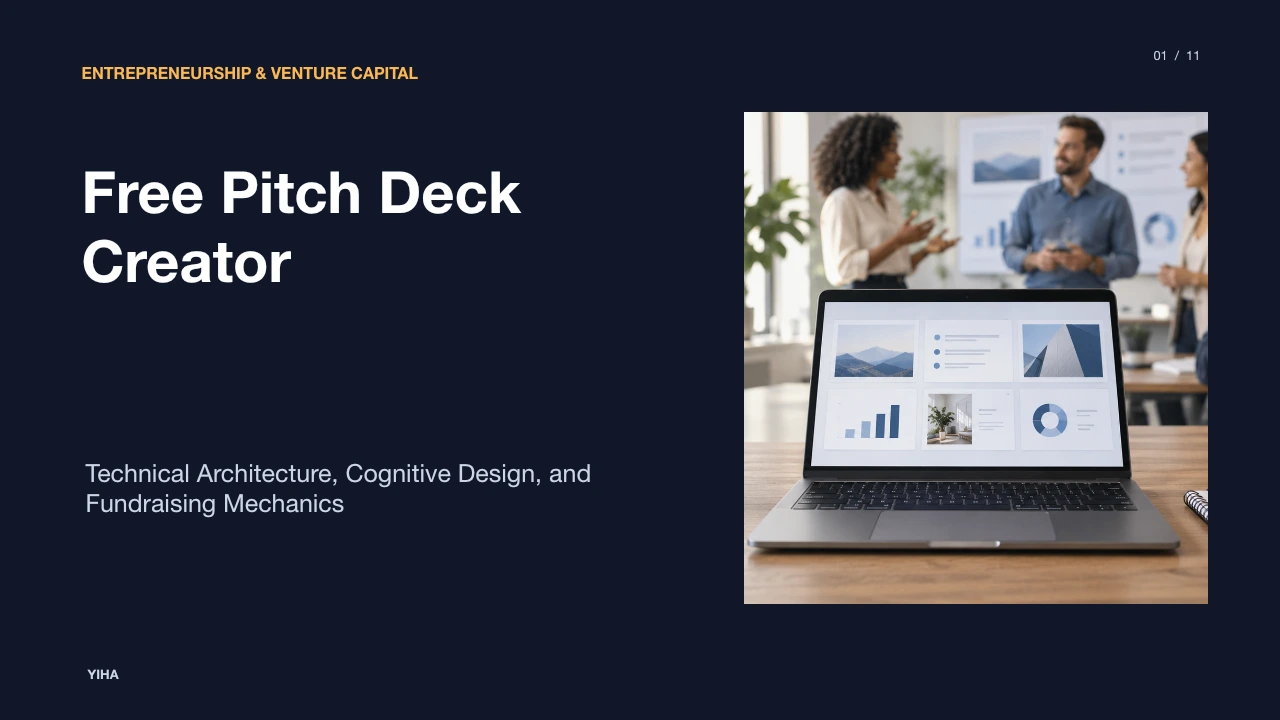
Free Pitch Deck Creator
A technical examination of automated pitch deck tools, presentation hierarchy, slide sequencing standards, and investor review behaviors.
Free download · 4.9 MB11 editable slides · PowerPoint format
Download the editable PPTX
PPTX · 4.9 MB · 11 editable slides · Free to edit and reuse with attribution to Yiha.ai
View every slide
Use ← →, Home/End, or swipe on mobile
Early-stage fundraising depends on concise, disciplined communication. Before an institutional venture investor reads an exhaustive operating model or examines legal data rooms, they evaluate a presentation deck. Software-driven deck creators and structured generative tools have transformed how founders assemble these initial assets, shifting presentation authoring from manual layout adjustment into structured outlining workflows. Using these digital tools effectively requires balancing the speed of automated layout generation against rigorous analytical standards and factual validation.
The Strategic Role of Pitch Decks in Early-Stage Capital
A pitch deck is not an exhaustive operating plan. Instead, it serves as an initial deal-screening instrument designed to determine whether a startup warrants deeper diligence and a formal partner meeting. Investment partners review dozens of inbound decks each week, scanning for clear signals of customer demand, market dynamics, and operational execution. Structured frameworks like the God of Prompt Investor Pitch Deck Creator standardize this presentation format around core categories: problem definition, proposed solution, addressable market, business model, operational milestones, and the capital ask.
When founding teams confuse a pitch deck with a complete business plan, they crowd slides with dense paragraphs that obscure core commercial logic. Across creative and commercial industries, as highlighted in the Celtx Guide on Building a Film Pitch Deck, an effective presentation functions as a visual translation of a project narrative, showing decision-makers how a concept works before major resources are committed. For technology startups, the strategic objective remains identical: to demonstrate commercial viability and execution capability quickly without requiring hours of preliminary reading.
Cognitive Load and Slide Scannability Mechanics
Slide scanning patterns directly determine whether an investor registers critical claims during an initial review. Presentation analysis from Zamora Design on Pitch Deck Evolution notes that investors often spend under four minutes viewing an entire initial pitch deck. High visual density, competing typographic weights, and cluttered layouts force readers to search for conclusions rather than absorbing the central narrative flow.
To manage reader cognitive demand, slides must enforce a predictable visual hierarchy. Clear title claims, prominent quantitative callouts, and restrained body copy allow reviewers to process information rapidly. Automated layout software guides creators toward simplified arrangements, but founders must actively resist cluttering slides with non-functional decorative graphics or redundant captions. As examined in the slide-deck.io Pitch Deck Creator Guide, non-designers benefit from automated typography and spacing rules, but intentional editing remains essential to ensure each slide communicates a single dominant operational assertion.
Standard Slide Sequencing Across Major Accelerators
Accelerators and venture firms rely on standard presentation sequences because predictability accelerates deal screening. Most early-stage pitch decks follow a consistent progression: title, problem, solution, market size, business model, traction, competitive positioning, team credentials, and the funding request. Structured prompts from the God of Prompt Investor Deck Resource help standardize these slides so founders avoid omitting essential operational foundations.
Narrative requirements evolve across startup funding stages. Research from Zamora Design indicates that seed-stage decks primarily emphasize problem definition, founding insights, and customer discovery. By Series A and Series B, presentations shift toward proven unit economics, repeatable customer acquisition channels, and margin defensibility. Pitch decks in creative domains, such as the templates documented in FinalBit AI Movie Pitch Deck Templates, similarly sequence concepts from high-level loglines to world development, character arcs, and budget summaries.
How Automated Deck Creators Generate Presentations
Automated presentation platforms rely on structured input extraction, layout slotting, and programmatic graphic rendering. Systems referenced in the slide-deck.io Platform Overview allow users to input plain-text business descriptions, which parsing engines segment into distinct slide categories. The software binds text fragments into pre-built layout cards, applies typographic hierarchies, and sets matching color palettes automatically.
Interactive platforms such as the Storydoc AI Pitch Deck Creator move beyond static slides by compiling scrollable, web-based layouts with dynamic components and customer relationship management integrations. In traditional slide environments, downloadable layouts from libraries like Slidesgo Pitch Deck Templates provide pre-built arrangements for Google Slides and PowerPoint. These generators reduce early formatting time from days to minutes, though human verification remains necessary to ensure logical consistency across the narrative.
Empirical Investor Engagement and Time Allocation
Tracking tools reveal substantial variance in how much attention individual slides receive during investor evaluation. Analytics workflows detailed by the Pitch Deck Creator Platform demonstrate that investors do not distribute attention equally across a presentation. Reviewers frequently skim introductory problem descriptions to spend concentrated time scrutinizing financial models, revenue mechanics, and team backgrounds.
Interactive formats reviewed by Storydoc capture viewer drop-off points, scroll depth, and link engagement. When slides contain vague summaries without verifiable numbers, reviewers move quickly to operational proof points. If unit economics or go-to-market data appear ungrounded, overall review time drops sharply. Understanding these reading habits encourages founders to place verifiable operational milestones early in their presentations rather than burying them at the back.
Articulating Unit Economics and Defensible Metrics
Quantitative slides determine whether an investor moves forward with serious due diligence. Guidance from the GPTPromptEngine Startup Pitch Collection recommends structuring market slides through bottom-up calculations rather than generic top-down industry reports. A bottom-up calculation models target customer counts multiplied by realistic annual contract values, demonstrating grounded commercial logic.
Furthermore, research documented by Zamora Design highlights that later-stage presentations must prove unit economics through customer acquisition cost, recurring revenue growth, and retention metrics. Seed presentations may highlight prototype feedback and initial customer validation, but Series A presentations require proof of repeatable sales motions. Illustrative financial models must separate historical accomplishments from future projections, avoiding unsupported hockey-stick revenue graphs that erode credibility.
Evaluating Free Software Against Custom Agency Decks
Founders face distinct operational tradeoffs between automated presentation creators and custom design agencies. Modern presentation software like Pitch.com Collaborative Platform combines customizable templates, brand style repositories, and live co-editing, allowing distributed teams to assemble professional slides without agency fees.
Free and software-driven tools offer rapid turnaround times, immediate layout updates, and standardized layouts. As highlighted in the slide-deck.io Pitch Deck Creator Guide, non-designers can quickly build on-brand presentations. However, automated systems can produce visual homogeneity if founders rely exclusively on default settings without adding unique brand assets. Custom design agencies deliver tailored art direction and bespoke iconography, but they require substantial capital expenditure and slower feedback cycles. For early fundraising rounds where core hypotheses evolve weekly, automated software provides sufficient visual polish while preserving strategic flexibility.
Common Technical Traps and Hallucination Pitfalls
Using generative language tools to draft pitch decks introduces specific failure modes. When founders rely on automated tools without supplying source data, algorithms frequently invent market statistics, hallucinate competitor limitations, or produce generic value propositions. The prompt frameworks cataloged on GPTPromptEngine emphasize providing explicit operational inputs, such as verified customer counts and pricing figures, to prevent generic copy.
Another trap is over-reliance on industry buzzwords that conceal actual product mechanisms. As noted in the Celtx Production Deck Guide, clarity and disciplined editing build trust, whereas dense jargon signals evasive positioning. Founders must also evaluate corporate privacy policies before pasting proprietary technical roadmaps or confidential customer contracts into third-party artificial intelligence engines.
Integrating Deck Generation into the Fundraising Funnel
Pitch deck creation is an iterative pipeline rather than a one-time publishing task. Modern fundraising workflows leverage web-based analytics, as described in the Storydoc Platform Documentation, to monitor engagement across specific investor cohorts. Tracking open rates, viewing times per slide, and link clicks helps teams identify confusing sections that trigger drop-offs.
Document version control is vital. Pitch generators allow teams to maintain distinct variations for angel syndicates, institutional venture funds, or strategic corporate partners. Specialized genre frameworks, such as those cataloged in the FinalBit Film Pitch Deck Guide, illustrate that tailoring slides to specific buyer archetypes improves resonance. Reviewing slide performance data enables continuous narrative refinement throughout an active fundraising campaign.
Research sources
- Investor Pitch Deck Creator Prompt for ChatGPT | God of Prompt · godofprompt.ai
- AI Pitch Deck Creator: Get Funded and Win Deals · www.storydoc.com
- How to Build a Film Pitch Deck (+ Free Checklist) · blog.celtx.com
- How to Create a Pitch Deck Online · slide-deck.io · slide-deck.io
- Seed vs Series A vs Series B Pitch Deck: Narrative Strategy - Zamora Design · zamora.design
- Ready-to-Use Film Pitch Deck Templates & Free Generator · www.finalbitai.com
- Free Pitch Deck Google Slide themes and PowerPoint templates · slidesgo.com
- Pitch Deck Creator | Design Winning Investor Presentations · pitchdeck.io
- Free ChatGPT Prompts for Startup Pitch Deck Writing - 2026 Entrepreneur Collection · gptpromptengine.com
- Presentation software for fast-moving teams | Pitch · pitch.com
- Film Pitch Deck Template: A Slide-by-Slide Guide + 35 Free Template Previews (2026) · www.finalbitai.com