Indigenous Storytelling Lesson Plan
A guide for educators teaching Indigenous oral traditions, exploring community protocols, learning circle structures, drama arts alignment, and respectful narrative reflection.
Free download · 4.9 MB11 editable slides · PowerPoint format
Download the editable PPTX
PPTX · 4.9 MB · 11 editable slides · Free to edit and reuse with attribution to Yiha.ai
View every slide
Use ← →, Home/End, or swipe on mobile
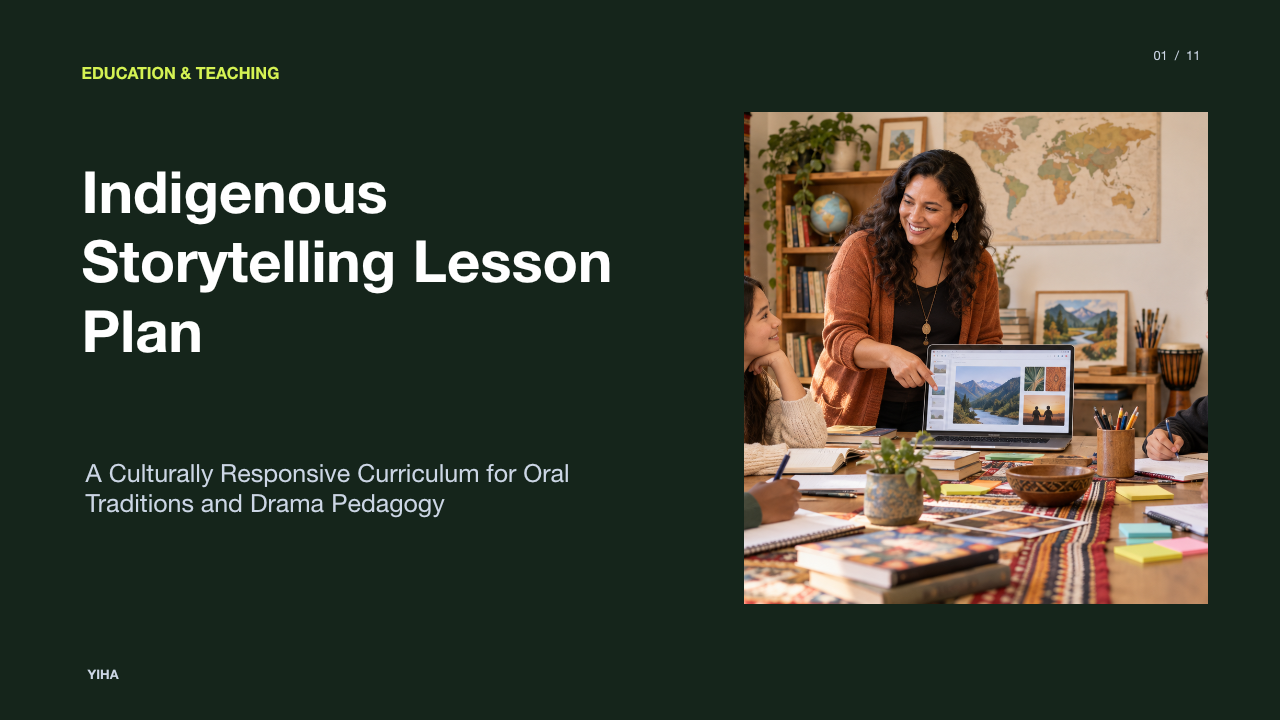
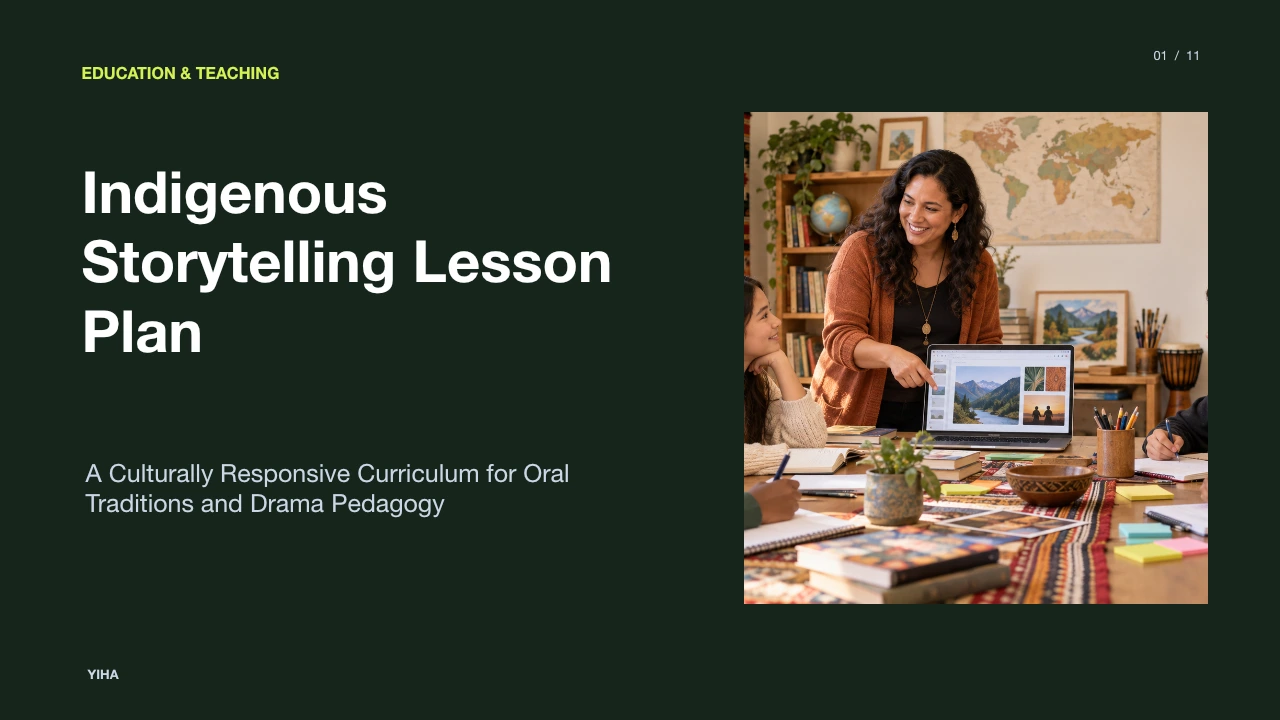
Teaching Indigenous storytelling requires moving beyond conventional Western educational models that reduce oral narratives to quaint fables, simplistic folklore, or disposable creative writing prompts. In Indigenous intellectual traditions, storytelling functions as a living vessel of communal law, territorial history, ecological science, and social governance. Crafting an authentic lesson plan requires educators to approach narratives with rigor, respecting cultural ownership, territorial contexts, seasonal telling practices, and the reciprocal relationship between teller and listener. By embedding authentic cultural protocols and structured pedagogical frameworks into instructional units, teachers can guide students to engage with oral traditions respectfully and thoughtfully.
Oral Tradition as Living Knowledge, Not Myth
Oral traditions represent core intellectual systems through which Indigenous nations sustain historical records and convey governance systems across generations. As documented by Oral Traditions | indigenousfoundations, Western discourse historically prioritized the written word as the dominant form of record-keeping, inaccurately treating oral societies as groups without history. In reality, First Nations maintain rigorous documentation and validation systems. These include performative practices such as drumming, dancing, and formal recitations during potlatches and feasts, where historical narratives are witnessed, evaluated, and affirmed by the collective community.
Oral traditions are collective enterprises where no single narrator claims exclusive proprietary authority over a shared history. Scholars Renée Hulan and Renate Eigenbrod explain that oral traditions connect speaker and listener in a communal experience that unites past and present in memory. To ensure historical fidelity, narrators practice what scholars describe as oral footnoting, identifying the ancestors, Elders, or community knowledge keepers from whom they received the teaching. Stó:lō historian Naxaxalhts’i (Albert McHalsie) distinguishes between sacred transformation accounts (sxwóxwiyam) that establish the origins and laws of the land, and personal family histories (sqwelsqwel). When bringing oral traditions into secondary classrooms, teachers must make clear that oral accounts are sophisticated archives rather than fictional myths.
Protocols of Permission, Land, and Seasonality
Educators cannot simply choose an Indigenous story from an anthology without examining the cultural protocols governing its transmission. As highlighted by the National Centre for Collaboration in Indigenous Education, curriculum materials are not one-size-fits-all resources. Cultural knowledge and practices relate directly to the specific land and people where they originate. Flattening diverse First Nations, Inuit, and Métis traditions into pan-Indigenous lessons erases distinct regional identities, legal systems, and geographical realities.
Cultural protocols also dictate when and where specific narratives may be told. Many nations observe seasonal restrictions that permit certain stories to be shared only during the winter season when snow is on the ground. For instance, in the Treaty 4 region among Saulteaux, Cree, Dakota, Lakota, and Nakota peoples, winter storytelling protocols protect spiritual relations while recognizing seasonal rhythms of community life. Furthermore, as noted by the Storytelling Overview from the First Nations Pedagogy Online Project, certain narratives are owned by particular clans, families, or societies and may only be spoken by authorized members. Teachers must verify seasonal restrictions and clan ownership, consulting local Elders or cultural resource centers before presenting texts in class.
The Learning Circle as Pedagogical Space
Classroom architecture shapes instructional dynamics. Standard classroom designs arrange desks in parallel rows oriented toward a central instructor, reinforcing top-down authority and passive listening. In contrast, the learning circle model developed by Algonquin educator Allison Green in the Indigenous Storytelling Unit: 6-Lesson Drama Unit | DTA transforms the classroom into an egalitarian space of shared inquiry.
In a learning circle, all participants sit at an equal level with unobstructed sightlines, removing hierarchical barriers between teacher and learner. Active listening becomes an intentional communal duty rather than a passive obligation. Guidance from 6 Ways to Use Indigenous Pedagogies in Your Classroom - Learning Bird stresses that when using Indigenous approaches, teachers must explicitly explain the pedagogical rationale to learners. The circle format communicates that every participant contributes a valid voice to collective understanding, encouraging collaborative discussion and reflective dialogue while fostering deep cultural competence.
The Research, Recreate, and Understand Cycle
To prevent superficial mimicry and cultural appropriation, storytelling units require structured, multi-phase investigation. Allison Green’s instructional model in the Indigenous Storytelling Unit: 6-Lesson Drama Unit | DTA organizes classroom learning around a three-part pedagogical framework: Research, Recreate, and Understand.
During the Research phase, students investigate the narrative’s specific geographic origins, the traditions of the originating nation, and the ecological markers embedded in the text. In the Recreate phase, students analyze narrative structure through plot mapping and retell the story using their own authentic voice, avoiding cartoonish caricatures or exaggerated vocal mannerisms. Finally, in the Understand phase, students synthesize how the story's themes inform ethical responsibilities to community, family, and the natural environment. This deliberate cycle teaches students that responsible performance requires disciplined inquiry and cultural humility rather than casual consumption.
Indigenous Storywork and Non-Linear Meaning
Engaging with Indigenous narratives requires shifting away from European literary frameworks that reduce stories to neat, linear morals. As highlighted on the Storytelling Overview from the First Nations Pedagogy Online Project, educational scholar Jo-ann Archibald demonstrates that preparing to listen requires patience, relational trust, and listening with three ears: two on the head and one in the heart. Listening is an active, reflective discipline encompassing visualization, emotional resonance, and contemplation.
Western fables often deliver an overt moral summary at the end of the text. In contrast, Indigenous teaching stories function as open-ended intellectual systems where meaning unfolds across a person's life through lived experience and relational reflection. The narrative provides an interpretive foundation connecting community history, kinship obligations, and ecological responsibility. In the classroom, educators must give students sufficient time to sit with unresolved questions and multiple valid perspectives rather than rushing toward quick multiple-choice answers or reductive one-sentence takeaways.
Embodied Orality and Drama Arts Alignment
Oral tradition is inherently embodied, relying on deliberate vocal modulation, pacing, physical gesture, and presence. Aligning storytelling units with secondary drama curricula allows students to develop expressive performance skills while honoring cultural boundaries. As detailed on Storytelling Overview from the First Nations Pedagogy Online Project, authentic oral delivery requires vocal range, intonation, verbal imagery, facial expression, and natural pacing.
These performance techniques connect directly with fine arts standards. The Indigenous Storytelling Unit: 6-Lesson Drama Unit | DTA links oral narrative study with national theatre competencies, guiding students to analyze how vocal inflections and physical gestures express narrative meaning. Students develop collaborative ensemble staging, exploring character objectives and dramatic conflict. Crucially, instructors must establish strict cultural guardrails: students should never wear imitation ceremonial regalia, apply face paint, or mimic stereotypical accents. Isolating storytelling skills from sacred ceremonial items preserves cultural respect while refining theatrical craft.
Differentiating Indigenous Narrative from Fables
Classrooms often mistakenly categorize Indigenous oral traditions as allegorical fables designed solely for children's entertainment or simplistic behavioral warnings. As demonstrated by Oral Traditions | indigenousfoundations, Indigenous oral accounts serve as comprehensive legal covenants and geographic records. In Stó:lō territory (S’ólh Téméxw), geological landmarks mark the historic interventions of the Transformers (Xe:xals), who turned individuals who disrupted harmony into stone formations or beneficial animal kin.
These narratives create an enduring map linking community law to physical geography. Encountering a landmark reminds community members of the legal precedents, ecological guidelines, and family truths associated with that place. European didactic fables typically employ generic anthropomorphic characters in non-specific settings to teach individualistic moral lessons. In contrast, Indigenous narratives are tied to specific named lands and rivers, preserving living treaties, hereditary crests, and communal obligations across generations.
Scaffolding the Storytelling Unit in Practice
Implementing a multi-session storytelling unit requires deliberate scaffolding that balances context, artistic development, and reflection. Building upon the instructional sequence outlined in the Indigenous Storytelling Unit: 6-Lesson Drama Unit | DTA, teachers can structure a six-phase curriculum model:
- Phase 1: Orientation and Protocols: Introduce the learning circle, examine localized territorial connections, and discuss seasonal telling protocols.
- Phase 2: Contextual Research: Investigate an authorized origin story from a specific nation, identifying geographic markers and communal history.
- Phase 3: Narrative Plot Graphing: Diagram the narrative progression, identifying dramatic conflict and character choices without imposing rigid formulas.
- Phase 4: Choral and Physical Rehearsal: Practice vocal modulation, pacing, and ensemble movement in small groups using students' own natural speech.
- Phase 5: Circle Retelling: Share retold narratives within the learning circle to maintain an intimate, participatory community environment.
- Phase 6: Synthesis and Circle Reflection: Convene the circle to evaluate personal insights, source attribution, and ongoing community responsibilities.
This structured pacing ensures that students spend adequate time building background knowledge before attempting narrative expression.
Respectful Assessment and Student Reflection
Assessment in an Indigenous storytelling curriculum must prioritize cultural integrity, collaborative process, and contextual understanding over rote memorization. Rubrics adapted from the Indigenous Storytelling Unit: 6-Lesson Drama Unit | DTA assess whether students cited their narrative sources accurately, recognized the originating nation, and demonstrated disciplined ensemble collaboration.
Assessment should incorporate guided self-reflection and peer dialogue within the learning circle. Students evaluate how their understanding of oral tradition changed, whether they maintained respectful performance choices, and how they avoided stereotypical dramatization. By centering evaluation on cultural attribution and collaborative practice, teachers reinforce accountability, ethical engagement, and genuine respect for living Indigenous knowledge systems. This pedagogical approach equips students with enduring research disciplines and relational awareness that extend far beyond the classroom walls.
Research sources
- Oral Traditions | indigenousfoundations · indigenousfoundations.arts.ubc.ca
- Understanding Indigenous Stories and Storytelling - NCCIE · www.nccie.ca
- 9 Components of an Effective Lesson Plan - Teacher Strategies · www.teacherstrategies.org
- Storytelling Overview from the First Nations Pedagogy Online Project · firstnationspedagogy.ca
- Indigenous Storytelling Unit: 6-Lesson Drama Unit | DTA · www.theatrefolk.com
- 6 Ways to Use Indigenous Pedagogies in Your Classroom - Learning Bird · learningbird.com
- Storytelling in ESL: 10 Best Activities + Lesson Plan · tahricteaches.com
- Reflection in Lesson Plans: 7 Practical Steps - Teacher Strategies · www.teacherstrategies.org
- Creative Writing & Storytelling Lesson Plan: Turn Real Places into Amazing Stories / Learning Corner · learningcorner.co
- Free AI Lesson Plan Generator for Teachers · www.theschoolhouse.org