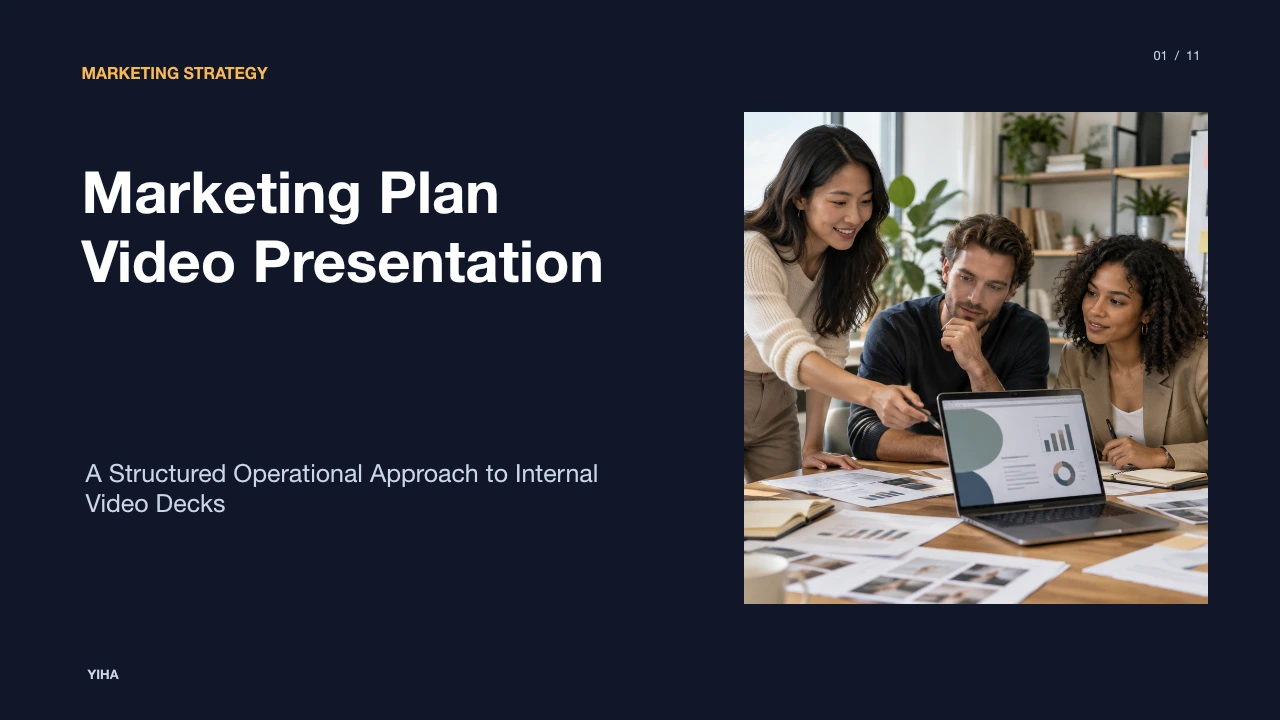
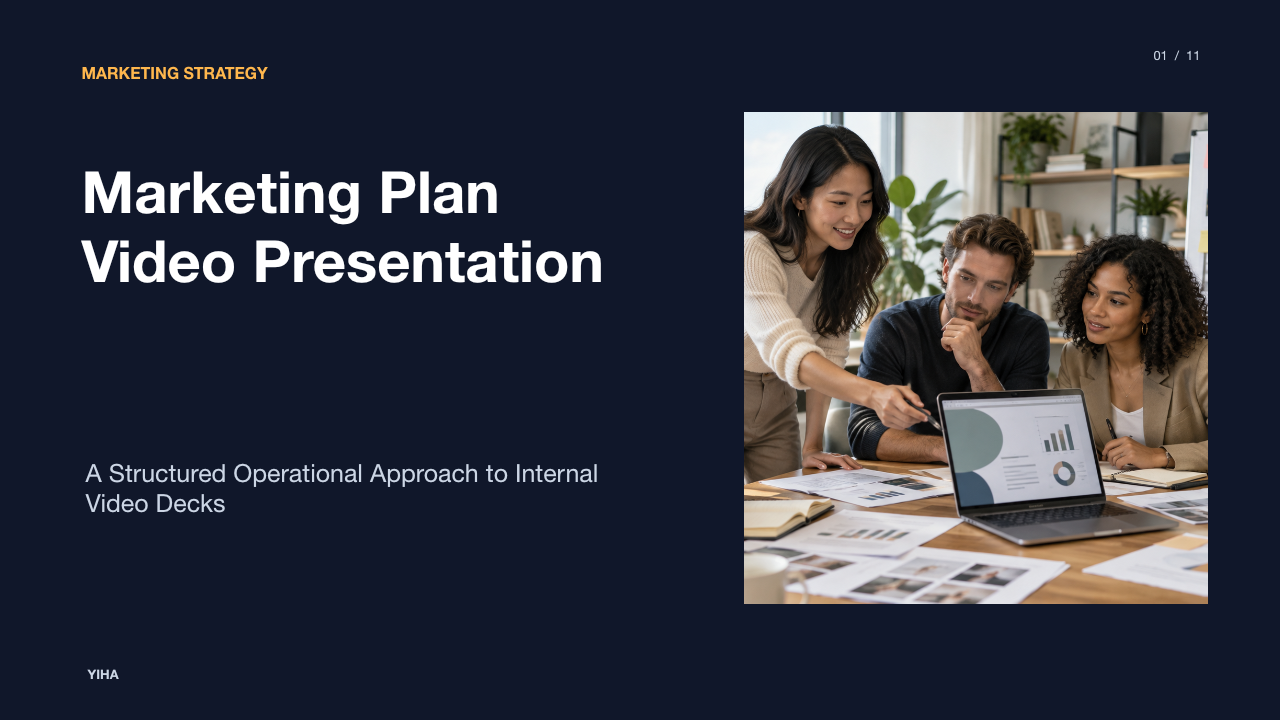
Marketing Plan Video Presentation
A comprehensive operational guide to transforming static marketing plans into clear video presentations, covering executive narrative design, storyboarding, and workflows.
Free download · 4.9 MB11 editable slides · PowerPoint format
Download the editable PPTX
PPTX · 4.9 MB · 11 editable slides · Free to edit and reuse with attribution to Yiha.ai
View every slide
Use ← →, Home/End, or swipe on mobile
Marketing leaders increasingly operate in distributed environments where cross-functional alignment and executive buy-in determine whether strategic plans succeed or stall. Traditional slide decks often fail because they rely on dense text blocks that lose context when circulated offline. A marketing plan video presentation transforms a static planning deck into an asynchronous audiovisual briefing that conveys strategic priorities, resource allocation, and operational timelines with consistent clarity.
The Shift from Static Slide Decks to Video Formats
Modern strategic marketing demands clear communication across distributed executive committees. As outlined in the B2B Video Marketing Strategy Guide, business decision-making involves multiple organizational stakeholders who conduct extensive self-directed research before committing resources. When strategic marketing initiatives are shared solely through flat presentation slides or written memos, critical nuance regarding strategic tradeoffs and market positioning is frequently lost.
Asynchronous video presentations bridge this communication divide. According to analysis in the B2B Video Marketing Funnel Guide, multi-stakeholder groups benefit from structured video content because visual and verbal explanations clarify priorities faster than static documents. Presenters can walk through complex market dynamics, highlight key operational dependencies, and ensure that every leader reviews an identical, high-fidelity explanation of the marketing roadmap.
Defining Strategic Objectives and Viewer Personas
An effective marketing plan video presentation targets specific organizational outcomes rather than reciting tactical activities. The framework detailed in the Editorial Calendar Guide demonstrates that strategic content planning must align directly with measurable business objectives, such as customer acquisition, market awareness, or customer retention. Internal marketing presentations require the same discipline.
Presenters must tailor narrative depth to the executive personas reviewing the recording. The chief financial officer evaluates budget efficiency and projected returns on investment. The sales leadership team assesses pipeline growth and lead qualification criteria. The product marketing team focuses on go-to-market milestones and feature positioning. Commentary from the 5 Key Takeaways from Wyzowl's 2025 Video Marketing Report notes that executive time constraints represent a major barrier to content consumption. Designing persona-specific chapters ensures that each executive gains direct visibility into their respective priorities.
Structuring the Narrative and Script for Executive Clarity
Executive audiences require a clear narrative arc that presents problem framing, strategic options, and concrete execution steps. The planning methodology shared in How to Use Storyboarding to Plan Marketing Videos That Convert emphasizes that locking the script and core message before developing visuals prevents expensive production revisions. A script that wanders through unvetted tactical minutiae dilutes strategic impact.
A practical executive presentation script follows a three-part structure. First, it establishes the operational baseline, covering recent market conditions and competitive shifts. Second, it articulates strategic interventions, explaining why specific programs were chosen over alternatives. Third, it outlines required resources and expected operational deliverables. As emphasized in the B2B Video Marketing Strategy Guide, each presentation segment should address a single distinct decision point to maintain clarity.
Industry Evidence on Video Formats and Viewer Preferences
Audience engagement patterns reveal a distinct structural preference for dynamic audiovisual communication over long-form written proposals. Editorial commentary from the Content Marketing Institute highlights that modern viewers increasingly expect organizations to communicate their narratives through direct, memorable video formats. Decision-makers apply these same consumption expectations to internal corporate strategy briefings.
Effective marketing presentations combine live-action narration with on-screen visual evidence. As documented in the Video Marketing Statistics 2026 Compilation, live-action presentations and focused screen recordings remain common production styles because they offer direct personal engagement and authentic delivery. Combining on-camera leadership commentary with live dashboard walkthroughs provides executives with clear proof of past performance and future campaign viability.
Visual Storyboarding and Production Asset Preparation
Translating an approved marketing strategy script into an engaging visual presentation requires systematic pre-production planning. The workflow provided in the Free Marketing Video Storyboard Template Guide shows that storyboarding creates a visual blueprint where narrative beats, visual elements, and camera directions are mapped frame by frame. Setting technical parameters, such as a universal 16:9 widescreen format, ensures optimal viewing across enterprise desktop environments.
During asset preparation, teams should gather supporting collateral, including campaign mockups, analytics screenshots, and milestone timelines. According to the B2B Video Marketing Strategy Guide, marketing teams should exercise scope discipline by avoiding unnecessary motion graphics that do not clarify the core business proposition. Clean data visualizations and prominent callout arrows direct viewer attention toward critical performance indicators without inflating production timelines.
In-House Creation Versus External Agency Collaboration
Marketing leadership must decide whether to produce internal video presentations in-house or contract external agency support. Annual research published in Wyzowl's Video Marketing Statistics 2026 highlights that while many organizations produce video material in-house to maintain strategic control, a substantial share of teams rely on external video creators to support production demands. In-house production provides rapid turnaround and deep familiarity with corporate strategy, but sustained content creation can strain internal marketing resources.
Conversely, external production agencies provide polished visual design and audio mixing but introduce logistical complexity. Analysis in the Video Production Workflow for Enterprise Marketing Teams notes that enterprise video programs frequently stall when cross-functional legal reviews, brand governance checks, and external vendor handoffs lack centralized coordination. Many organizations implement a hybrid production model: internal leaders capture the spoken narration and strategy slides, while a specialized agency handles editing, pacing, and graphic finishing.
Common Technical Obstacles and Measurement Limitations
Executing video presentations presents practical technical challenges and tracking limitations. As highlighted in How to Use Storyboarding to Plan Marketing Videos That Convert, misalignments between spoken dialogue and on-screen visuals often remain hidden until post-production, making thorough script reviews essential. Technical issues such as degraded microphone audio or unbalanced volume levels immediately erode executive confidence in the underlying strategic proposal.
Furthermore, measuring the success of an internal video presentation requires metrics beyond basic view counts. Secondary analysis in Short-Form Video Statistics for 2026 emphasizes tracking viewer completion rates and audience drop-off points rather than simple play numbers. For internal marketing decks, presenters must evaluate whether stakeholders watched the complete strategic ask, submitted constructive questions, and aligned around proposed resource allocations.
Operational Workflows and Editorial Scheduling
Sustaining a consistent video presentation cadence requires disciplined workflow governance. In Video Production Workflow for Enterprise Marketing Teams, researchers emphasize that project delays rarely stem from the recording process itself. Instead, bottlenecks occur when approvers participate out of sequence or when distribution specifications are treated as an afterthought. Teams must establish clear approval gates for each production phase.
An illustrative example of an operational pipeline includes dedicated stages for narrative brief sign-off, storyboard validation, rough-cut review, and final cut sign-off. As recommended in the B2B Video Marketing Strategy Guide, marketing teams can improve operational efficiency by batching multiple quarterly updates into a single recording session. Distributing finalized presentations through secure corporate repositories guarantees version control across all executive review groups.
Synthesizing Findings for Strategic Marketing Decisions
A marketing plan video presentation must conclude by guiding executive leaders toward a definitive business decision. The funnel planning framework detailed in the Video Marketing Funnel Strategy stresses the importance of prioritizing high-impact, lower-effort formats before scaling into complex, resource-heavy productions. When delivering the concluding segment, presenters should explicitly restate core trade-offs regarding program timing, team capacity, and budget distribution.
Additionally, the closing chapter must outline key project dependencies, implementation milestones, and performance review checkpoints. As emphasized in the Editorial Calendar Guide, aligning cross-functional teams around a transparent strategic schedule enables sales, product, and leadership groups to support the marketing rollout effectively. Providing an immediate channel for executive feedback ensures rapid authorization and execution across the enterprise.
Research sources
- B2B Video Marketing Strategy & B2B Video Agency Guide · www.pixel8production.com
- B2B Video Marketing Funnel: Right Content for Every Stage | Lychee · www.lychee.video
- How to Use Storyboarding to Plan Marketing Videos That Convert · www.foxtalemedia.com
- Editorial Calendar Guide: Plan Content for ROI | Pancentric Digital · www.pancentric.com
- 5 Key Takeaways from Wyzowl’s 2025 Video Marketing Report — Bunker Hill Media · www.bunkerhillmedia.com
- Must-Know Video Strategies and Tips for 2025 · contentmarketinginstitute.com
- Video Marketing Statistics 2026: ROI, Ad Spend, Consumer Data | ShortsIntel · www.shortsintel.com
- Free Marketing Video Storyboard Template [2026] · www.studiobinder.com
- Video Marketing Statistics 2026 (12 Years of Data) | Wyzowl · wyzowl.com
- Video Production Workflow for Enterprise Marketing Teams - Lemonlight · www.lemonlight.com
- Short-Form Video Statistics for 2026: Platform Benchmarks, Engagement Rates, ROI, Consumer Behavior, Ad Spend, and Creator Data · www.shno.co
- Video Marketing Funnel: What to Create at Each Stage · www.stackmatix.com