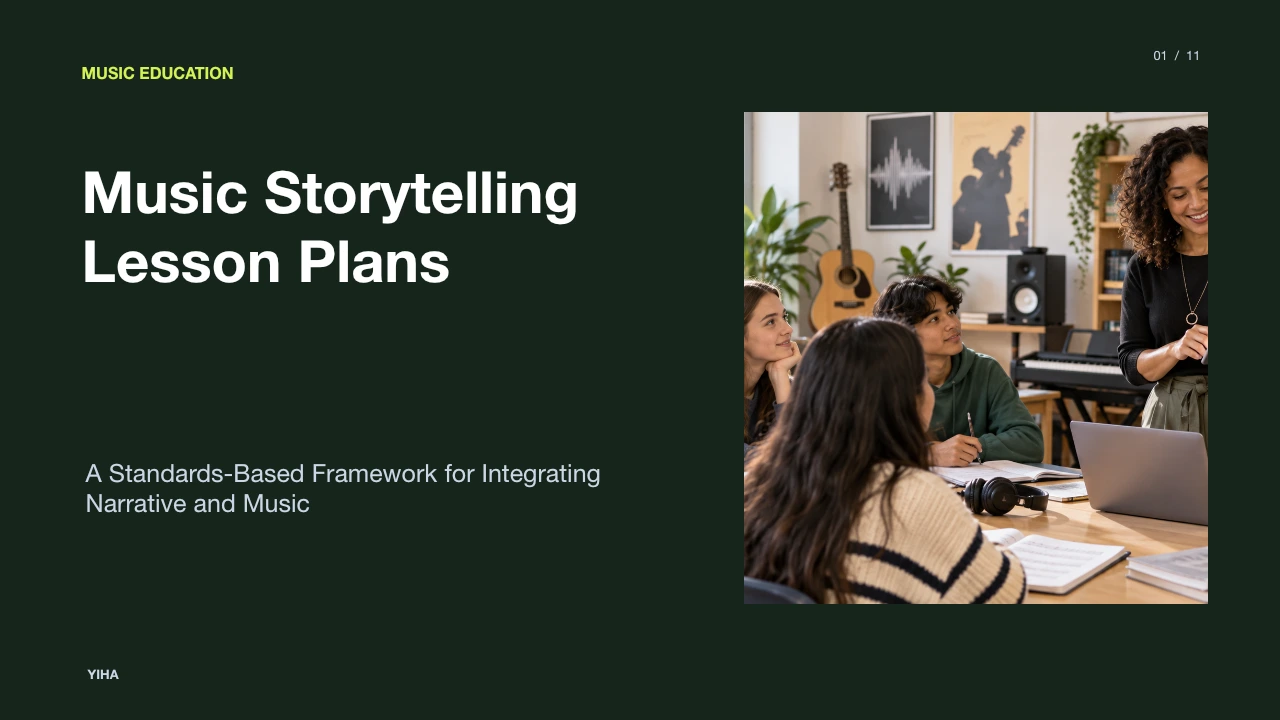
Music Storytelling Lesson Plans
A comprehensive guide for educators on structuring storytelling lesson plans across music, drama, and social studies, aligning narrative arcs with acoustic expression.
Free download · 4.9 MB11 editable slides · PowerPoint format
Download the editable PPTX
PPTX · 4.9 MB · 11 editable slides · Free to edit and reuse with attribution to Yiha.ai
View every slide
Use ← →, Home/End, or swipe on mobile
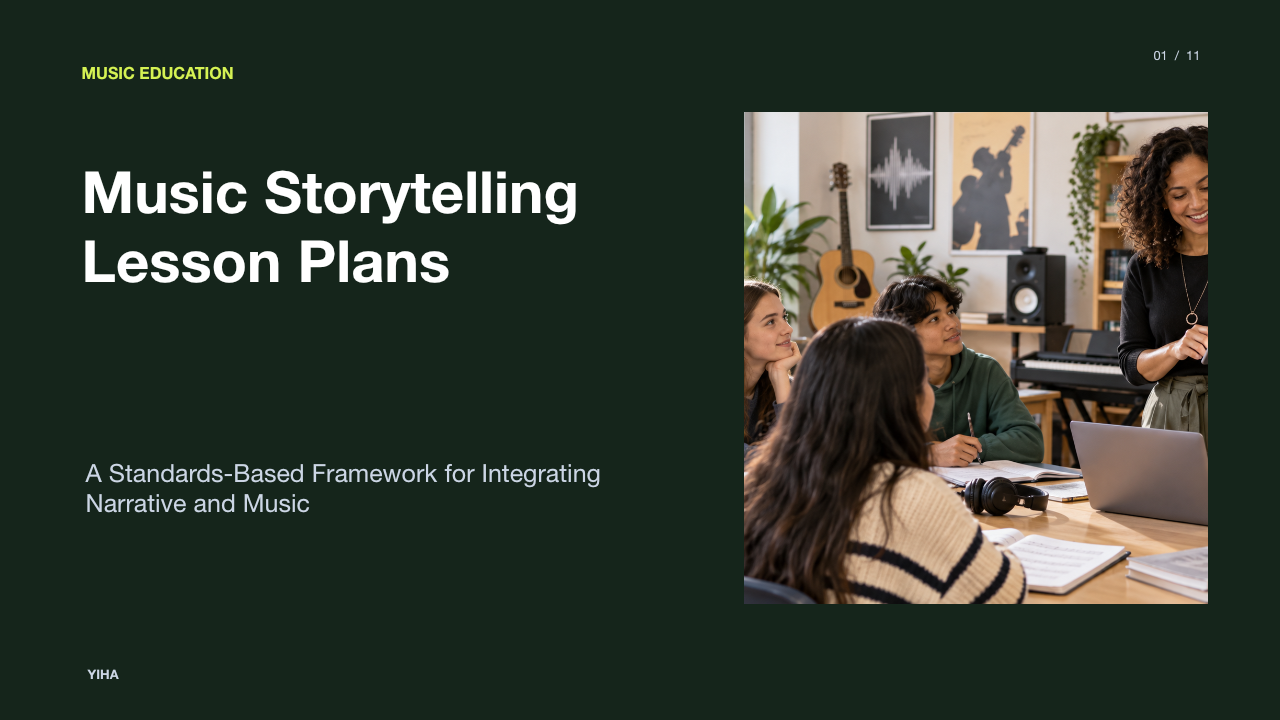
Music and narrative share fundamental structural principles. Both disciplines depend on pacing, exposition, tension, and resolution to communicate meaning. When educators incorporate narrative techniques into music and performing arts classrooms, students discover purposeful entry points into expressive sound design, lyrical analysis, and acoustic interpretation. Rather than practicing technical exercises without context, learners explore how sonic and vocal choices convey character motivation, emotional conflict, and plot progression.
Integrating storytelling into music lesson planning also creates natural pathways to cross-disciplinary learning. By examining how stories are preserved, adapted, and performed across cultures, students connect acoustic and dramatic elements to historical inquiry, literacy, and social studies. The following nine sections provide a structured approach to designing, differentiating, and assessing storytelling lessons across grade levels while addressing practical curriculum constraints.
Grounding Narrative in Core Music Standards
Developing an effective arts curriculum requires anchoring creative storytelling within recognized educational frameworks. In standard arts learning, educators structure instruction around core artistic processes: creating original material, performing or presenting work, responding to artistic choices, and connecting creative expressions to broader cultural and historical contexts.
Curricular frameworks such as the Indigenous Storytelling Unit: 6-Lesson Drama Unit | DTA demonstrate how structured learning circles allow students to analyze narrative structures, explore historical traditions, and synthesize multidisciplinary elements into unified artistic work. In that curriculum, high school students examine cultural context to justify personal responses, refine dramatic concepts, and analyze how text, movement, and music advance dramatic structure. Educators can apply this framework to music classrooms by requiring students to justify their melodic, harmonic, and dynamic choices during composition tasks. Grounding narrative explorations within rigorous standards ensures that classroom activities develop essential listening, analytical, and performance competencies rather than superficial dramatic play. A primary limitation is that aligning multi-part narratives with standard pacing often requires multiple class periods, which demands strict time management.
Translating Story Elements into Pitch, Tempo, and Dynamics
Translating story elements into acoustic parameters allows students to understand expressive music vocabulary through concrete narrative metaphors. Pacing, character traits, and conflict can be represented directly through changes in pitch register, tempo, and dynamic gradation.
In theatrical and dramatic writing curricula, such as the Playwriting Lesson Plans for Drama Teachers | DTA, students construct character profiles and conflict profiles to understand what drives a scene forward. A similar approach works well in music instruction. As an illustrative example, a student composer might assign high-register mallet percussion to depict an agile or timid protagonist, while low-register bass notes represent an obstacle or opposing force. Tempo variations reflect physical urgency: accelerando portrays panic or pursuit, while ritardando signals exhaustion or peaceful resolution. Dynamics provide spatial and emotional perspective, moving from a subtle whisper to an intense fortissimo climax. A clear limitation of this technique is that students may rely on literal sound effects rather than developing cohesive musical themes. Teachers must guide learners to organize acoustic choices into repeatable motifs rather than isolated sound cues.
Program Music and Leitmotifs in the Classroom
Instrumental storytelling relies on the ability of melodic themes and instrumental timbres to suggest narrative events without spoken dialogue. Teaching students to interpret and construct thematic motifs helps them recognize how instrumental composition functions as an autonomous storytelling medium.
Curated collections such as Oral Storytelling Lesson Plans & Worksheets Reviewed by Teachers highlight how students across grade levels explore traditional narratives, identify recurring thematic motifs, and practice communicating stories without relying exclusively on spoken text. In an instrumental music setting, teachers can guide students to track recurring motifs using visual listening maps. As an analytical exercise, educators can prompt students to identify how variations in orchestration, tempo, and articulation signal character growth or environmental change. By studying how distinct instrumental voices carry narrative meaning, students gain the analytical vocabulary needed to compose their own thematic motifs. However, without adequate melodic transcription skills, some students may find recurring motifs difficult to reproduce accurately on pitched instruments.
Narrative Song Forms, Ballads, and Lyric Analysis
Vocal traditions provide an enduring historical framework for storytelling through verse-and-refrain structures. Across diverse cultural traditions, vocal narratives have documented community struggles, honored historical figures, and preserved oral memory across generations.
Cross-curricular resources like Storytelling in the Social Studies Classroom | Read Write Think emphasize that exploring personal and community stories helps learners realize that history consists of real people and lived experiences. In vocal music units, students analyze how strophic song forms use repetitive melodic stanzas to deliver complex chronological narratives, while refrains reinforce central themes and community solidarity. By examining how lyric phrasing interacts with musical meter, students observe how songwriters build dramatic suspense and emotional catharsis. However, teachers should recognize that analyzing vocal ballads requires attention to poetic meter, rhyme scheme, and historical idiom, which may require pre-teaching unfamiliar vocabulary or historical background.
Integrating Movement, Gesture, and Dramatic Play
Embodied performance reinforces musical comprehension. When students physicalize musical phrasing, rhythm, and tension through movement and dramatic play, abstract acoustic concepts become tangible physical actions.
As detailed in the Playwriting Lesson Plans for Drama Teachers | DTA, drama curricula emphasize designing physical expression, matching or opposing physical movement to vocal choices, and exploring characters through devised movement pieces. In an integrated music setting, students can mirror musical phrasing through ensemble blocking and physical gesture. For example, an ensemble can physicalize a musical crescendo and decrescendo through spatial expansion and contraction. Physicalizing sound helps students internalize meter, tempo consistency, and dramatic pacing before committing their ideas to formal notation. Teachers should be mindful that spatial constraints and varying comfort levels with physical performance can impact student participation, requiring clear ground rules and inclusive movement options.
Student Composition of Incidental Music and Soundscapes
Student composition projects empower learners to apply theoretical knowledge to original dramatic scenes. Scoring incidental music and ambient soundscapes requires students to make intentional choices about timbre, acoustic balance, and texture to support spoken text.
In the curricular guide Songs of Our Lives: Using Lyrics to Write Stories | Read Write Think, educators explore how songs and non-print media serve as advanced organizers that help students connect personal narratives with broader creative themes. In an illustrative example, a small group receives a short narrative excerpt and develops three supportive acoustic layers: an underlying ambient drone that establishes setting, a recurring rhythmic ostinato that provides pacing, and melodic accent cues that punctuate key narrative beats. This layered exercise teaches students the functional purpose of incidental scoring: supporting and illuminating dialogue without overpowering the speaker. An inherent challenge in soundscape projects is balance, as students frequently play unpitched percussion too loudly over spoken lines unless dynamic thresholds are enforced.
Connecting Musical Narratives with Literacy and History
Story-based music lessons provide meaningful bridges to social studies, historical research, and language arts. Examining music created during significant historical events allows students to explore primary cultural expressions within their original social context.
As outlined in Storytelling in the Social Studies Classroom | Read Write Think, engaging students in storytelling about themselves, their families, and historical figures promotes understanding of cultural diversity and participatory citizenship. When students examine historical songs and oral narratives alongside primary source texts, they discover how communities have used music to document shared struggles and preserve community values. This interdisciplinary approach reinforces reading comprehension, visual representation, and research skills while deepening students' appreciation of music as a primary historical record. The main limitation is source availability, as finding authentic historical recordings with clear lyric transcriptions suitable for younger learners requires advance curation.
Scaffolding Narrative Complexity Across Grade Levels
Instructional scaffolding must align narrative complexity with the developmental stages of learners. A music storytelling exercise designed for early childhood must look fundamentally different from an assignment in a secondary classroom.
In early childhood education, as outlined in Preschool Education Lesson Plans: A Guide to Effective Preschool Activities, structured thematic units build fundamental listening, comprehension, and fine motor skills through accessible storytelling and hands-on activities. Early learners thrive when connecting simple sensory cues, such as tapping a triangle for a raindrop or striking a low drum for footsteps. In middle grades, students can advance to structuring binary (AB) or ternary (ABA) musical forms that reflect character departure, conflict, and return. Secondary students can tackle multi-track digital audio workstations or complex live orchestrations, scoring scenes with thematic motifs and varied harmonic textures. Adjusting technical expectations ensures that students develop musical literacy at an age-appropriate pace without feeling overwhelmed by advanced notation.
Assessing Narrative Coherence and Musical Expression
Evaluating creative music storytelling requires assessment tools that measure technical skill and narrative intent without stifling artistic expression. Formative rubrics and structured peer critique protocols provide objective standards for evaluating student work.
In the Indigenous Storytelling Unit: 6-Lesson Drama Unit | DTA, assessment standards emphasize cooperating as a creative team, responding to performance choices, and justifying meaningful feedback based on cultural and dramatic context. Similar rubrics can be established for music storytelling, assessing criteria such as narrative clarity (whether acoustic choices match story events), dynamic control, and ensemble balance. Peer review protocols, such as asking students to identify one effective acoustic choice and pose one question about narrative pacing, encourage respectful collaboration. Self-reflection prompts require students to explain why they selected specific instruments or tempos, ensuring that creative decisions remain intentional and accountable to the story.
By integrating standards-based curriculum design, physical embodiment, historical inquiry, and structured assessment, educators create rich learning environments where students discover their voices as thoughtful musical storytellers.
Research sources
- Preschool Education Lesson Plans: A Guide to Effective Preschool Activities · www.theschoolhouse.org
- Indigenous Storytelling Unit: 6-Lesson Drama Unit | DTA · www.theatrefolk.com
- Storytelling in the Social Studies Classroom | Read Write Think · www.readwritethink.org
- Playwriting Lesson Plans for Drama Teachers | DTA · www.theatrefolk.com
- Oral Storytelling Lesson Plans & Worksheets Reviewed by Teachers · www.lessonplanet.com
- Storytelling Drama Lesson Plans PPT Template | ReelMind · reelmind.ai
- Songs of Our Lives: Using Lyrics to Write Stories | Read Write Think · www.readwritethink.org
- Free AI lesson plan generator to create impressive lesson plans in minute · www.visme.co