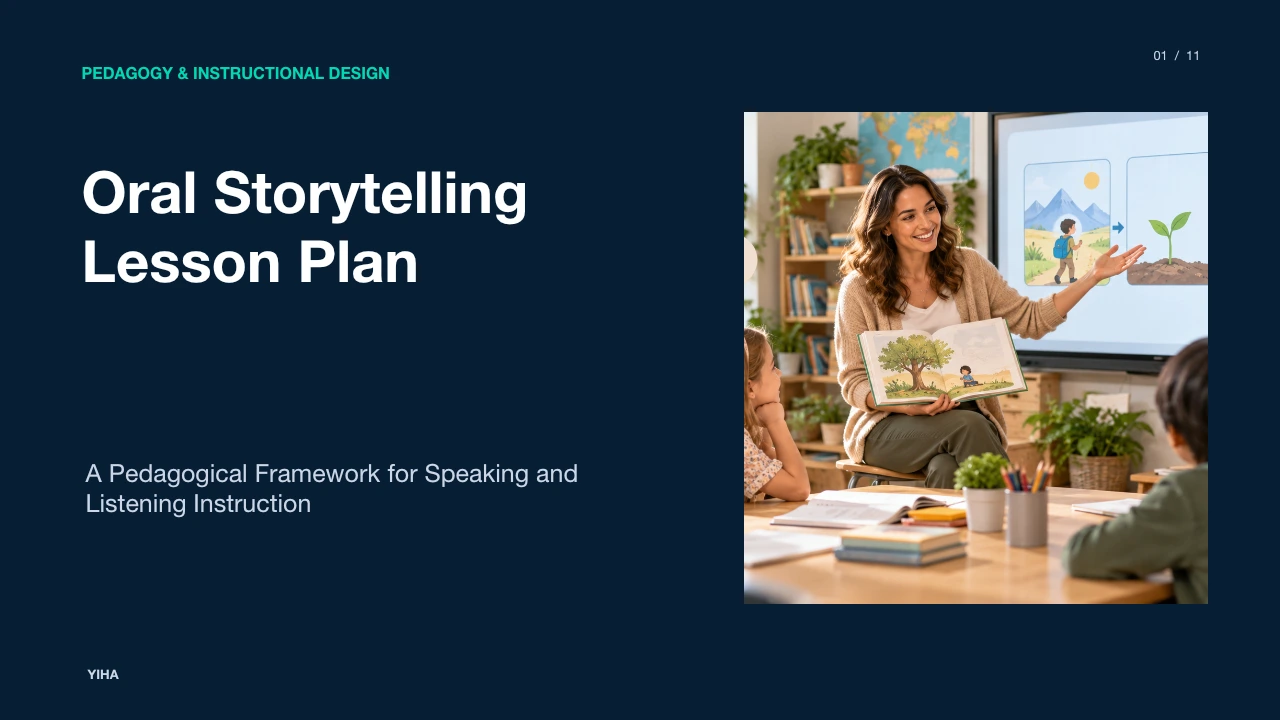
Oral Storytelling Lesson Plan
A comprehensive pedagogical guide to structuring oral storytelling lessons, featuring evidence-based strategies for schema activation, collaborative retelling, formative assessment, and bridging spoken narrative into written literacy.
Free download · 4.9 MB11 editable slides · PowerPoint format
Download the editable PPTX
PPTX · 4.9 MB · 11 editable slides · Free to edit and reuse with attribution to Yiha.ai
View every slide
Use ← →, Home/End, or swipe on mobile
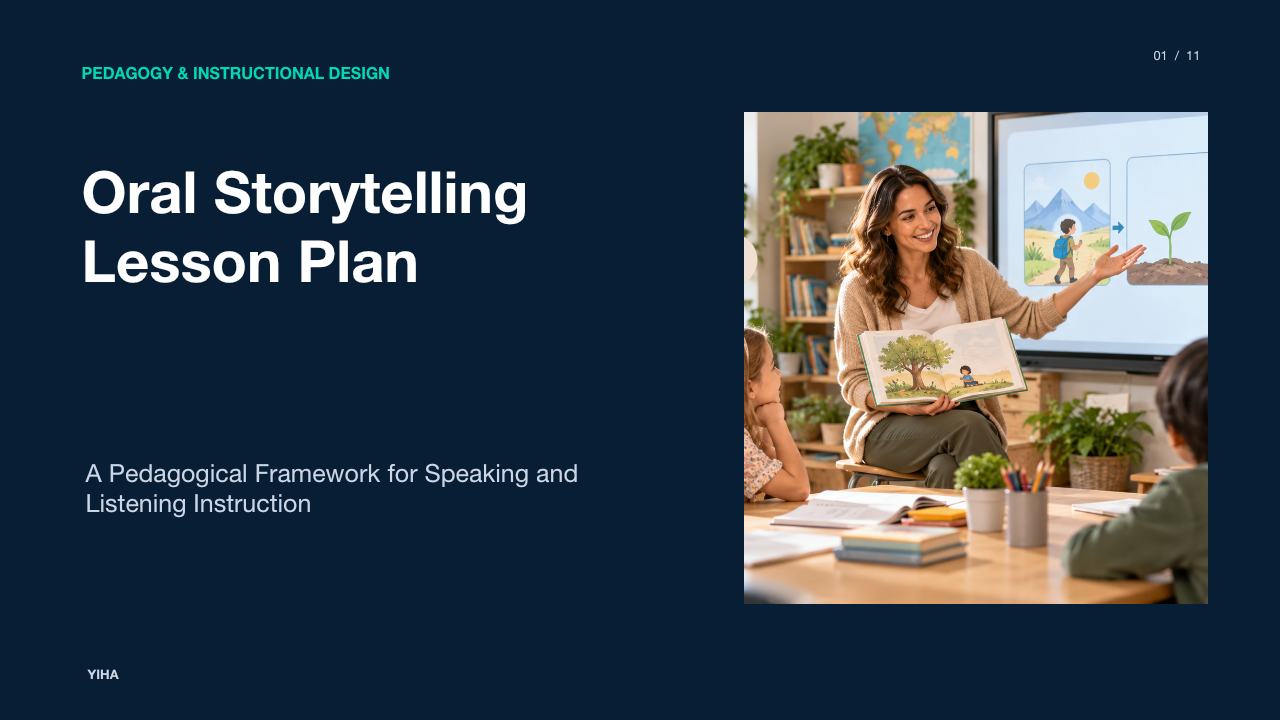
Oral storytelling serves as a foundational pillar of human communication and literacy development. Before children decipher written symbols, they make sense of spoken language, sequential logic, and emotional expression through oral narrative. Designing an intentional lesson plan around spoken tales requires moving beyond casual recitation. Educators must construct structured learning sequences that guide students from passive listening to expressive, independent communication.
The Cognitive and Linguistic Basis of Oral Storytelling
Oral narrative processing engages core neurological mechanisms that support communication. Research cited by Storytelling in ESL: 10 Best Activities + Lesson Plan highlights findings from Princeton demonstrating that when listeners hear a story, their neural activity mirrors that of the storyteller. This neural coupling synchronizes speaker and listener brains, facilitating deeper comprehension than detached factual lists. Narrative structure provides a predictable cognitive framework where characters, problems, and solutions unfold in a logical chain.
From a language acquisition perspective, storytelling delivers comprehensible input within rich conversational contexts. As explored in 10 Lesson Plan Examples, Plus Helpful Expert Tips, responsive instructional design must meet students where they are, taking into account their background knowledge, cultural context, and developmental readiness. When children process oral tales, they develop auditory working memory by tracking story elements across time. They also absorb the syntactic rhythms of past narrative tenses, including the past simple, past continuous, and past perfect, well before encountering formal grammar worksheets.
However, these cognitive gains do not emerge automatically from unguided listening. If spoken input exceeds learner comprehension thresholds without visual anchoring, the cognitive load overwhelms auditory memory. Teachers must therefore scaffold narrative input deliberately.
Designing Targeted Speaking and Listening Objectives
Every effective oral storytelling lesson requires clear, observable objectives rather than vague aspirations. According to 9 Components of an Effective Lesson Plan - Teacher Strategies, instructional plans function as navigational roadmaps where learning objectives establish the exact coordinates of student growth. Objectives must be specific, measurable, and tied to educational standards rather than simple classroom participation.
In oral language instruction, educators must differentiate between rote recitation and authentic communicative competence. A rote objective might require a child to memorize five lines of a script. In contrast, an authentic speaking and listening objective requires a student to retell a narrative problem and resolution using chronological transition words, or to maintain a character persona while answering spontaneous peer questions. As Storytelling in ESL: 10 Best Activities + Lesson Plan points out, structured listening constraints force focused reception, while collaborative output routines turn passive listeners into active communicators.
A limitation of objective design in oral language is assessing spontaneity. While written rubrics evaluate standardized outputs easily, oral discourse contains variability in pronunciation, pacing, and tone. Teachers must ensure criteria focus on communicative clarity and sequential coherence rather than native-like phonological perfection.
Selecting and Structuring Culturally Rich Mentor Tales
Selecting appropriate mentor texts forms the core of narrative instruction. As demonstrated in Teaching About Story Structure Using Fairy Tales | Read Write Think, familiar narratives such as traditional folktales and fables provide clear plot architecture with defined beginnings, middles, and endings. These archetypal structures establish an accessible base for analyzing plot development and character motivation.
When choosing mentor tales, teachers must weigh linguistic accessibility against cultural authenticity. As outlined in Storytelling in ESL: 10 Best Activities + Lesson Plan, beginning language learners benefit from stories with controlled vocabularies and repetitive linguistic refrains. Folktales featuring the classic pattern of three, such as three challenges, three character interactions, or three wishes, naturally build repetition into the narrative. This repetition reinforces sentence patterns and allows learners to anticipate the sequence.
Nevertheless, selecting folklore requires careful cultural vetting. Teachers must avoid tales that reinforce outdated stereotypes or reduce rich cultural traditions to generic tropes. Selecting literature that represents students' heritage validates their identities and enriches classroom discourse.
Pre-Story Scaffolding: Schema Activation and Key Words
Before launching into an oral performance, teachers must activate students' prior knowledge and pre-teach essential vocabulary. Unfamiliar terminology can disrupt narrative engagement. If students stall on unknown words in the first two sentences, they lose track of the larger narrative arc.
To prevent cognitive overload, Storytelling in ESL: 10 Best Activities + Lesson Plan recommends pre-teaching five to eight critical words through visual images, brief student-friendly definitions, contextual examples, and choral repetition. Crucially, educators should avoid stopping every two sentences during the actual performance to gloss new words, as mid-story interruptions break the narrative flow and dissolve student focus. Pre-teaching provides the lexical foundation needed for smooth comprehension.
Furthermore, sensory hooks and visual prompts activate relevant schema. Presenting a mystery artifact, a character illustration, or an evocative setting image primes auditory anticipation. An illustrative example of this mechanism involves displaying a brass key and asking learners to predict its role in an upcoming tale. While such front-loading prepares students effectively, educators must ensure pre-story discussions remain concise (recommendation: five to eight minutes) so that instructional time focuses on the story itself.
Instructor Modeling: Expressive Delivery and Voice
When presenting the mentor story, the instructor's delivery serves as an expressive model of spoken English. Effective oral modeling relies on vocal prosody, varied pacing, deliberate pauses, and paralinguistic gestures that clarify narrative meaning without translating every word into print.
Pedagogical reflection is essential for refining this modeling practice. As detailed in Reflection in Lesson Plans: 7 Practical Steps - Teacher Strategies, deliberate educator reflection transforms daily lessons into opportunities for instructional growth. Teachers who evaluate their delivery can identify whether vocal modulation and physical gestures supported student comprehension or caused unintended distractions.
Practical guidance from Storytelling in ESL: 10 Best Activities + Lesson Plan underscores the necessity of teacher preparation. Delivering an oral story without prior rehearsal frequently leads to stumbled phrasing and fragmented pacing. A short rehearsal allows the teacher to plan deliberate pauses before dramatic turning points, adjust pitch to distinguish characters, and synchronize gestures with key descriptive words. The primary limitation of instructor modeling is the risk of passive reception if students listen without an active processing task, such as holding visual cue cards or listening for target phrases.
Collaborative Student Practice: Guided Retelling Tasks
Once students grasp the mentor story, instruction shifts from teacher delivery to collaborative student practice. Guided retelling routines scaffold spoken production without placing the pressure of solo stage performance on developing speakers.
Several interactive routines support this transition. As described in Storytelling in ESL: 10 Best Activities + Lesson Plan, teachers can implement sequenced image reconstruction, where pairs arrange three to six narrative illustrations into a logical sequence and retell the story. Because different pairs may organize illustrations differently, the activity demonstrates that meaning is constructed actively. Other valuable routines include:
- Story chains: Students sit in a circle and contribute one consecutive sentence under specific grammatical constraints, such as using past simple verbs.
- Disappearing board texts: The teacher writes a short six-to-eight-sentence summary on the board and erases words incrementally across multiple readings until learners reconstruct the full narrative from memory.
- Hot-seat character interviews: A student assumes a character persona while classmates ask questions that require first-person, in-character spoken responses.
Additionally, Using Story Innovation to Teach Fluency, Vocabulary, and Structure | Read Write Think illustrates how story innovation allows students to substitute character traits, settings, or narrative problems within a familiar structure. This strategy gives learners creative autonomy while maintaining structural support. A common pitfall in collaborative retelling is off-task chatter or dominance by confident peers, which teachers can mitigate by assigning explicit speaking roles and time limits.
Formative Assessment: Rubrics for Fluency and Discourse
Assessment in an oral storytelling lesson should measure communicative competence rather than reading recitation. Standard paper-and-pencil comprehension quizzes often fail to capture verbal agility, discourse structure, and listening comprehension.
Instead, formative assessment should be embedded directly within the narrative tasks. As argued in Storytelling in ESL: 10 Best Activities + Lesson Plan, attaching detached comprehension tests to the end of a storytelling lesson can stifle student enthusiasm. A more effective evaluation strategy uses a focused retelling rubric scored across four concrete criteria: chronological sequence, target vocabulary use, grammatical control, and oral fluency. Conducting two-minute paired retelling observations or collecting sixty-second recorded spoken summaries on a classroom tablet yields clear evidence of learning without halting classroom momentum.
Furthermore, The Reading Performance: Understanding Fluency Through Oral Interpretation | Read Write Think demonstrates that assessing oral performance requires explicit attention to prosody, pacing, and expressive volume. Rubrics must provide clear performance bands so learners understand how expressive delivery influences audience comprehension. The challenge of oral rubrics lies in scorer reliability. Teachers must maintain streamlined criteria (recommendation: three to four traits) to score real-time student speech consistently.
Differentiating for Multilingual and Reluctant Speakers
Classrooms contain students with wide variations in linguistic background, confidence, and expressive fluency. Differentiated instruction in oral storytelling ensures that multilingual learners and hesitant speakers participate fully without lowered academic expectations.
As explained by Differentiated Instruction for English Language Learners | Colorín Colorado, differentiation does not mean creating separate lessons for individual students. Rather, it involves presenting the same core task through varied entry points and scaffolding levels tailored to student proficiency. Content should remain rigorous, with teachers offering accessible paths for students to demonstrate understanding.
In an oral storytelling lesson, differentiation strategies include providing visual storyboard graphic organizers, offering sentence frames for retelling transitions (such as "At first," "Suddenly," and "In the end"), and allowing small-group peer rehearsals before whole-group sharing. As noted in Storytelling in ESL: 10 Best Activities + Lesson Plan, peer-paired retells lower anxiety compared to standing alone before the entire class. The primary limitation of differentiation lies in over-scaffolding: providing excessive sentence templates can turn authentic oral communication into mechanical recitation. Teachers should gradually remove scaffolds as learner confidence grows.
Curricular Transfer: Bridging Spoken Narrative to Text
Oral storytelling is not an isolated exercise. It acts as an instructional bridge into reading comprehension, formal writing, and interdisciplinary inquiry. Oral narrative practice establishes the conceptual and syntactic scaffolding that underpins written literacy.
As emphasized in Literature Response in Primary Classrooms | Read Write Think, drawing upon National Council of Teachers of English guidelines, writing for young learners begins with oral dialogue. Through talk, students clarify narrative thoughts, organize ideas, and rehearse expressive phrases before committing them to paper. Oral responses to literature lay the groundwork for thoughtful written compositions.
Instructional frameworks can formalize this transition. As noted in 5 Components to a Great Weekly Lesson Plan | Teacher.org, weekly planning connects daily lessons into cohesive progressions, showing how oral practice on Monday and Tuesday leads to collaborative drafting on Wednesday and independent narrative writing by Friday. Once students have verbally narrated and refined a story, writing down the plot becomes an act of transcription and elaboration rather than an intimidating struggle with blank-page paralysis.
By intentionally structuring each phase of the lesson from cognitive activation and mentor text modeling to collaborative retelling and written transfer, educators transform spoken storytelling into a powerful vehicle for language development across the curriculum.
Research sources
- Storytelling in ESL: 10 Best Activities + Lesson Plan · tahricteaches.com
- 10 Lesson Plan Examples, Plus Helpful Expert Tips · www.weareteachers.com
- 8 Best AI Lesson Plan Generators for Educators · www.weareteachers.com
- 9 Components of an Effective Lesson Plan - Teacher Strategies · www.teacherstrategies.org
- Free AI Lesson Plan Generator for Teachers · www.theschoolhouse.org
- Teaching About Story Structure Using Fairy Tales | Read Write Think · www.readwritethink.org
- Reflection in Lesson Plans: 7 Practical Steps - Teacher Strategies · www.teacherstrategies.org
- Literature Response in Primary Classrooms | Read Write Think · www.readwritethink.org
- Using Story Innovation to Teach Fluency, Vocabulary, and Structure | Read Write Think · www.readwritethink.org
- The Reading Performance: Understanding Fluency Through Oral Interpretation | Read Write Think · www.readwritethink.org
- Differentiated Instruction for English Language Learners | Colorín Colorado · www.colorincolorado.org
- 5 Components to a Great Weekly Lesson Plan | Teacher.org · www.teacher.org