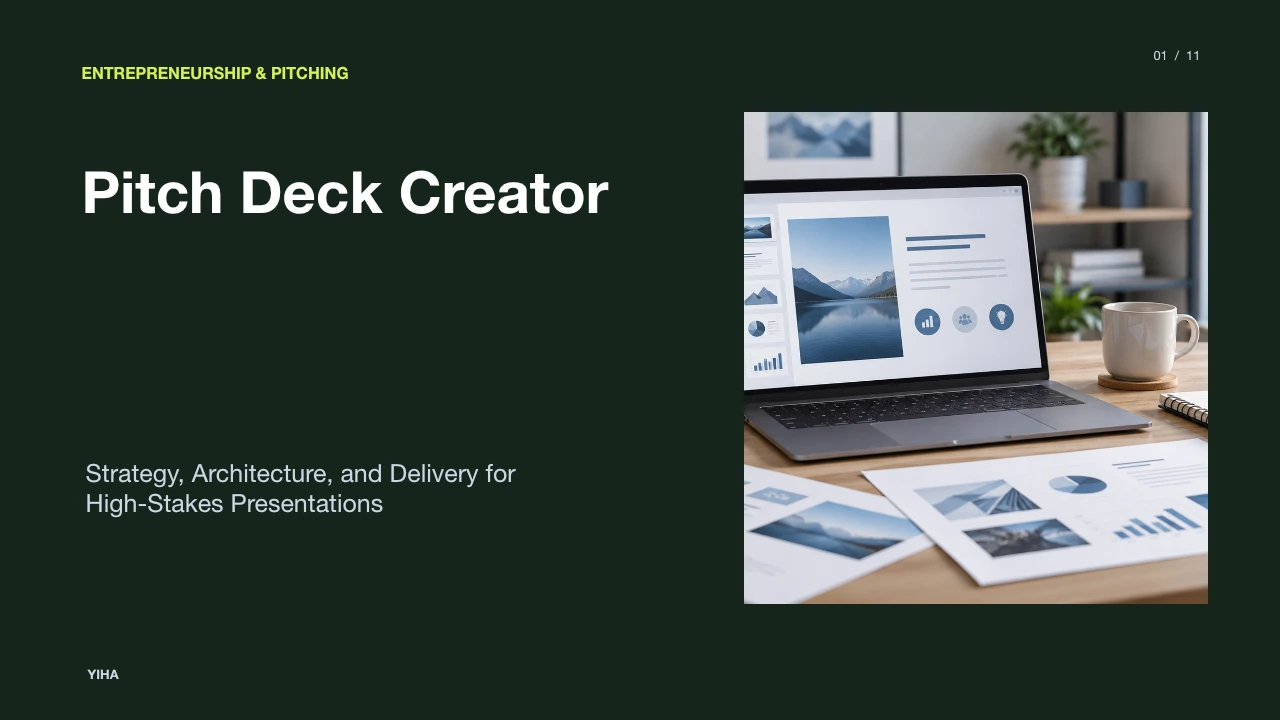
Pitch Deck Creator
A practical guide to building pitch decks for startup fundraising and creator partnerships, covering information architecture, narrative arcs, and presentation delivery.
Free download · 4.9 MB11 editable slides · PowerPoint format
Download the editable PPTX
PPTX · 4.9 MB · 11 editable slides · Free to edit and reuse with attribution to Yiha.ai
View every slide
Use ← →, Home/End, or swipe on mobile
Pitch presentations have evolved from static summaries of written business plans into specialized commercial instruments designed to secure investor meetings, agency representation, and brand partnerships [1, 2]. Whether a founder seeks venture capital or an independent creator seeks an enterprise brand collaboration, a presentation must deliver a defensible value proposition within a brief review window [1, 2]. Building an effective deck requires understanding audience behavior, narrative architecture, empirical data validation, and technical format selection [1, 2].
The Evolution of Pitch Decks in Venturing and Creator Economies
Historically, venture fundraising centered on forty-page business plans that detailed multi-year operational budgets and market assumptions [2]. As deal velocity increased and investor reading time contracted, the visual presentation deck replaced the comprehensive manual as the primary screening document [2]. In contemporary venture capital, a pitch presentation functions to spark interest and earn an exploratory meeting rather than to document every internal operational process [2].
This presentation format has also expanded across the creator economy. As documented in the InfluenceFlow Creator Pitch Decks Guide, creator pitch decks serve as professional proposals that present brand identity, audience demographic metrics, historical campaign performance, and collaborative concepts [1]. Modern creators use these presentations to negotiate brand sponsorships, secure talent agency representation, and attract early investment for creator-led commercial enterprises [1]. While venture founders emphasize technology defensibility and scalable business models, creators emphasize verified audience demographics, past campaign performance, and strategic content alignment [1, 2]. Both sectors rely on structured visual decks to translate operational output into commercial value [1].
Core Information Architecture: The 12-Slide Foundation
An effective commercial deck follows a modular structure aligned with how evaluators assess risk [2]. Analysis published by SlideEgg's Pitch Deck Guide outlines a standard twelve-slide sequence: cover, problem statement, solution overview, market opportunity, product breakdown, business model, traction milestones, competitive landscape, team credentials, financial projections, funding ask, and a closing contact slide [2].
This sequence reflects an evaluator's decision pathway [2]. The deck establishes that a painful inefficiency exists before demonstrating the product [2]. It then examines whether the market is large enough to sustain growth and whether the revenue model is viable [2]. Traction metrics and team backgrounds confirm execution capability before the presentation concludes with a capital requirement and strategic use of funds [2]. Maintaining one core message per slide prevents visual clutter and keeps cognitive load manageable for the reviewer [2].
Narrative Mechanics: Applying the Three-Act Storytelling Arc
Persuasive pitch decks structure information into a clear three-act narrative arc: the setup, empirical validation, and forward-looking vision [3]. As noted in the Pitch AI Pitch Deck Guide, a pitch must guide evaluators through distinct stages, transitioning from curiosity about an urgent problem to commercial conviction regarding the business opportunity [3].
Act One introduces market context and establishes the problem [3]. Evaluators need to grasp why current customer workflows fail and what friction exists [3]. Act Two introduces the product solution and provides operational validation through traction data, user adoption, and unit economics [3]. Act Three expands into the future scale opportunity, detailing the serviceable market, competitive advantages, and the financial trajectory enabled by new capital [3]. In commentary from Slidestack's Startup Pitch Deck Guide, brevity and narrative clarity remain central to effective delivery, ensuring each slide advances the overall business story rather than presenting disconnected facts [4].
Format Calibration: Email Decks Versus Live Presentations
A common mistake in pitch design is presenting the same slides during a live meeting that were distributed as cold email attachments [2]. As outlined in SlideEgg's Pitch Deck Guide, founders frequently maintain multiple versions of their material: an asynchronous email deck consisting of 8 to 10 slides designed for rapid scanning, and a meeting deck of 12 to 14 slides designed for conversational live delivery [2].
An asynchronous email deck must be self-explanatory [2]. Because the presenter is absent, the slides require written callouts, labeled chart axes, and standalone narrative headers. Conversely, a live presentation deck functions as a visual backdrop [2]. It should minimize on-screen text, relying on clear figures and simple diagrams while the speaker provides context and nuance [4]. Overloading live slides with paragraphs forces evaluators to read rather than listen, weakening the personal exchange [4].
Audience Attention Dynamics and the Initial Review Window
Reviewers evaluate dozens of presentations weekly and allocate minimal time to first-pass assessments [4]. In general market observations, investors review slide decks rapidly, focusing their early evaluation on whether the initial slides communicate a clear market pain point [2, 4]. Commentary from the Pitch AI Pitch Deck Guide suggests reviewers form an initial assessment on whether to continue reading within seconds of opening a deck [3].
This rapid screening window dictates how founders structure initial content [3]. According to Slidestack's Startup Pitch Deck Guide, reviewers often spend only a few minutes reviewing a standalone deck, making immediate clarity essential [4]. Analysis from SlideEgg's Pitch Deck Guide notes that if a startup has exceptionally strong traction, such as significant revenue or rapid growth, presenting those metrics on opening slides captures reviewer attention far more effectively than waiting until later in the sequence [2].
Data Validation: Bottom-Up Sizing and Quantified Pain Points
Presentations frequently lose credibility during the market sizing and problem definition stages [2, 3]. Many founders rely on top-down industry research reports that quote multitrillion-dollar broad categories [3]. According to the Pitch AI Pitch Deck Guide, top-down market sizing without realistic customer adoption rates undermines investor confidence, whereas bottom-up market sizing built on specific customer segments and realized pricing provides defensible validation [3].
In an illustrative example, an enterprise software startup calculating its market opportunity bottom-up multiplies its identifiable target customer count by its projected annual license fee. This produces a verifiable addressable market figure rather than an unsubstantiated top-down estimate. Similarly, customer pain points must be quantified in concrete terms of wasted hours, operational compliance costs, or lost margin rather than vague generalities [3]. Defensible market estimation demonstrates analytical rigor and reassures evaluators that assumptions are grounded in unit economics [3].
Static Documents Versus Interactive Presentation Software
The technology used to build and distribute pitch presentations has bifurcated into static document formats and web-based interactive applications [5, 6]. Traditional formats such as PDF exports and PowerPoint slides remain universal standards due to offline accessibility and predictable cross-platform formatting [2, 6]. However, as highlighted in the Storydoc AI Pitch Deck Creator overview, interactive web presentations enable dynamic content, including embedded video walkthroughs, interactive traction graphs, and telemetry tracking that records viewer opens, clicks, and page drop-offs [5].
Interactive platforms present trade-offs [6]. The LivePlan Pitch Deck Analysis emphasizes that while AI design generators and interactive builders offer rapid formatting, they cannot validate the integrity of underlying business models or financial statements [6]. When a presentation is hosted online, connectivity requirements can create obstacles during live in-person pitches [6]. Teams must determine whether interactive tracking outweighs the reliability of standardized PDF documents for specific audience contexts [6].
Common Structural Failure Modes and Market Sizing Fallacies
Pitch presentations frequently fail due to predictable structural errors [4]. According to Slidestack's Startup Pitch Deck Guide, founders often struggle by crowding slides with technical features while failing to explain how the product creates distinct economic value [4]. Pitch teardowns of successful early decks indicate that brevity and simple visual hierarchy consistently outperform exhaustive product inventories [4].
In addition, analysis from SlideEgg's Pitch Deck Guide notes that uncited Total Addressable Market (TAM) slides are among the most frequent sources of credibility loss [2]. Claiming massive market capture without clear Serviceable Addressable Market (SAM) and Serviceable Obtainable Market (SOM) boundaries raises immediate skepticism [2]. Other failure modes include concealing customer churn, presenting ungrounded revenue projections without operational hiring plans, and failing to define specific competitive differentiators [2, 3].
Execution Strategy: Versioning, Personalization, and Tracking
A systematic pitching workflow requires clear version control, tailored recipient messaging, and disciplined follow-up protocols [2, 4]. The SlideEgg Pitch Deck Guide highlights that decks ending with a clear, actionable call to action, including direct contact details and meeting booking links, facilitate productive follow-up conversations compared to decks that close on passive summary slides [2].
Furthermore, as discussed in LivePlan's Pitch Deck Tool Review, advanced fundraising management benefits from linking presentation workflows with dedicated pipeline tracking and financial models [6]. Founders who personalize executive summaries to reflect a venture fund's investment thesis or a brand's strategic marketing objectives establish immediate relevance [1, 4]. Telemetry tools can reveal when an evaluator reviews slides, allowing teams to deliver timely, context-aware follow-up communications that advance the discussion [5].
Research sources
- Creator Pitch Decks: Ultimate 2026 Guide - InfluenceFlow · influenceflow.io
- AI Pitch Deck Creator: Get Funded and Win Deals · www.storydoc.com
- The 10 Best Pitch Deck Creators for Raising Funding (2026) · www.liveplan.com
- How to Create the Perfect Pitch Deck: Complete 2026 Guide | Pitch AI | Pitch AI · www.pitchai.com
- How to Make a Pitch Deck: The Complete 2026 Guide | SlideEgg · www.slideegg.com
- A Complete Guide to Creating a Killer Startup Pitch Deck – Step-by-Step Guide | Slidestack · slidestack.com