Presentation Intro
A comprehensive guide to structuring and delivering presentation openings. Learn cognitive primacy effects, the INTRO model, audience relevance tests, visual anchors, and anxiety control routines.
Free download · 4.9 MB11 editable slides · PowerPoint format
Download the editable PPTX
PPTX · 4.9 MB · 11 editable slides · Free to edit and reuse with attribution to Yiha.ai
View every slide
Use ← →, Home/End, or swipe on mobile
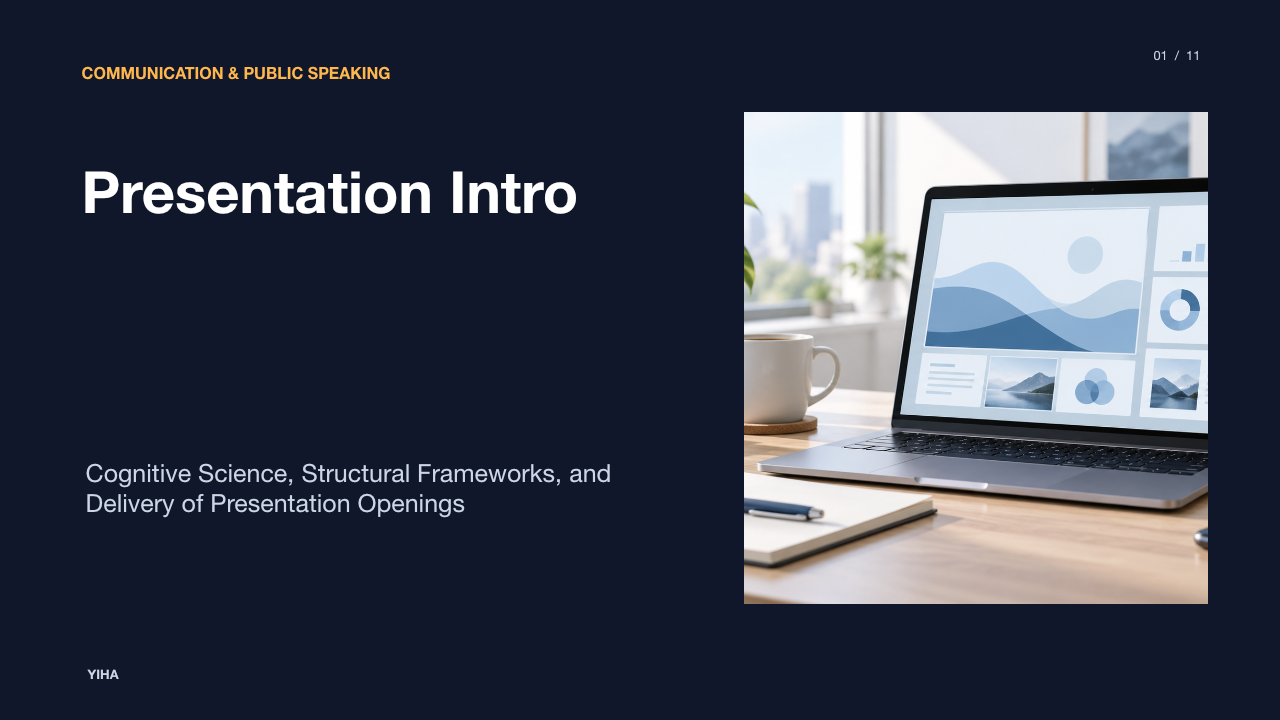
The opening sequence of an oral presentation determines how an audience evaluates the speaker, processes the incoming message, and decides whether to sustain active mental focus. Rather than treating the introduction as perfunctory administrative overhead, experienced communicators treat the first minute as a high-leverage cognitive gateway. Research and practical frameworks show that structured openings clarify expectations, lower physiological apprehension, and anchor core concepts before passive listening sets in.
The Critical First Minute of an Oral Presentation
The beginning of an oral presentation represents the moment of peak listener attention. According to analysis on opening design by How to Start a Presentation: 14 Catchy Intro Ideas & Examples, audiences decide whether to continue listening to you within the first minute of your talk. Attention levels are naturally highest at the start of your presentation and then drift gradually along the length of the talk, falling to lower levels around the ten-minute mark.
When a speaker starts with unfocused small talk, technical delays, or passive administrative formalities, that initial concentration window dissipates. Listeners involuntarily evaluate whether the session justifies their presence. As highlighted by How to Start a Presentation – the INTRO Model, establishing an organized structure immediately from the start captures early interest and establishes clear expectations. Presenters must therefore treat the initial sixty seconds as a deliberate mechanism to provide listeners with an immediate reason to pay attention.
Cognitive Mechanisms of the Primacy Effect
The disproportionate influence of an opening relies on memory architecture. Cognitive psychology identifies the primacy effect as the tendency for information presented first to be transferred and encoded into long-term memory more effectively than subsequent data. As noted in How to Start a Presentation: 14 Catchy Intro Ideas & Examples, the primacy effect makes listeners far more likely to remember your opening message during a talk.
Visual perception enhances this encoding advantage through the picture superiority effect. Experimental findings referenced in cognitive literature show that people remember visual information longer than hearing information or learning through text. Introducing a physical visual aid, an evocative object, or a focused visual anchor during the opening minute locks the primary message into associative memory. However, presenters face the limitation of physical transport logistics and stage setup constraints when using complex physical models. In software environments, introductory documentation like Intro to workspaces in Notion demonstrates an analogous visual anchoring principle, using dedicated top-level interfaces to ground user focus before navigating nested technical spaces.
Audience Stakeholder Filtering and the Relevance Test
During the initial moments of any talk, listeners operate with an internal filter centered on the question: "What is in it for me?" If the speaker does not answer this question promptly, audience attention fractures. As discussed in How to Start a Presentation: 14 Catchy Intro Ideas & Examples, answering that question directly is the key characteristic of an effective opening.
To pass the relevance test, the speaker must align the topic with the existing priorities, challenges, or goals of the audience. The analysis in How to Start a Presentation – the INTRO Model emphasizes that audiences disengage when they do not understand why their attendance is necessary. Connecting a tangible operational need to the session's topic reassures stakeholders that their time is well spent. An illustrative example of this alignment is a project lead who opens a process presentation by showing that team members waste hours weekly on unaligned handoffs, making the operational fix an immediate personal benefit.
Structural Frameworks for Multi-Part Openings
Ad-libbing an opening frequently leads to rambling and uncoordinated delivery. Structured systems provide a dependable sequence that establishes authority while maintaining conciseness. A prominent framework is the INTRO model, detailed by How to Start a Presentation – the INTRO Model. The acronym breaks down the opening sequence into five distinct functional phases: Interest, Need, Title, Range, and Objectives.
Interest captures attention immediately using an engaging statistic, narrative, or visual anchor. Need states the concrete operational reason why this audience must be present today. Title introduces an outcome-oriented session title that focuses on solutions rather than generic topics. Range provides an agenda roadmap that defines the breadth of topics and how they connect. Objectives define clear learning outcomes stating what listeners will understand or be able to do by the conclusion.
This deliberate progression creates structural clarity. A complementary operational model is found in structured data management systems such as Intro to databases in Notion, where complex information environments are made comprehensible by defining explicit properties and categories before presenting granular operational records.
Typology and Selection of Attention Hooks
Different audience profiles require distinct introductory devices. As cataloged by How to Start a Presentation: 14 Catchy Intro Ideas & Examples, presenters can draw from multiple hook typologies, provided the hook integrates seamlessly into the core message:
- Surprising Facts and Statistics: Using counterintuitive, verified data jolts listeners out of passive listening while enhancing credibility. Interactive variants, like a Myth or Fact prompt, convert passive listening into immediate participation.
- Diagnostic Questions: Targeted, scenario-based questions prompt internal reflection. Presenters must avoid excessively broad questions, such as asking vague generalities, which cause audiences to tune out.
- Historical Anecdotes: Short, little-known stories from history generate curiosity. However, presenters should avoid overused cliches, such as standard anecdotes about Newton's apple, which dilute impact.
- Bold Assertions: Delivering a decisive, contrarian observation captures focus instantly, though speakers should exercise caution to ensure the statement remains authentic rather than forced or alienating.
Complementing these techniques, How to Start a Presentation – the INTRO Model notes that multimedia hooks such as brief video clips or striking images also serve as strong interest catalysts.
Cognitive Roadmapping and Agenda Signposting
Presenting complex analytical material without an explicit agenda increases cognitive load. Listeners expend mental energy trying to predict the direction of the talk rather than processing content. In How to Start a Presentation – the INTRO Model, the Range step explicitly instructs presenters to cover the agenda early, painting a cohesive picture of how the parts fit together to address the audience's underlying need.
Effective roadmapping pairs verbal direction with minimalist visual signposts. According to How to Start a Presentation: 14 Catchy Intro Ideas & Examples, an intro slide should support the speaker's words rather than distract from them. Once the opening hook is delivered, showing a clear agenda slide anchors the sequence. In digital architectures such as Intro to workspaces in Notion, navigation sidebars and top-level page structures fulfill the same structural function by providing visible navigational boundaries so users never feel lost in deeper documentation.
Tradeoffs Between Narrative Suspense and Directness
Speakers often face a strategic decision: should they use narrative suspense and curiosity loops, or deploy a direct bottom-line-upfront summary? As highlighted in How to Start a Presentation: 14 Catchy Intro Ideas & Examples, an opener that works well for a creative brainstorming meeting may fail completely in a technical conference with specialized engineers.
Narrative suspense builds emotional engagement by revealing the problem while delaying the solution until later in the presentation. However, in time-constrained executive environments, withholding the core takeaway introduces impatience. Direct problem-solution openers cut straight to the chase by declaring the pressing issue and the proposed remedy immediately. Structured information environments, exemplified by Intro to databases in Notion, mirror this tradeoff: executive views require summary metrics upfront, whereas investigative views permit drilling down sequentially into underlying entries.
Common Pathologies and Credibility Risks in Introductions
Presenters frequently undermine their authority through avoidable introductory habits. One widespread pathology is reading the title slide verbatim. As argued by How to Start a Presentation – the INTRO Model, titling a presentation merely as "A Presentation About Sales Figures" is uninspiring and fails to connect with outcomes; it should instead focus on active direction, such as "How We Will Increase Our Sales This Quarter."
Another significant risk is sensationalizing mundane subject matter. According to How to Start a Presentation: 14 Catchy Intro Ideas & Examples, exaggerating routine updates like a soap opera erodes speaker credibility. Similarly, introducing disconnected gimmicks, such as arbitrary jokes or unrelated trivia, leaves listeners questioning the speaker's intent. Visual clutter presents another common hazard; intro slides must visually reinforce the spoken hook without competing against it with excessive text.
Rehearsal Protocol and Stage Anxiety Management
Public speaking anxiety peaks disproportionately during the opening ninety seconds of an oral presentation. The sudden physiological surge of adrenaline can cause mental lapses, voice tremors, and accelerated speech. Having a tightly structured opening framework directly mitigates these nervous reactions, as outlined in How to Start a Presentation – the INTRO Model. Knowing the exact words and sequence of the opening minutes provides a psychological anchor that restores confidence.
Micro-rehearsal protocols focus on memorizing the first three sentences and the self-introduction. As explained by How to Start a Presentation: 14 Catchy Intro Ideas & Examples, the first thirty seconds dedicated to self-introduction establish credibility while answering why the audience should listen. Rehearsing these opening sentences out loud until they become automatic ensures smooth verbal fluency, allowing the speaker's physiological state to normalize before transitioning into complex technical content.
Research sources
- How to Start a Presentation: 14 Catchy Intro Ideas & Examples · wordcortex.com
- How to Start a Presentation – the INTRO Model | Articles | Revolution Learning & Development · www.revolutionlearning.co.uk
- Intro to workspaces in Notion | Notion Help – Notion Help Center · www.notion.com
- Intro to databases in Notion | Notion Help – Notion Help Center · www.notion.com