Runway Incursion Avoidance Lesson Plan
A complete flight training syllabus covering runway incursion prevention, surface risk management, airport visual aids, sterile flight deck procedures, and FAA ACS evaluation standards.
Free download · 4.9 MB11 editable slides · PowerPoint format
Download the editable PPTX
PPTX · 4.9 MB · 11 editable slides · Free to edit and reuse with attribution to Yiha.ai
View every slide
Use ← →, Home/End, or swipe on mobile
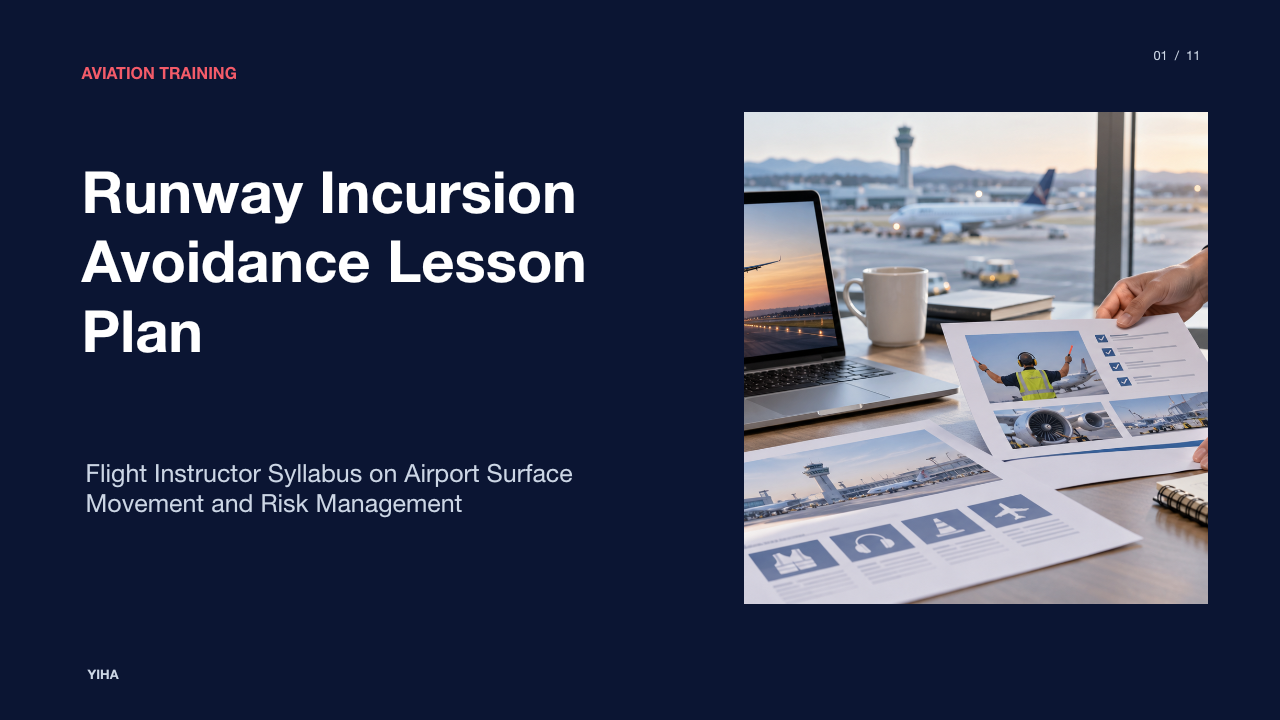
Surface navigation on airport movement areas is one of the most critical phases of flight operations. A routine taxi clearance, landing rollout, or runway crossing can rapidly deteriorate into a catastrophic hazard if communication breaks down, situational awareness lapses, or flight deck distractions intervene. The worst accident in aviation history occurred not in cruise flight, but directly on an active runway during ground movement. To prepare pilots for complex airport environments, flight instructors must integrate runway safety education across all stages of initial and recurrent flight training.
This structured lesson plan provides flight instructors and aviation educators with a comprehensive curriculum for teaching runway incursion avoidance. Grounded in Federal Aviation Administration standards and practical flight deck disciplines, the material covers fundamental risk definitions, surface briefing strategies, communication rigor, visual navigation cues, operational workload controls, and rigorous airman assessment techniques.
Defining Incursions and Surface Risk Fundamentals
A runway incursion is formally defined as any occurrence at an aerodrome involving the incorrect presence of an aircraft, vehicle, or person on the protected area of a surface designated for the landing and takeoff of aircraft. This formal standard differs fundamentally from a surface incident. As detailed in the Runway Incursion Avoidance syllabus, a surface incident occurs within a designated movement area such as a taxiway, but does not infringe upon an active runway surface, whereas an incursion involves the critical protected area of a runway. Movement areas encompass runways, taxiways, and other surfaces controlled by air traffic control, distinct from non-movement areas like ramps and parking aprons where aircraft operate without direct tower control.
Surface movement accidents represent a significant hazard across civil aviation. With increasing air traffic and ongoing aerodrome expansion, complex runway and taxiway configurations make surface operations more demanding and elevate the potential for incursions. Routine surface operations can quickly become critical whenever pilot communication, taxi planning, or visual awareness falters. Historical accidents demonstrate that incursions can lead to catastrophic collisions with severe loss of life and equipment. Consequently, flight training programs must treat surface navigation with the same structured discipline, systematic verification, and situational awareness that pilots apply to en route flight.
Pre-Taxi Route Briefing and Aerodrome Hot Spots
Preparation for ground movement must begin well before releasing the parking brake or advancing the throttle. Flight instructors should train learners to treat taxiing as an active navigational exercise requiring systematic planning. As outlined in the Flight Instructor (Airplane) Runway Incursion Avoidance Lesson Plan - CFI Notebook, learners must review current airport diagrams, trace anticipated taxi routes, verify notices to air missions, and identify critical intersections prior to taxiing.
A central focus of pre-taxi planning is the aerodrome hot spot. Hot spots are designated locations in airport movement areas with an established history of or heightened risk for collisions or runway incursions. They are typically located at confusing taxiway and runway intersections, complex geometries, or short taxiway connectors. On published airport diagrams, hot spots are depicted as open circles or ellipses for movement hot spots and rectangles for wrong-surface alignment risks, designated by the letters HS followed by an identifying number. Instructors must require students to brief each hot spot on the expected path, confirm how the route bypasses or navigates those locations, and identify all anticipated runway crossings before the aircraft moves.
ATC Communications, Clearances, and Readback Protocol
Effective communications between pilots and air traffic controllers represent the strongest defense against unauthorized runway entries. Misunderstandings, call sign confusion, and incomplete transmissions contribute directly to pilot deviations. The guidance in Task II.B: Runway Incursion Avoidance | Mark Berry - CFI Notebook emphasizes that pilots must write down complex taxi instructions, read back critical clearances completely, and maintain strict vigilance when other aircraft with similar call signs are operating on the frequency.
Federal operating standards require explicit clearances for runway operations. Air traffic control must issue specific instructions to cross or hold short of every runway, even when the runway is closed or inactive. Clearances to cross multiple runways are typically issued one at a time, requiring the aircraft to safely clear the first runway safety area before a subsequent crossing clearance is provided. Mandatory readbacks must include the full call sign, explicit runway designator, and the hold-short directive. When copying instructions, pilots should utilize standardized shorthand notation to prevent ambiguity. If any part of a taxi route, holding instruction, or crossing authorization is uncertain, pilots must stop the aircraft immediately and request clarification or request progressive taxi instructions.
Airport Visual Aids: Markings, Signage, and Lighting
Visual surface cues provide primary real-time verification of an aircraft position on the movement area. Flight training must establish immediate recognition of painted pavement markings, illuminated signage, and specialized lighting systems. Pavement markings dictate movement boundaries, most critically the runway holding position marking. As documented in the Runway Incursion Avoidance guide, this marking consists of four yellow lines across the taxiway width: two solid lines and two dashed lines. The solid lines are always situated on the side where the aircraft must stop, signifying that no portion of the aircraft may cross without explicit air traffic clearance.
In addition to hold markings, learners must master airport signage categories. Mandatory instruction signs feature white inscriptions on a red background and denote entrances to active runways, runway approach holding areas, or prohibited surfaces. Location signs feature yellow text on a black background to identify the taxiway or runway currently occupied, while direction signs show black text on a yellow background with arrows indicating upcoming turnoffs. Holding position markings for Instrument Landing System critical areas consist of horizontal parallel lines joined by vertical line pairs, preventing aircraft from interfering with navigational guidance during poor weather. Pavement hold short markings and runway guard lights must be confirmed visually before advancing past any intersection.
Cockpit Workload Management and Sterile Surface Rules
Workload inside the flight deck must be carefully managed so that pilot attention remains focused externally throughout taxi operations. High cockpit workload during taxiing is a leading contributor to lost situational awareness and inadvertent runway incursions. Training standards in the Flight Instructor (Airplane) Runway Incursion Avoidance Lesson Plan - CFI Notebook require pilots to stop the aircraft completely before performing heads-down activities such as reviewing checklists, programming avionics, consulting charts, or troubleshooting unexpected anomalies.
A sterile flight deck environment must be enforced from engine startup until the completion of taxi operations. Non-essential conversations, passenger interruptions, and mobile electronic device usage must be eliminated during surface movement. Pilots should complete essential pre-taxi checklists, set navigation and communication frequencies, and program flight management systems while parked with the parking brake set. When moving, the crew maintains an active scan outside the cockpit windows, verifies taxiway centerline tracking, and continuously correlates visual exterior cues with the airport diagram. If any flight deck duty diverts attention from aircraft steering and clearance compliance, the aircraft must come to a complete halt.
Exterior Lighting Protocols for Aircraft Conspicuity
Aircraft exterior lighting provides vital visual alerting to other pilots, ground vehicle drivers, and tower controllers. Standard operational procedures dictate specific lighting sequences to broadcast aircraft movement status across the airfield. Operating advice detailed in Task II.B: Runway Incursion Avoidance | Mark Berry - CFI Notebook explains how exterior lights establish conspicuity during various surface operational phases.
Prior to engine start, rotating beacons or anti-collision lights are activated to warn ground personnel that the aircraft is energizing. During surface taxi across movement areas, navigation and position lights remain illuminated, and taxi lights are energized once the aircraft begins moving. When crossing an active runway, all exterior illumination including landing lights and strobe lights should be turned on to ensure maximum visibility to approaching and departing traffic. Upon receiving a clearance to enter the runway for takeoff or when instructed to Line Up and Wait, pilots illuminate all exterior lighting except landing lights. Once the takeoff clearance is received and the departure roll commences, landing lights are fully activated. By adhering to this consistent protocol, pilots alert all surrounding operators to their operational state.
Surface Operations at Nontowered Aerodromes
Operating at airports without an operating control tower requires heightened vigilance, autonomous decision-making, and disciplined radio communication. At non-towered facilities, there is no air traffic controller sequencing ground movements, granting runway crossing clearances, or separating taxiing aircraft from arriving flights. As outlined in the Runway Incursion Avoidance instructional curriculum, pilots must rely on the Common Traffic Advisory Frequency, rigorous visual scanning, and wind indicators to construct a complete mental picture of surrounding airfield traffic.
Pilots must announce their intentions clearly on the correct advisory frequency prior to taxiing, specifying aircraft identity, location, and planned movement path. However, flight instructors must caution learners that radio transmissions alone do not guarantee traffic separation because non-radio-equipped aircraft may be operating legitimately at the field. Before taxiing onto or crossing any runway, pilots must visually scan the entire runway surface and clear both the final approach path and departure corridor for unannounced or conflicting traffic. When calm wind conditions exist, traffic may utilize more than one runway simultaneously, compounding convergence risks. Pilots must yield whenever doubt arises and never enter a runway based solely on assumptions about other aircraft positions.
Managing Human Factors, Expectation Bias, and Night Ops
Human cognitive limitations represent a prominent vulnerability in surface safety. Expectation bias occurs when a pilot anticipates receiving a specific clearance and unconsciously hears what was expected rather than what the controller actually said. This bias frequently emerges when crews anticipate an immediate takeoff clearance but are instead instructed to hold short or Line Up and Wait. Training concepts in Task II.B: Runway Incursion Avoidance | Mark Berry - CFI Notebook address the behavioral risks associated with runway rollout proximity and nighttime ground operations.
Operations conducted at night or in reduced visibility conditions amplify disorientation and misidentification of taxiway intersections. During night operations, pilots must taxi at reduced ground speeds, adjust cockpit interior lighting to protect outside visual adaptation, and verify signage closely. When instructed to Line Up and Wait at night, pilots should align the aircraft slightly to the left or right of the runway centerline so that the airplane silhouette and lighting can be differentiated from runway centerline lighting by approaching aircraft. Furthermore, when exiting a runway following landing rollout, pilots must ensure the entire aircraft, including the tail section, has crossed completely over the hold short line into the taxiway before stopping. If an adjacent parallel runway prevents full clearance, the pilot must halt immediately and notify air traffic control.
Instructional Delivery, Evaluation, and ACS Standards
Flight instructor candidates must demonstrate both practical technical understanding and instructional delivery competence in runway incursion avoidance. Under FAA-S-ACS-25 for the Flight Instructor Airplane rating, instructors are evaluated on Area of Operation II, Task C. As structured in the Flight Instructor (Airplane) Runway Incursion Avoidance Lesson Plan - CFI Notebook, examiners require applicants to teach surface risk principles using realistic aerodrome scenarios, airport diagram analysis, and simulated clearance readback exercises.
To build genuine operational competence, modern educators utilize scenario-based instructional methods that mirror complex operational demands. Instructors present learners with challenging ground movement challenges, such as navigating unfamiliar intersections at high-density hub airports with parallel runways. Structured educational frameworks, such as lesson plan models outlined in Free AI Lesson Plan Generator for Teachers, emphasize that structured starting outlines enable instructors to spend more time on direct teaching and meaningful interaction with learners rather than administrative groundwork. By prompting learners with guided questions during pre-flight briefings, evaluating their stop-and-clarify choices, and assessing sterile flight deck discipline during actual taxi regimes, flight instructors build lasting safety habits that prevent runway incursions throughout an aviator's flying career.
Research sources
- Runway Incursion Avoidance · mycfibook.com
- Task II.B: Runway Incursion Avoidance | Mark Berry - CFI Notebook · cfi.treklog.com
- Flight Instructor (Airplane) Runway Incursion Avoidance Lesson Plan - CFI Notebook · www.cfinotebook.net
- Free AI Lesson Plan Generator for Teachers · www.theschoolhouse.org