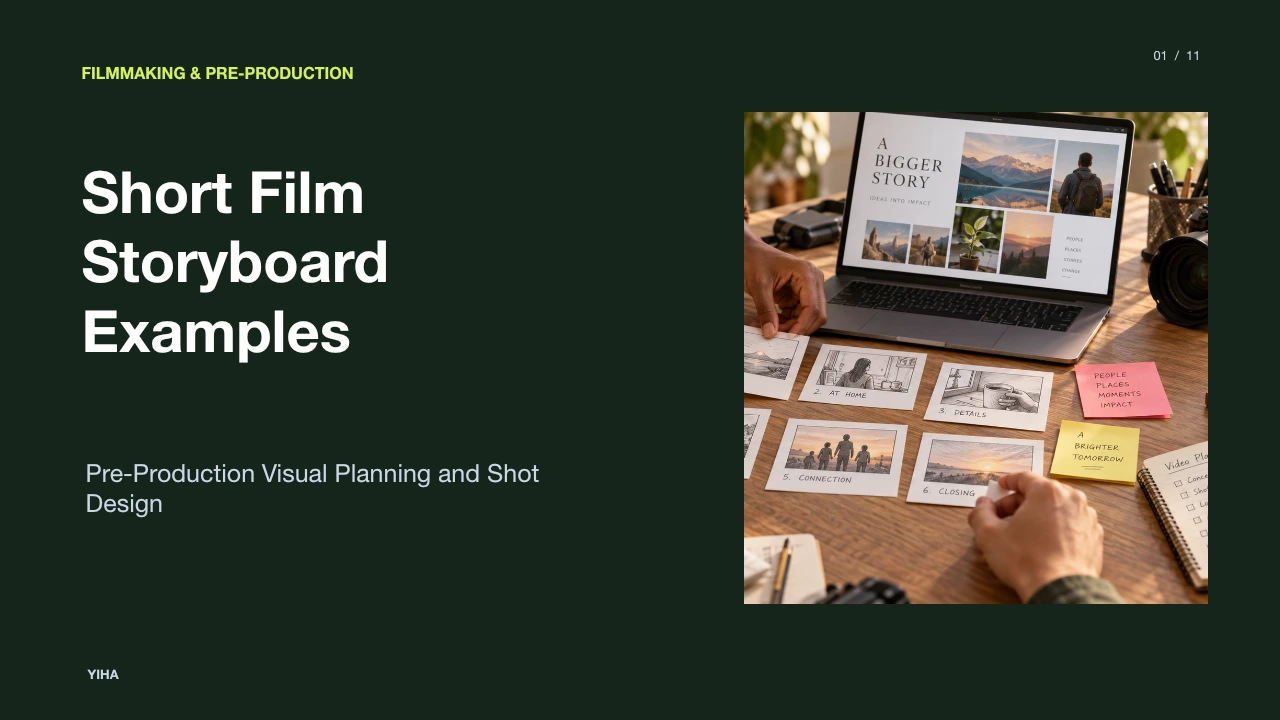
Short Film Storyboard Examples
A technical guide to short film storyboards, covering script beat breakdown, 16:9 staging, motion notation, multi-field metadata, economy shots, and animatics.
Free download · 4.9 MB11 editable slides · PowerPoint format
Download the editable PPTX
PPTX · 4.9 MB · 11 editable slides · Free to edit and reuse with attribution to Yiha.ai
View every slide
Use ← →, Home/End, or swipe on mobile
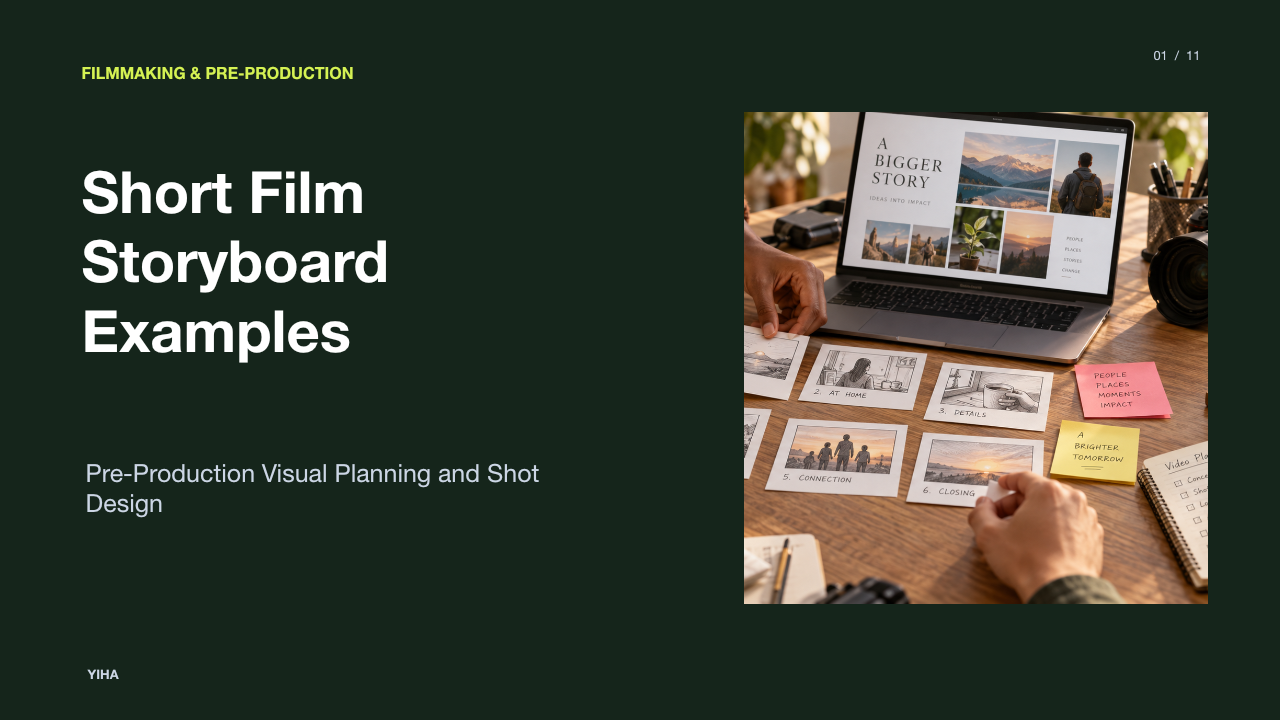
Short films demand rigorous visual planning because every second of screen time must drive the narrative forward. While feature films can absorb pacing lulls and elaborate coverage setups, short narratives operate under strict constraints of running time and budget. Storyboards function as technical blueprints that resolve narrative structure, screen geometry, and camera choreography long before physical production begins.
Visual Blueprints in High-Stakes Short Films
In short film production, narrative runtimes typically span between 5 and 20 minutes, leaving no room for superfluous coverage or unmotivated transitions. As noted in How to Storyboard a Short Film (2026 Guide), every shot must justify its place by advancing the plot, shifting an emotion, or revealing narrative information. Pre-production storyboarding forces creative teams to commit to concrete visual choices when alterations carry zero production cost, rather than discovering structural problems on set when camera crews and lighting gear are accruing hourly expenses.
Directors and cinematographers use storyboards to establish a unified visual identity across the project. Disconnected camera setups disrupt short projects more severely than long-form features because audiences lack the time to acclimate to stylistic shifts. By planning shot groups in advance, teams evaluate entire scene progressions rather than isolated frames. As outlined in A Guide on How to Create a Storyboard for Your Short Film, mapping out camera angles, lighting approaches, and shot lists creates an actionable roadmap that aligns heads of department before lighting equipment is unloaded.
Deconstructing Scripts into Visual Beat Sheets
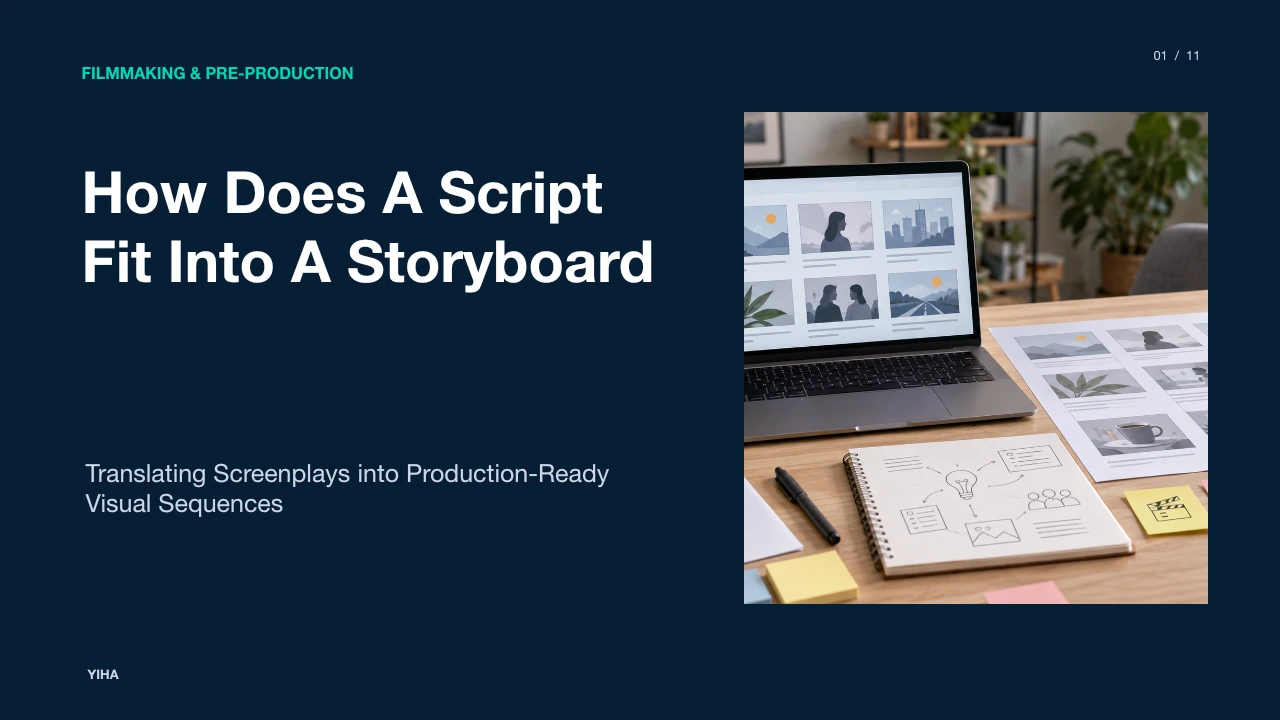
Translating a screenplay into visual panels begins with identifying visual beats. A visual beat marks a moment of physical or narrative transformation on screen, such as a character entering a room, a sudden shift in emotional posture, or a key revelation. According to How to Storyboard a Short Film (2026 Guide), an effective practical method involves printing the script and drawing vertical dividing lines in the margin at every change in visual state to isolate potential panels, combining adjacent lines whenever coverage can be shared.
As explained in How to Make a Storyboard for a Short Film: Step-by-Step Guide, every sequence requires a distinct turn where characters make a choice, gain knowledge, or face consequences. Storyboard artists evaluate pacing by matching panel count to target runtimes. An illustrative recommendation suggests 15 to 25 panels for a 1-to-3 minute short, 30 to 50 panels for a 5-to-7 minute project, and 50 to 80 panels for a 10-to-15 minute narrative. In Storyboard Examples for Film: Pro Tips to Land the Job, annotating beats with exact timecodes allows the creative team to verify the rhythm of the story before drafting detailed panels.
Aspect Ratios and Staging Geometry
Selecting a frame aspect ratio defines the compositional canvas and geometric restrictions of every panel. Standard modern production relies heavily on the 16:9 widescreen format, matching standard digital sensors and modern displays. As highlighted in 16:9 Storyboard Template & Examples for Film and Video, 16:9 boards provide adequate horizontal breadth for blocking multiple subjects, staging movement, and balancing visual elements.
Within these dimensions, filmmakers apply classical framing rules to guide audience perception. In A Guide on How to Create a Storyboard for Your Short Film, applying the rule of thirds, leading lines, and intentional negative space creates spatial depth. Negative space plays a critical narrative role, as detailed in Storyboard Examples for Film: Pro Tips to Land the Job. By deliberately leaving sections of a panel empty, the storyboard preserves visual real estate for impending narrative reveals, tension buildup, or environmental scale.
Thumbnail Passes and Functional Clarity
Effective storyboarding prioritizes communication over elaborate illustration. As argued in Storyboard Examples for Film: Pro Tips to Land the Job, professional storyboards serve as technical instructions rather than gallery artwork. When artists over-render initial sketches, they often lose track of whether the camera progression functions mechanically.
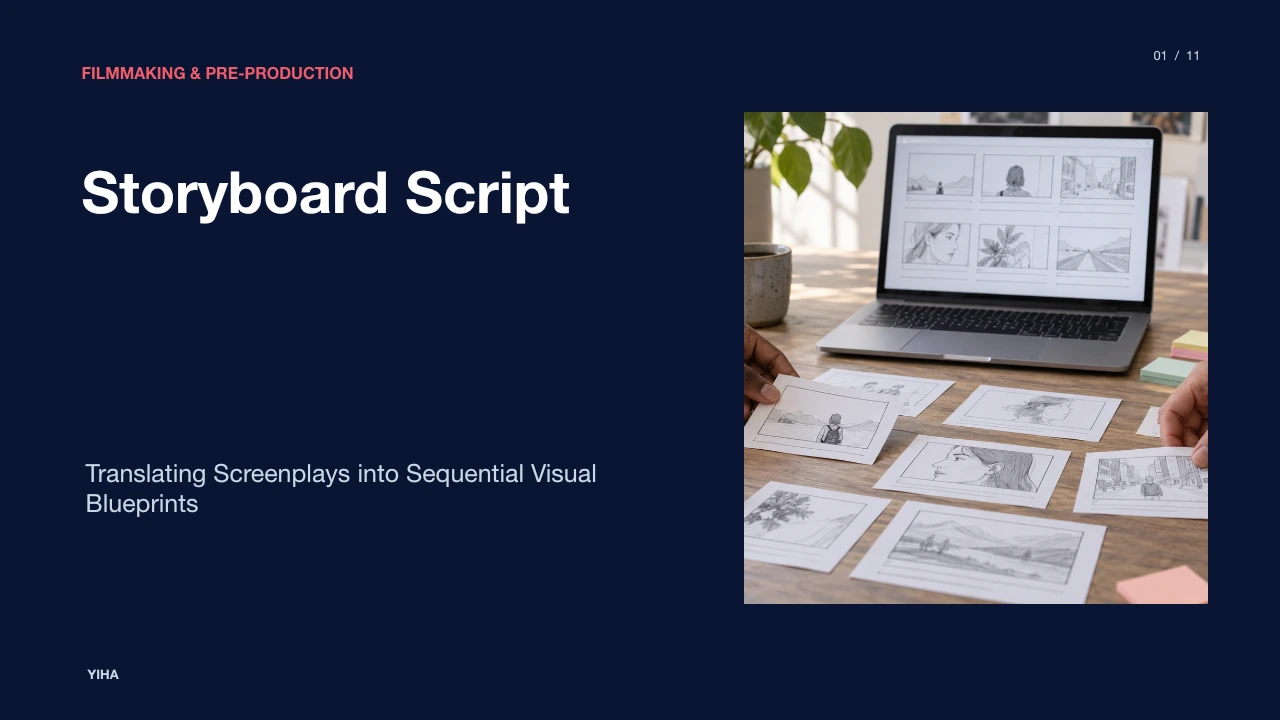
Filmmakers solve coverage challenges during rapid thumbnail passes. According to How to Make a Storyboard for a Short Film: Step-by-Step Guide, thumbnailing relies on simple stick figures, silhouette blocking, and basic geometry to confirm character placement, eyeline direction, and camera perspective. As corroborated in How to Create a Storyboard for a Short Film for Free [2026], minimalist drawings that clearly articulate character positions and actions are completely adequate for crew communication. If an operator can understand camera height, subject placement, and cut points from a rough sketch, the thumbnail pass achieves its objective.
Camera Direction and Motion Vector Notation
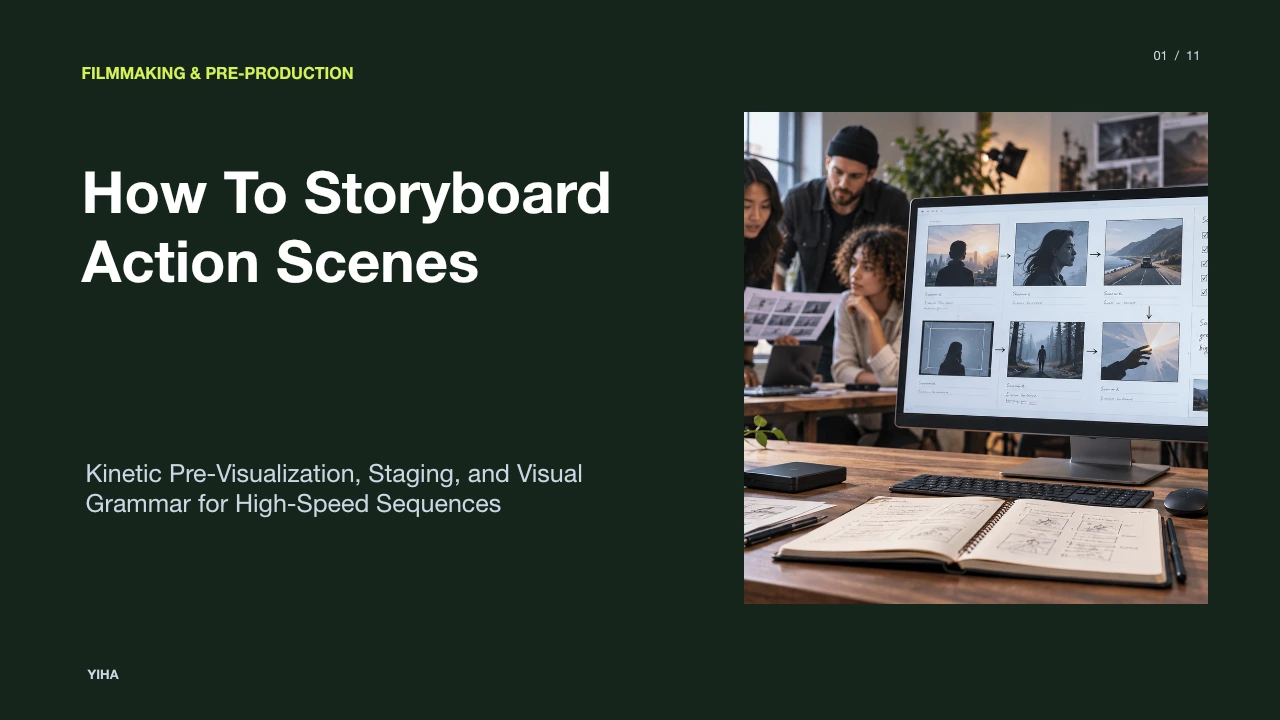
Static storyboard frames must depict continuous dynamic motion. Production teams accomplish this through standardized visual vector notation, specifically differentiated directional arrows. As detailed in Storyboard Examples for Film: Pro Tips to Land the Job, character movement arrows and camera movement arrows must be clearly distinguished to avoid confusing the camera operator on set.
When a shot involves continuous physical movement, such as an extended push-in or tracking shot, artists split the action across multiple linked panels rather than crowding a single frame. As advised in How to Make a Storyboard for a Short Film: Step-by-Step Guide, breaking dynamic camera motion into two or three sequential panels connected by directional arrows preserves spatial clarity. Screen direction must also be rigorously protected across cuts. If an actor exits frame right, standard continuity dictates entering frame left in the subsequent panel unless a deliberate disorientation cut is requested.
Multi-Field Metadata and Technical Callouts
Panels require structured written metadata beneath the visual cells to contextualize staging choices for each department. According to How to Make a Storyboard for a Short Film: Step-by-Step Guide, every template requires a standardized note area containing four primary fields: shot number, shot size (wide, medium, close-up, or insert), camera movement, and a concise action description.
Production templates expand these parameters based on department requirements. In How to Storyboard a Short Film (Step-by-Step Guide), standard fields incorporate Sound, Action, Lighting, Camera, and Notes. Sound fields isolate critical dialogue cues, voiceovers, or foley hits that motivate visual cuts. Furthermore, Storyboard Examples for Film: Pro Tips to Land the Job notes that recording lens intent, camera height, panel duration, and specific transition mechanics (such as match cuts or hard cuts) prevents misinterpretations between directors, cinematographers, and editors.
The Short Film Economy Shot
Feature productions often cover two-person dialogue using six to eight camera setups, including master wides, over-the-shoulder angles, single mediums, close-ups, and cutaways. Short films rarely have the schedule or lighting package to support that volume of setups. As defined in How to Storyboard a Short Film (2026 Guide), the short film economy shot consolidates multiple storytelling functions into a single deliberate setup.
A carefully blocked two-shot can simultaneously establish physical geography and cover continuous dialogue. Similarly, a wide-angle over-the-shoulder shot can convey emotional distance while showing essential background props. In Storyboard Examples for Film: Pro Tips to Land the Job, a focused sequence utilizes eight to twelve well-conceived panels containing an establishing wide, single coverage on pivotal dialogue, an insert, and an answer reaction shot at the narrative inflection point. Limiting unnecessary setups preserves set time for strong performances and precise lighting.
From Static Panels to Timed Animatics
Static storyboard drawings cannot fully convey temporal rhythm or pacing problems. To test scene timing prior to filming, filmmakers assemble their panels into an animatic. As explained in How to Make a Storyboard for a Short Film: Step-by-Step Guide, creating an animatic involves placing numbered storyboard panels onto a timeline in editing software, assigning each panel an estimated duration, and layering scratch audio or placeholder dialogue.
Viewing boards in sequence exposes structural weaknesses that look acceptable on paper. In Storyboard Examples for Film: Pro Tips to Land the Job, sequences built to fixed runtimes, such as a thirty-second montage, compel filmmakers to eliminate dead space and redundant frames. Testing duration against scratch dialogue confirms whether dialogue scenes drag or whether rapid action cuts compromise readability. Correcting pacing flaws during animatic review protects production resources by ensuring only functional setups are photographed.
Version Control and Crew Distribution
As scenes evolve during rehearsals, location scouting, and budget reviews, storyboards require systematic version management. As outlined in How to Make a Storyboard for a Short Film: Step-by-Step Guide, any change to a sequence requires updating three interconnected elements: the panel sketch, the shot list entry, and the document version tag, alongside an explicit revision log.
Distributing storyboard assets efficiently keeps all departments aligned on set. According to How to Create a Storyboard for a Short Film for Free [2026], maintaining clean PDF exports with three to six frames per page prevents visual clutter while distributing daily packets to camera, lighting, and art departments. In 28 Storyboard Examples: Film, Animation & Video (2026), clear sequential boards guide crews through complex blocking and stunt movements with minimal miscommunication, ensuring the director, director of photography, and editor share identical expectations.
Research sources
- How to Storyboard a Short Film (2026 Guide) | Story2Board · story2board.com
- A Guide on How to Create a Storyboard for Your Short Film - Garden of Edits · www.gardenofedits.com
- Storyboard Examples for Film: Pro Tips to Land the Job · storyboardart.org
- How to Make a Storyboard for a Short Film: Step-by-Step Guide · storyboardart.org
- 16:9 Storyboard Template & Examples for Film and Video · www.storyboardthat.com
- How to Create a Storyboard for a Short Film for Free [2026] · www.studiobinder.com
- How to Storyboard a Short Film (Step-by-Step Guide) | Boords · boords.com
- 28 Storyboard Examples: Film, Animation & Video (2026) | Boords · boords.com