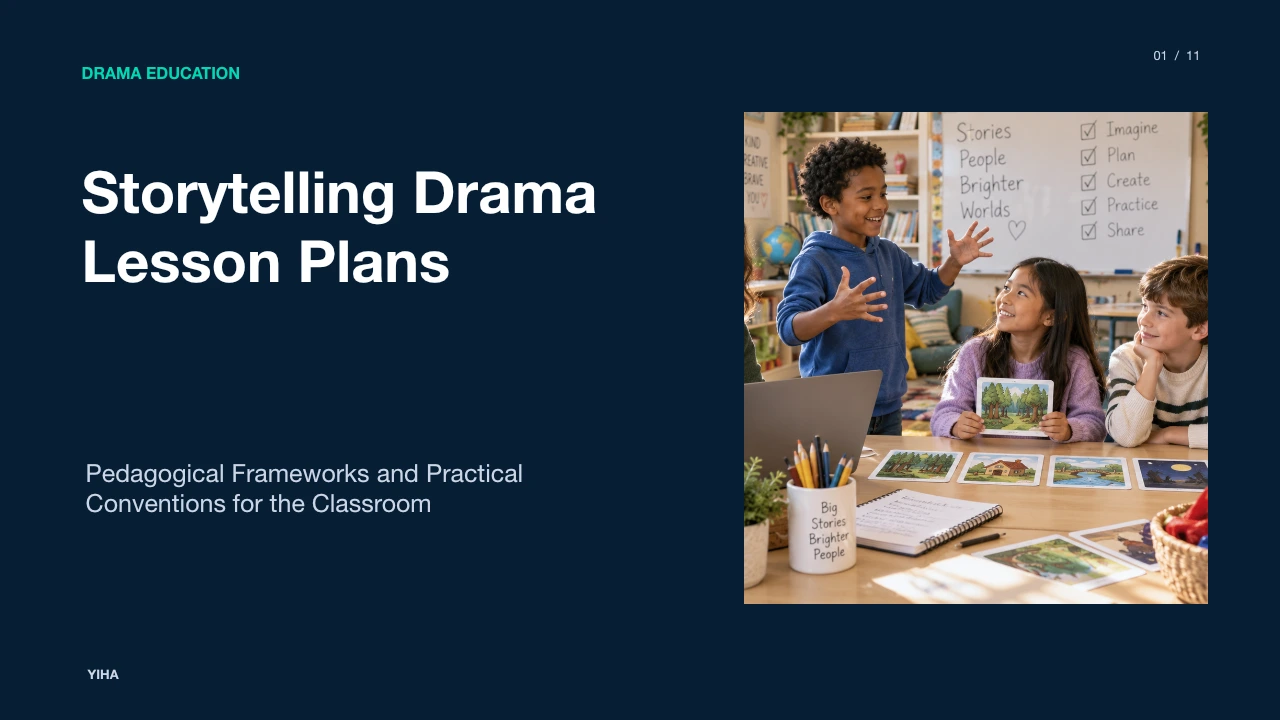
Storytelling Drama Lesson Plans
A comprehensive pedagogical guide to planning storytelling drama lessons. Discover actionable classroom strategies ranging from physical freeze frames and auditory soundscapes to teacher-in-role dilemmas, group devising, and formative assessment.
Free download · 4.9 MB11 editable slides · PowerPoint format
Download the editable PPTX
PPTX · 4.9 MB · 11 editable slides · Free to edit and reuse with attribution to Yiha.ai
View every slide
Use ← →, Home/End, or swipe on mobile
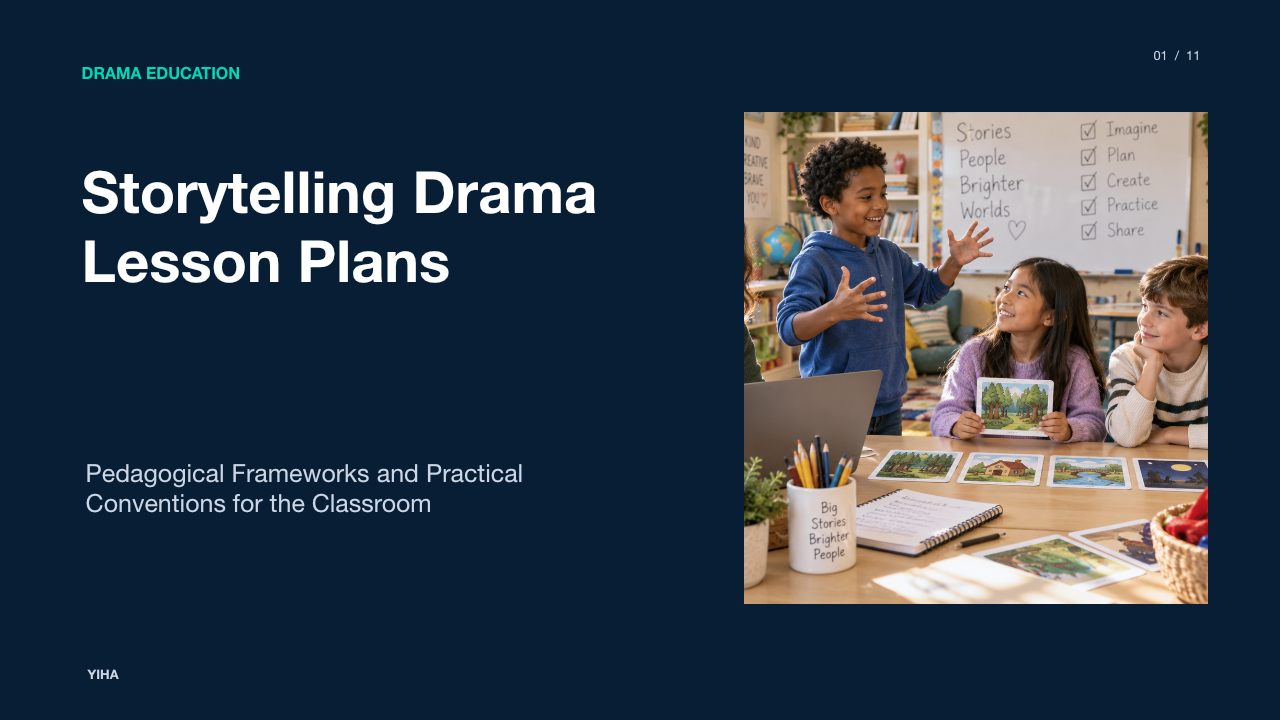
Integrating narrative storytelling into drama education bridges oral language, embodied expression, and collaborative inquiry. Drama lesson planning requires more than having students memorize scripts or act out predetermined lines; it relies on structured conventions that invite students to step into fictional worlds, examine dilemmas, and physicalize story beats. When structured intentionally, storytelling drama lessons support language acquisition, physical literacy, perspective-taking, and ensemble problem-solving across early years, primary grades, and secondary classrooms.
Effective storytelling drama units balance clear pedagogical frameworks with spontaneous creative choices. By anchoring lesson plans around established process drama strategies, such as physical tableaux, auditory soundscapes, thought tracking, and student-led scene building, educators can help students deconstruct complex narrative arcs while developing strong ensemble habits. The following sections outline the essential phases of planning, facilitating, and assessing narrative drama units.
Pedagogical Principles of Narrative Drama
Narrative drama operates at the intersection of literary comprehension and theatrical creation. When planning narrative-centered units, educators align drama techniques with core literacy objectives, including understanding narrative structure, analyzing character motives, and identifying cultural contexts. As detailed by The Drama Teacher, exploring storytelling traditions allows students to recognize diverse plot structures, examine how specific cultural backgrounds influence narrative development, and observe unique performance conventions such as the role of griots in African oral traditions.
From early childhood through upper grades, effective lesson sequences introduce stories not as static texts to recite, but as dynamic landscapes to explore. As noted in early childhood planning guidance from The Schoolhouse, structured lesson plans provide a necessary roadmap that ensures developmental appropriateness, matching physical, cognitive, and language capabilities without overwhelming learners. In upper primary and secondary classrooms, this principle extends to civic and historical narratives: resources from ReadWriteThink illustrate that storytelling enables students to explore real human experiences and practice adjusting spoken and visual language for distinct audiences.
Narrative drama does have pedagogical limitations. When teachers omit clear conventions, narrative lessons can quickly devolve into chaotic play without clear learning outcomes. Conversely, over-scripting the session stifles individual exploration. Striking an intentional balance requires clear boundaries and predictable routines.
Establishing Ensemble and Warm-Up Routines
Every effective drama lesson begins with focused physical and vocal preparation that transitions students out of passive desk work and into an active ensemble mindset. According to Drama Lesson Plans, starter games and warm-ups prepare learners physically, vocally, and mentally, establishing sustained focus, group trust, and clear routines without excessive performance pressure.
A central building-block strategy is Ten Second Objects, highlighted by David Farmer on Drama Resource. In this exercise, small groups of four to six students have exactly ten seconds to join their bodies together to form a designated object, such as a volcano, a washing machine, or a car, while utilizing varying physical levels including high, medium, and low shapes. Because the countdown is brief, participants must make immediate creative decisions, negotiate physical contact safely, and set aside performance anxieties.
These initial routines establish ensemble awareness. An illustrative example of this progression is asking groups to build a simple machine, adding a rhythmic mechanical sound, and then freezing on a cue. Warm-ups fail when they lack clear safety guidelines or when instructions are overly elaborate; keeping starter games short and low-stakes ensures all learners feel secure enough to participate.
Selecting and Adapting Source Narratives
Selecting appropriate source texts is a foundational choice in narrative lesson design. Stories must offer identifiable stakes, clear emotional arcs, and open-ended problems that invite dramatic intervention rather than mere mimicry. As Justin Cash explains in his curriculum guide on The Drama Teacher, units built around global narratives expose learners to diverse cultural tale traditions, enabling students to craft culturally inspired outlines while developing empathy and critical analysis.
Curriculum models discussed by ReelMind suggest that drama teachers select from folk tales, myths, picture books, short scripts, or improvised situations depending on their curricular goals. Early years classrooms benefit from stories with clear repetitive refrains, sensory contrasts, and physical actions, supporting foundational language and motor development as highlighted by The Schoolhouse. In contrast, middle and secondary grades thrive on moral dilemmas found in myths, historical accounts, or contemporary social conflicts.
When adapting global or traditional folklore, teachers must guide students toward cultural respect rather than caricature. Teachers should lead explicit discussions on cultural context before adaptation begins, preventing stereotypical vocalizations or gestures and focusing instead on human dilemmas and narrative motifs.
Physicalizing Plot with Freeze Frames and Living Pictures
Once a story is introduced, translating its plot into frozen physical images prevents students from getting bogged down in line memorization or uncoordinated movement. As documented on Drama Resource, freeze frames, also known as still images or tableaux, allow individuals or groups to press pause on a scene and communicate characters, objects, or abstract emotions without dialogue. Because freeze frames remove the pressure of speaking, they serve as an accessible entry point for less confident performers.
Planning strategies from David Farmer on Drama Resource demonstrate how freeze frames can structure plot comprehension: groups create three distinct tableaux representing the beginning, middle, and end of a narrative. Teachers can also introduce predictive freeze frames, freezing a scene right before a pivotal turn and asking what happens next. Complementary strategies like 3D Living Pictures allow students to step into a book illustration or historical artwork, adding physical depth, while Action Clip brings a freeze frame to life for a few seconds of improvised movement following a teacher clap.
The pedagogical limitation of tableaux is the risk of passive staging. If students merely stand in a straight line, dramatic tension disappears. Instructors must explicitly coach ensembles to use contrasting vertical levels, expressive facial choices, and deliberate body angles to communicate subtext visually.
Layering Soundscapes and Choral Movement
Physical images become substantially more immersive when paired with layered auditory environments and collective movement. In David Farmer's planning framework on Drama Resource, the Soundscape strategy adds an auditory layer to a picture or scene to build atmosphere and narrative tension. Students use their voices, body percussion, or found classroom items to build a live acoustic backdrop, such as a bustling village marketplace, a stormy ocean, or an eerie forest.
To move entire classes through a narrative simultaneously, educators frequently implement the Storytelling Whoosh technique, detailed in Farmer's unit resources on Drama Resource. In a Whoosh, the class sits in a circle while the teacher narrates a tale. As new characters, animals, or elements appear, the teacher taps students to step into the center circle and physicalize the action. When the space becomes crowded or an episode concludes, the teacher calls 'Whoosh!', prompting everyone to reset quickly to the perimeter. This choral method ensures full-class engagement, rapid pacing, and low performance anxiety.
Complementing these methods, high school curriculum maps from Theatrefolk highlight choral movement and choral odes as tools for building synchronized ensemble discipline. Auditory layering can occasionally become unfocused if volume levels are not regulated; facilitators should establish non-verbal conductor signals, such as raising or lowering an open hand, to modulate group volume.
Deepening Character Through Language Conventions
After students establish spatial and physical baselines, teachers introduce targeted language conventions to reveal character motivations. As outlined on Drama Resource, strategies such as Thought Tracking, Hot Seating, and Teacher in Role encourage students to articulate subtext directly.
In Thought Tracking, the teacher taps a student frozen in a tableau on the shoulder, prompting them to speak their internal monologue aloud in one or two sentences. Hot Seating places a character in front of the ensemble to be interviewed about their background and motivations. Variations like the Magic Microphone even extend this questioning to inanimate objects, such as interviewing a pivotal prop or weapon from a scene. To introduce higher dramatic stakes, Teacher in Role allows the educator to step into the dramatic fiction, adopting a specific persona to challenge students' assumptions, provoke debate, or present obstacles, as described in process drama models on Drama-Based Pedagogy and Drama Resource.
Teacher-in-role facilitation requires clear boundaries. Teachers should use an overt physical signifier, such as putting on a hat, draping a scarf, or taking a specific seat, to clearly signal the transition into and out of role. Without clear signifiers, younger learners may confuse teacher instruction with in-character provocations.
Analyzing Dilemmas with Conscience Alley and Role on the Wall
Narratives derive dramatic power from ethical turning points and internal conflicts. To explore these moments thoroughly, drama lesson plans incorporate Conscience Alley and Role on the Wall. As detailed on Drama Resource, Conscience Alley, also known as Decision Alley or Thought Tunnel, provides a physical structure for analyzing dilemmas: students arrange themselves into two parallel lines facing inward, while a student representing the central character walks slowly down the corridor. As the character passes, students on either side whisper contrasting advice, urging opposing courses of action before the protagonist reaches the end and announces a choice.
Alongside Conscience Alley, Role on the Wall offers a visual, reflective framework for character analysis, as noted on Drama Resource. Teachers draw a large outline of a human body on chart paper or a whiteboard. Students write the character's internal feelings and self-perceptions inside the silhouette, while writing external opinions, rumors, and societal pressures on the outside. Cross-curricular lesson plans from ReadWriteThink demonstrate that exploring character traits and personal values helps students draw clear connections between literary dilemmas and civic responsibility.
A common limitation in dilemma analysis is a rush toward simple moralizing. If students offer identical, simplistic advice, the tension collapses. Facilitators should deliberately assign specific perspectives or social roles to each side of the alley to ensure rigorous debate.
Scaffolding Group Devised Scenes and Playwriting
Moving from teacher-led exercises to independent group devising gives students ownership over their storytelling. According to professional devising frameworks published on Drama-Teachers.com, devising means creating original work from a prompt, theme, or stimulus rather than memorizing a preexisting script. Devising builds student-centered collaboration and problem-solving, utilizing non-naturalistic conventions such as split scenes, stylised voice, and symbolic movement to construct theatrical narratives.
To prevent small groups from stalling during unstructured rehearsal time, educators must scaffold the creation process into distinct milestones. Curriculum resources from Drama Notebook recommend using short story starters, character illustrations, or reader's theatre prompts to guide the transition from spoken story to written scene. Similarly, workflow mapping from ReelMind illustrates how structured storyboards and defined sequence markers keep student groups focused on narrative beats, character obstacles, and transitions.
Devising can cause frustration if group roles are ambiguous. Teachers should assign clear responsibilities within each ensemble, such as timekeeper, dialogue scribe, and stage manager, ensuring all group members contribute equitably regardless of whether they have a speaking role on stage.
Formative Assessment, Reflection, and Debriefing
No storytelling drama lesson is complete without structured reflection and assessment. Formative assessment in drama focuses on observing process skills, including physical expression, vocal modulation, ensemble collaboration, and narrative analysis. Curriculum units on The Drama Teacher emphasize concluding performances with structured peer feedback centered on character portrayal and cultural representation, followed by whole-class reflective discussions on plot structures.
To make feedback transparent, educators and students can collaborate to establish explicit evaluation criteria. Planning frameworks from ReadWriteThink demonstrate the value of building a shared rating scale that students apply to self-assessment and peer critiques. Similarly, ReelMind notes that lesson plans should provide defined review prompts and closing action steps, enabling teachers to record formative notes on vocal clarity, stage awareness, and ensemble listening.
Debriefing must avoid vague praise like 'everyone did great.' Facilitators should pose targeted, objective questions: 'Which physical levels communicated the shift in power?' or 'What specific sound choices heightened the tension in scene two?' This grounded reflection connects practical drama conventions directly to analytical learning goals.
Research sources
- Delightful 10-Lesson Cultural Storytelling Unit For Grade 5/6 Drama | The Drama Teacher · thedramateacher.com
- Storytelling in the Social Studies Classroom | Read Write Think · www.readwritethink.org
- Preschool Education Lesson Plans: A Guide to Effective Preschool Activities · www.theschoolhouse.org
- Drama Warm-Up & Starter Activities | Drama Lesson Plans · www.drama-lesson-plans.co.uk
- Ten Second Objects - Drama Resource · dramaresource.com
- Planning A Storytelling Drama Lesson - Drama Resource · dramaresource.com
- Storytelling Drama Lesson Plans PPT Template | ReelMind · reelmind.ai
- Freeze Frames - Drama Resource · dramaresource.com
- Drama Lesson Plans - Drama Resource · dramaresource.com
- Drama One: Drama Curriculum and Lesson Plans | DTA · www.theatrefolk.com
- Role Play | Drama-Based Pedagogy · dbp.theatredance.utexas.edu
- Teacher in Role - Drama Resource · dramaresource.com
- Conscience Alley - Drama Resource · dramaresource.com
- An Introduction To Devising Drama Effectively - Drama Teachers · drama-teachers.com
- Playwriting and Storytelling Lesson Plans for Kids and Teens-PDF Downloads · www.dramanotebook.com