Storytelling Pitch Deck
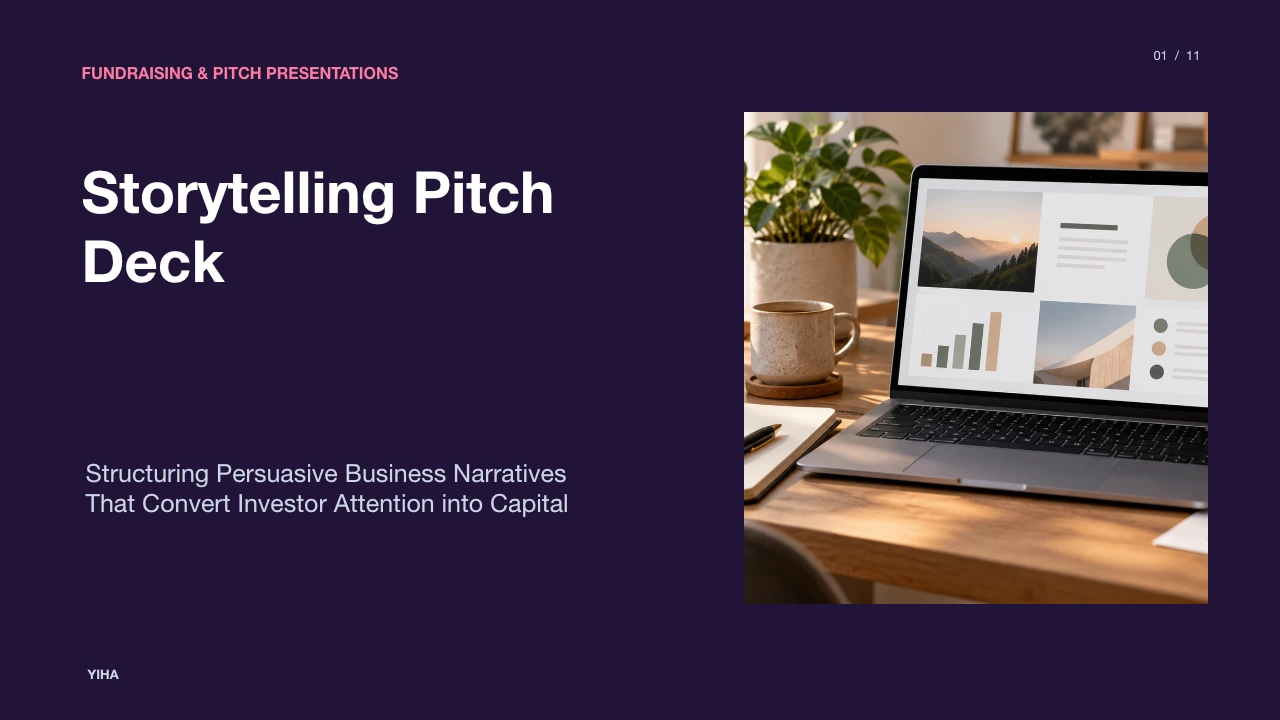
A deep dive into crafting a storytelling pitch deck that balances narrative structure with business traction, financial metrics, and investor engagement realities.
Free download · 4.9 MB11 editable slides · PowerPoint format
Download the editable PPTX
PPTX · 4.9 MB · 11 editable slides · Free to edit and reuse with attribution to Yiha.ai
View every slide
Use ← →, Home/End, or swipe on mobile
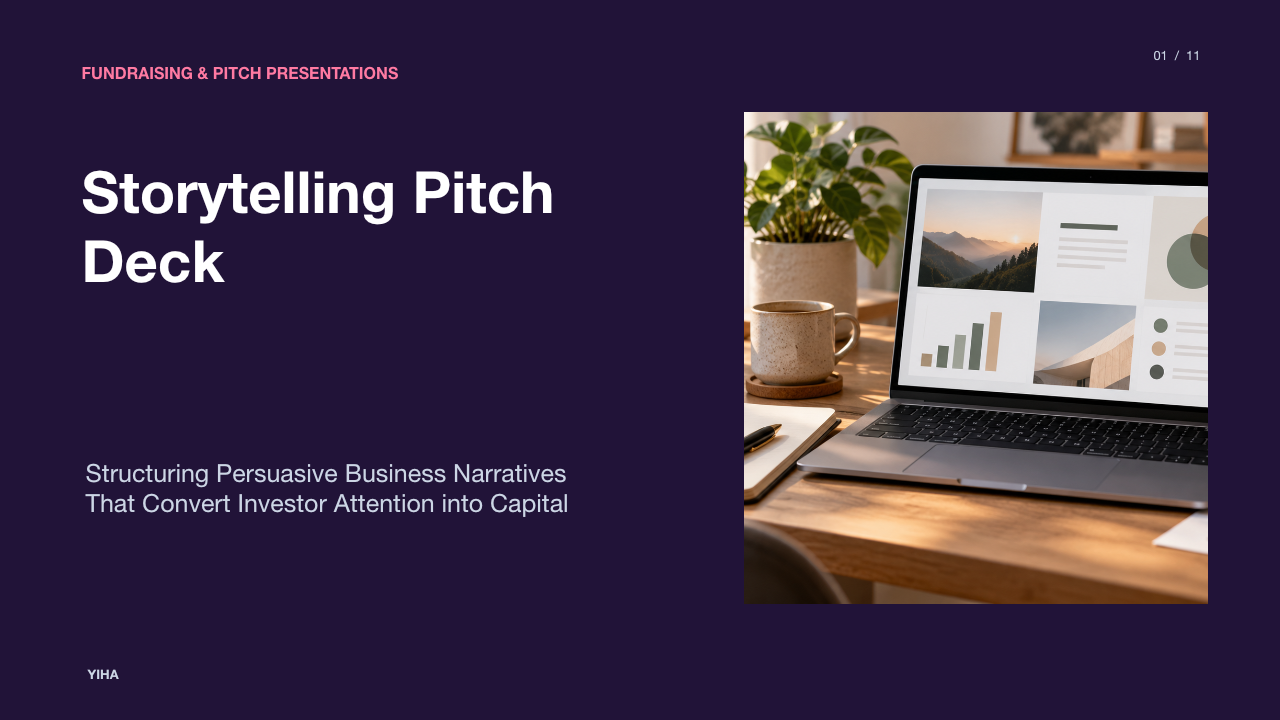
A pitch deck is rarely evaluated in an isolated vacuum of spreadsheets. Instead, it enters an intense review workflow where investors process hundreds of company briefs each month. Founders often assume that presenting raw metrics and technical specifications will naturally persuade an audience. However, standalone data points often lack cohesion when presented without context. A storytelling pitch deck arranges factual insights, customer pain points, and commercial validation into a structured logical sequence. By learning how narrative techniques intersect with investor decision habits, founders can structure clearer, more memorable presentations that respect an investor's limited time while highlighting commercial validation.
The Investor Attention Window and Document Engagement Realities
Securing investor capital begins with recognizing the severe constraints on an investor's working day. Secondary industry analyses frequently point out the brief window in which early screening occurs. For example, commentary published by Allied Venture Partners reports that investors spend an average of just 2 minutes and 12 seconds reviewing a pitch deck, requiring founders to deliver core context within the opening 40 seconds. Separately, Bullpen references DocSend tracking figures showing an average read time of 3 minutes and 44 seconds. While exact tracking benchmarks vary across cohorts and platforms, both observations point to the same structural reality: an investor skims before deciding whether to read thoroughly.
Founders must adapt their narrative pacing to this reading behavior. When presentations front-load dense technical background before establishing what the business actually does, readers drop off early. A concise overview of your commercial model, your core thesis, and your stage should appear immediately on your introductory slides. As highlighted by Harvard Business School Online, short pitches often operate within three to ten minutes, serving primarily to spark enough interest to earn a deeper meeting rather than resolving every diligence item immediately. A storytelling approach is therefore not about creative elaboration; it is an organizational method to ensure the most vital commercial facts are absorbed during initial screening.
Cognitive Mechanisms of Narrative Versus Data-Heavy Decks
Presenting data alone often fails to produce clear understanding because metrics require situational meaning to evaluate properly. While a revenue figure or a user retention metric confirms past performance, it does not explain why those results occurred or whether they will continue. Narrative structure organizes metrics into an interpretable cause-and-effect relationship, moving the presentation from static facts to a coherent investment hypothesis.
As analyzed by Qubit Capital, a structured narrative addresses both the analytical proof and the contextual understanding an investor needs. When data points are presented in isolation, the reviewer must assemble their own explanation of the startup's operational context. If that investor lacks industry background, they may misinterpret customer turnover or misjudge acquisition costs. By contrast, a narrative provides the connective tissue: it frames who the customer is, details the specific bottleneck they confront, and demonstrates how product adoption drives specific unit economics. As noted in Qubit Capital's guide to pitch deck narrative arcs, a structured arc guides readers from the initial challenge through key milestones to a logical conclusion, turning dry statistics into an understandable business progression.
Structural Narrative Models from Hero's Journey to Bridge
Founders frequently draw upon established communication frameworks to shape their pitch decks. Rather than inventing novel structures, successful presentations adapt tested rhetorical forms to commercial evaluation. As summarized by Bullpen, three frameworks frequently applied in venture materials include the Hero's Journey, Before-After-Bridge, and Problem-Agitate-Solve.
The Hero's Journey, when translated to venture presentations, casts the target customer as the protagonist, the market friction as the obstacle, and the startup's product as the mentor or enabling tool that empowers the customer to achieve results. Before-After-Bridge focuses on immediate contrast: it documents the painful baseline state (Before), paints the productive future state (After), and positions the company's platform as the essential link (Bridge). Problem-Agitate-Solve expands upon the pain point by demonstrating the ongoing financial or operational friction of inaction before offering the company's solution. Commentators note that companies such as Airbnb combined aspects of these frameworks, establishing the traveler's struggle, agitating the cost of hotels, and bridging into local accommodations. Blending these models allows founders to present concise, high-impact slides without losing logical discipline.
Framing Market Shifts and Defining an Irrefutable Problem
Every convincing pitch narrative rests upon a precisely framed problem. If the underlying problem is trivial or easily resolved by existing alternatives, the rest of the presentation loses relevance. Commentary by Qubit Capital emphasizes that pitches falter when their core problem definition is vague, unvalidated, or lacks clear commercial urgency. When investors evaluate an introductory problem slide, they look for clarity regarding who experiences the problem and what that friction costs.
To build credibility, problem slides should combine identifiable market shifts with grounded operational realities. As outlined by Ellty, effective problem slides define a specific pain point, illustrate its scale through evidence, and connect that pain to wider industry shifts such as regulatory changes, cost spikes, or technological obsolescence. An illustrative example would be a logistics company describing regulatory decarbonization mandates: the regulation is the external shift, while the inability of existing software to track fleet carbon output is the direct operational bottleneck. Maintaining a clean division between the problem and the solution slide is vital; conflating the two prevents the investor from appreciating the true severity of the customer's challenge.
Positioning the Solution as an Enabler Rather than the Hero
One of the most frequent missteps in pitch deck storytelling is turning the startup's technology into the self-congratulatory center of the universe. In an effective venture presentation, the customer remains the primary actor, while the startup's product serves as the catalytic enabler. As noted in Allied Venture Partners' analysis, the story should highlight the customer's journey, showing how the product removes operational obstacles and delivers clear impact.
When a deck presents a product as a solitary breakthrough detached from real workflow integration, investors question whether customers will actually adopt it. Solutions must be described through their tangible functional benefits and demonstrable efficiencies. Framing the solution as an enabler also clarifies the value proposition. Instead of listing extensive technical feature inventories, founders should demonstrate how specific features reduce costs, compress turnaround times, or unlock new revenue streams for users. As observed in Bullpen's discussion, viewing the startup as a guide or mentor rather than the solitary hero creates a logical contract: the capital funds the product platform, enabling thousands of business customers to overcome systemic friction.
Validating the Arc Through Grounded Traction and Proof Points
Narrative without empirical validation is simply conjecture. A storytelling pitch deck must anchor its narrative arc in verifiable operational milestones. As stated by Startup Fundraising, investors evaluate progress rather than ungrounded claims. The traction slide functions as the central proof point in the narrative, demonstrating that customer demand exists and that the startup has developed a functional acquisition model.
Selecting the right metric depends heavily on company stage and sector. Founders should identify one primary hero metric, such as monthly recurring revenue growth for enterprise software or active user engagement cohorts for platforms, and display that data transparently across recent operational months. Presenting performance data on a monthly or quarterly basis rather than using cumulative aggregate curves provides a realistic picture of underlying momentum. Furthermore, as suggested by Allied Venture Partners, pairing quantitative metrics with brief customer case examples reinforces the narrative, demonstrating that top-line performance is driven by genuine user satisfaction and healthy retention.
Bridging Story with Unit Economics and Scalability
As a presentation transitions from initial product-market validation toward expansion plans, the narrative must incorporate commercial unit economics. Early slides establish why customers need the product; later slides must show how the business captures economic value without runaway costs. According to Allied Venture Partners, demonstrating scalability requires showing that revenue can grow significantly faster than operational costs over time.
Connecting unit economics to the broader story prevents financial projections from feeling like disconnected formulas. For example, if the deck earlier argued that a novel distribution channel reduces customer acquisition complexity, that claim should directly align with lower customer acquisition costs on the financial slide. If customer stickiness was praised during the problem-solution transition, it should be mirrored in net retention rates and customer lifetime value. As noted by Qubit Capital, a disciplined presentation links high-level vision directly with financial realities, proving to investors that the executive team understands both the overarching mission and the balance sheet.
Common Storytelling Failure Modes in Investor Presentations
While narrative techniques offer clear advantages, they also carry distinct failure modes when improperly applied. One primary breakdown occurs when founders over-dramatize emotional hooks while omitting basic operational facts. As pointed out by Ink Narrates, many decks focus heavily on stylistic presentation polish while neglecting substantive commercial detail. A pitch is not theater; its purpose is to convey a business case to professional capital allocators.
A second common error involves confusing the investor with the end user. Founders sometimes pitch the investor as if trying to sell them a subscription, burying unit economics, competitive barriers, and go-to-market strategies beneath marketing taglines. A third failure mode is ignoring business risks. Analysis from Bullpen emphasizes that addressing potential challenges explicitly builds founder credibility. Investors recognize that every company faces competitive responses, regulatory changes, or churn risks. Omitting these factors makes a founder appear unprepared, whereas framing clear mitigation strategies within the narrative proves operational maturity.
Executing a Cohesive Multi-Format Narrative Arc
Fundraising involves multiple communication formats across the diligence pipeline. Founders rarely present just one deck; they utilize standalone send-ahead decks, live spoken presentations, and detailed diligence data rooms. As highlighted by Qubit Capital, keeping your narrative cohesive across all these touchpoints is essential for sustaining investor interest.
Each format serves a specific functional role and requires deliberate calibration:
- The Send-Ahead Deck: Designed for independent reading during initial screening. Because the founder is not present to narrate, slides must feature complete sentences, clear titles, and self-contained chart annotations.
- The Live Presentation Deck: Designed to support synchronous speech. Here, founders should follow concise presentation guidelines, such as Guy Kawasaki's 10/20/30 rule referenced by Qubit Capital, which recommends 10 slides, 20 minutes of speaking time, and clean, legible typography. Slide content should remain uncluttered so attention centers on the speaker.
- The Diligence Data Room: Designed for thorough verification. Detailed cohort retention tables, customer contracts, and audited financials must directly substantiate the core narrative points established in the pitch decks.
By aligning the underlying thesis across reading materials, live discussions, and technical diligence documents, founders present a cohesive, credible vision that supports disciplined investor decision-making.
Research sources
- How to Pitch a Business Idea: 5 Steps | HBS Online · online.hbs.edu
- How to Use Storytelling in Pitch Decks — Allied Venture Partners · www.allied.vc
- Storytelling for Startups: Create Investor-Winning Pitch Decks · qubit.capital
- Pitch Deck Storytelling Techniques That Hook Investors · qubit.capital
- 7 Storytelling Frameworks for Pitch Decks That Hold Attention | Bullpen Blog | Bullpen · www.thebullpen.co
- Problem Slide Pitch Deck: Detailed Guide & Examples · www.ellty.com
- How to Build a Powerful Problem Slide for Your Pitch Deck · qubit.capital
- Traction Slide Guide for Pitch Decks: Metrics & Examples · startupfundraising.com
- A Guide to Pitch Deck Storytelling [Framework & Technique] · www.inknarrates.com