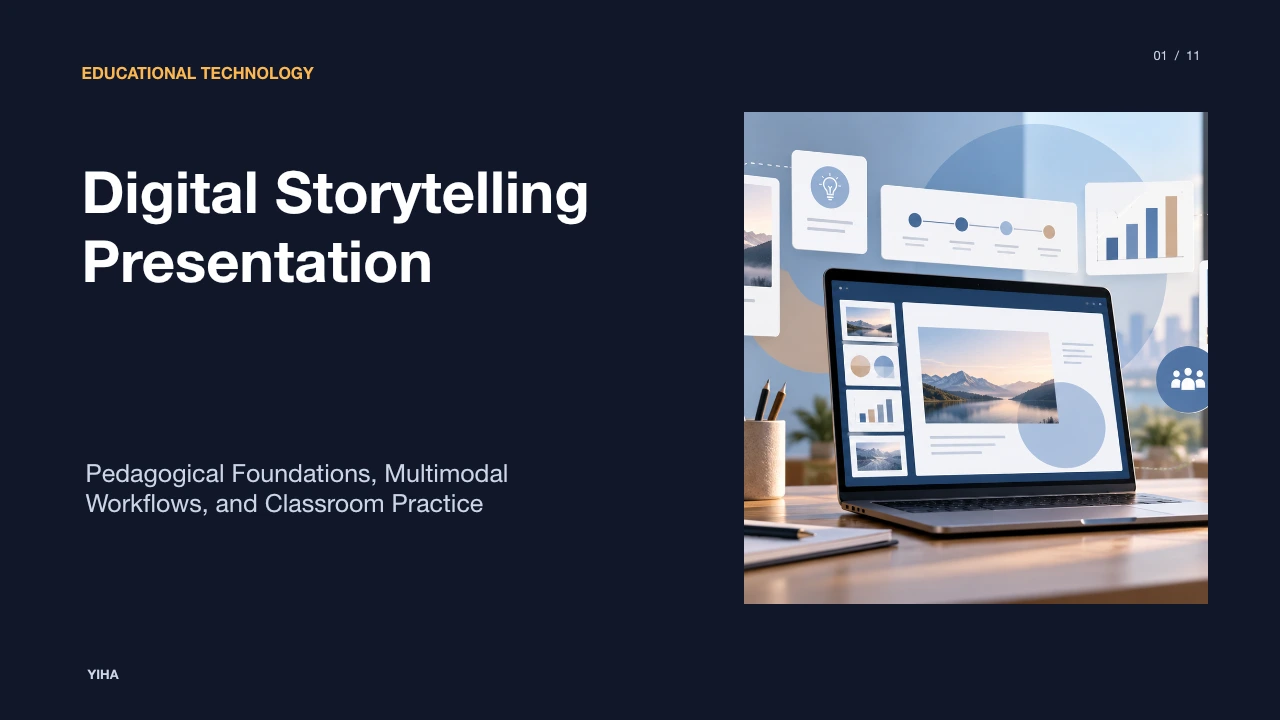
Digital Storytelling Presentation
A comprehensive pedagogical framework for digital storytelling, detailing historical models from StoryCenter, cognitive foundations, pre-production workflows, disciplinary projects, and multimodal assessment.
Free download · 4.9 MB11 editable slides · PowerPoint format
Download the editable PPTX
PPTX · 4.9 MB · 11 editable slides · Free to edit and reuse with attribution to Yiha.ai
View every slide
Use ← →, Home/End, or swipe on mobile
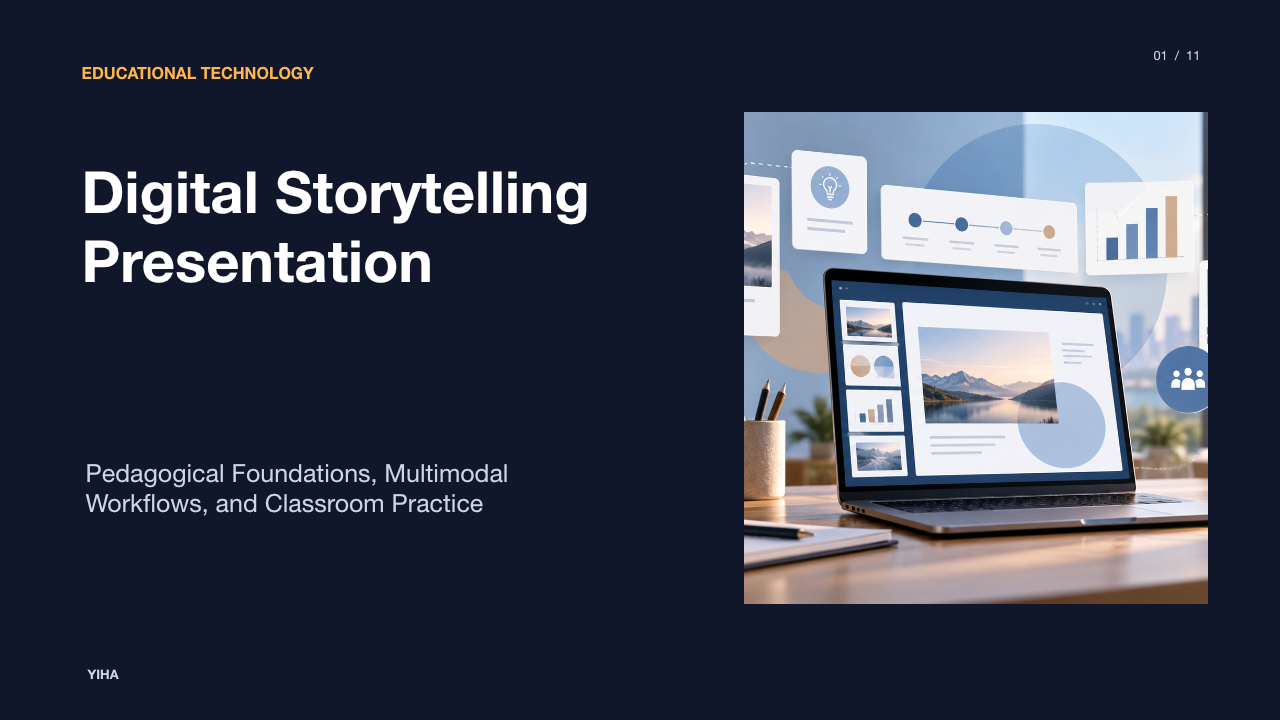
Digital storytelling integrates traditional narrative structure with digital media tools, allowing creators to convey personal, historical, or conceptual subjects through combined audio, imagery, and text. In instructional environments, digital storytelling shifts students from passive recipients of informational media into active authors who evaluate evidence, synthesize ideas, and articulate their own voices. Understanding the history, cognitive mechanics, and production workflows of this medium enables educators and institutional leaders to design meaningful multimedia assignments rather than superficial technology exercises.
Origins and Definition of Digital Storytelling
The origins of the modern digital storytelling movement trace back to the 1990s, emerging out of community theater and participatory art in California. Joe Lambert and his colleagues established the Center for Digital Storytelling (now known as StoryCenter), pioneering community workshops designed to help everyday citizens capture personal experiences on digital media. As outlined in scholarship hosted on Digital Pedagogy in the Humanities, the Center for Digital Storytelling created an intensive workshop model where individuals developed concise, autobiographical narratives. These projects were typically composed as two-to-four-minute videos relying on spoken voiceover scripts of approximately 300 words combined with personal photographs, ambient audio, and basic editing techniques. Technology instruction remained intentionally minimal, providing only enough operational training to enable creative composition without overwhelming novice authors.
Over subsequent decades, this grassroots workshop model transitioned into academic institutions. Scholars such as Bernard R. Robin at the University of Houston expanded the framework into elementary, secondary, and postsecondary classrooms. As highlighted by StoryCenter, digital storytelling evolved from strictly personal autobiographical memoirs into instructional explainers, historical recreations, and participatory community research across disciplines. Despite evolving software, the central definition remains consistent: a digital story is a short multimodal narrative that combines recorded voice narration, still or moving visuals, and intentional pacing to communicate a focused theme.
The Seven Core Elements of Digital Narratives
To guide authors without professional film backgrounds, Joe Lambert codified the composition process into a structured curriculum designed around core narrative components. As discussed in Digital Pedagogy in the Humanities, this formalized framework grew out of community media practices to center personal voice and accessible digital editing. In educational research documented in the ERIC Digital Education Review, Bernard R. Robin explains that digital storytelling combines computer-based images, text, recorded audio narration, video clips, and music to present information across a wide variety of subjects. In classroom adaptations, educators frequently examine these media components through seven foundational elements:
- Point of View: Establishing the author's personal perspective and the core premise of the story.
- Dramatic Question: Defining the central tension or unresolved inquiry that maintains audience attention until the resolution.
- Emotional Content: Connecting serious human experience, vulnerability, or stakes directly to the subject matter.
- The Gift of Voice: Utilizing the creator's natural recorded voice to personalize the narrative and communicate tone.
- The Power of the Soundtrack: Incorporating instrumental music or ambient sound that complements the spoken script without overpowering it.
- Economy: Limiting content strictly to necessary images, words, and sounds, preventing clutter and cognitive strain.
- Pacing: Controlling the tempo and rhythm of speech and visual transitions to reinforce narrative impact.
These elements prevent student productions from devolving into standard slide presentations with voiceover. By anchoring production around a single dramatic question and strict economy, authors must distill complex subject matter down to its most meaningful components.
Cognitive and Pedagogical Mechanisms
From a cognitive perspective, authoring a digital story aligns directly with constructivist learning theories. Rather than memorizing external facts, students build internal mental schemas by reorganizing primary evidence into narrative relationships. According to analysis on Digital Pedagogy in the Humanities, story production functions as a synthetic learning methodology that combines research, remixing, and critical interpretation across multiple media channels. Students actively construct meaning as they select, represent, examine, and respond to disciplinary material.
Multimodal composition also activates dual-coding processing: learners integrate verbal information from the script with nonverbal information from visual assets. In her classroom pedagogical guides, educational consultant Monica Burns notes in Class Tech Tips that effective integration requires establishing structured tasks before software introduction. When learners script and storyboard, they practice metacognitive monitoring. They must evaluate how an image alters the meaning of a spoken phrase, eliminating extraneous elements that cause cognitive overload and ensuring that visual media directly reinforces instructional goals.
Pre-Production: Scriptwriting and Storyboarding
The most decisive phase of digital storytelling occurs before any editing software is opened. Classroom instructors frequently observe that giving students early access to software tools leads to aimless browsing for visual effects rather than structured thinking. Methodologies refined by StoryCenter stress that pre-production must center on textual economy, peer review, and deliberate storyboarding. In their core workshops, participants begin with a targeted narrative script of roughly 300 words, which corresponds to two to four minutes of finished video.
Once an initial draft is prepared, participants engage in a "story circle." In this structured collaborative session, storytellers read their draft scripts aloud to a small group of peers. The story circle allows authors to receive constructive feedback on pacing, clarify emotional tone, and identify points of confusion. As described in Digital Pedagogy in the Humanities, this process transforms the classroom into a collaborative zone of co-creation. Following peer critique, creators draft a visual storyboard that maps each sentence of voiceover to specific still photographs or archival footage, ensuring that visual assets directly support the spoken argument before video assembly begins.
Media Assembly and Multimodal Balance
Once pre-production assets are finalized, creators move into media assembly. Production involves layering voice narration, still images, short video clips, ambient room tone, and background music into a unified timeline. According to curriculum frameworks detailed on Digital Pedagogy in the Humanities, technical instruction in digital storytelling should remain minimal, focusing strictly on basic timeline editing, volume balancing, and image transitions to ensure that software mechanics do not overshadow the narrative.
A frequent limitation in novice projects is auditory competition, where instrumental tracks drown out subtle inflections in spoken narration. Audio balancing guidelines recommend reducing background music volume substantially whenever spoken voice is present, or dropping music entirely during key dramatic moments. As detailed in production resources from StoryCenter, individualized feedback during visual design and video editing helps creators maintain narrative focus. Furthermore, visual pacing requires intentional restraint. As an instructional recommendation, displaying a single photograph for five to eight seconds allows viewers to absorb historical context, whereas rapid, erratic cuts disrupt focus and undermine the central message.
Disciplinary Applications Across Curriculum
While digital storytelling originated as an autobiographical medium, educators have adapted its principles across diverse curricular subjects. In humanities and social studies classrooms, students produce micro-documentaries that analyze historical letters, newspaper archives, and oral testimonies to investigate historical events. In literary studies, students construct character analyses or alternative perspective narratives that interpret narrative subtext.
STEM disciplines also utilize digital storytelling for conceptual communication. As shared in lesson frameworks on Class Tech Tips, students use ebook and multimedia platforms to document laboratory experiments, illustrate environmental cycles, or narrate historical scientific debates. For an illustrative example of this mechanism, a biology student might record a three-minute digital story combining microscope photographs with voiceover narration to explain cellular mitosis step-by-step. In community health and sociology programs documented by StoryCenter, digital stories serve as participatory action research tools, allowing community members to document localized environmental hazards or public health barriers in their own voices.
Copyright, Fair Use, and Media Ethics
Multimodal authoring requires careful attention to intellectual property law, fair use doctrines, and personal disclosure ethics. Students who search online image databases often assume all visible media may be redistributed freely. Grounding digital storytelling within media literacy requires teaching students how to locate public domain assets, interpret Creative Commons licenses, and cite media sources systematically. As Bryan Alexander notes in Digital Pedagogy in the Humanities, contemporary digital storytelling involves remixing and critical rearrangement of existing cultural materials, challenging romantic models of isolated authorship.
Beyond legal copyright compliance, digital storytelling introduces serious ethical questions regarding personal vulnerability. Because personal narrative assignments frequently touch upon lived challenges, family history, or sensitive reflections, institutions must respect student privacy and autonomy. As emphasized by workshop facilitators at StoryCenter, digital storytelling ethics require voluntary consent. Students must retain complete ownership of their narratives, maintain control over whether their work is shared publicly, and have the option to pursue alternative analytical topics without grade penalties.
Evaluation Criteria and Multimodal Rubrics
Evaluating multimodal student work presents distinct challenges for instructors accustomed to traditional term papers. A recurring error in assessment is rewarding high-production software polish, such as elaborate motion graphics, while neglecting weak research and flawed narrative structure. Rubrics must evaluate intellectual rigor, content mastery, and multimodal synergy alongside technical execution.
Educators referenced on Book Creator and instructional guides on Class Tech Tips emphasize separating assessment into clear criteria and sharing exemplars before production begins. An effective multimodal rubric allocates distinct points across core dimensions:
- Research and Narrative Content: Depth of factual accuracy, central dramatic question, and logical structure.
- Spoken Delivery and Voice: Clarity of vocal delivery, conversational pacing, and emotional authenticity.
- Multimodal Integration: Intentional relationship between spoken script and visual evidence, avoiding visual redundancy.
- Technical Assembly and Media Legality: Audio clarity, consistent audio levels, smooth pacing, and verified media citations.
Establishing transparent rubrics prior to production ensures that students prioritize rigorous synthesis over decorative visual effects.
Institutional Adoption and Implementation Tradeoffs
Adopting digital storytelling across educational departments requires balancing significant pedagogical advantages against real logistical tradeoffs. Research published by Bernard R. Robin in the ERIC Digital Education Review indicates that faculty interested in digital storytelling encounter barriers involving class time limitations, varying hardware capabilities, and student anxiety regarding technology and personal sharing. Robin highlights that sustained implementation requires practical guidelines and structured support for educators.
Digital storytelling projects demand considerable instructional time, often requiring multiple class sessions dedicated to script revision, technical tutorials, and peer screening. When institutions mandate high-end video software without dedicated media lab support, instructors spend valuable course time troubleshooting software crashes rather than teaching subject matter. Conversely, as discussed in Digital Pedagogy in the Humanities, using lightweight, accessible media authoring tools lowers technical friction and shortens production timelines. Institutional programs succeed when they provide faculty development workshops, establish dedicated media rubrics, and align digital storytelling with existing course objectives rather than treating it as an isolated novelty.
Research sources
- Storytelling | Digital Pedagogy in the Humanities · digitalpedagogy.mla.hcommons.org
- StoryCenter · www.storycenter.org
- Digital Storytelling Archives - Book Creator app · bookcreator.com
- ERIC - EJ1125504 - The Power of Digital Storytelling to Support Teaching and Learning, Digital Education Review, 2016-Dec · eric.ed.gov
- Digital Storytelling Lesson Ideas with Book Creator - Class Tech Tips · classtechtips.com