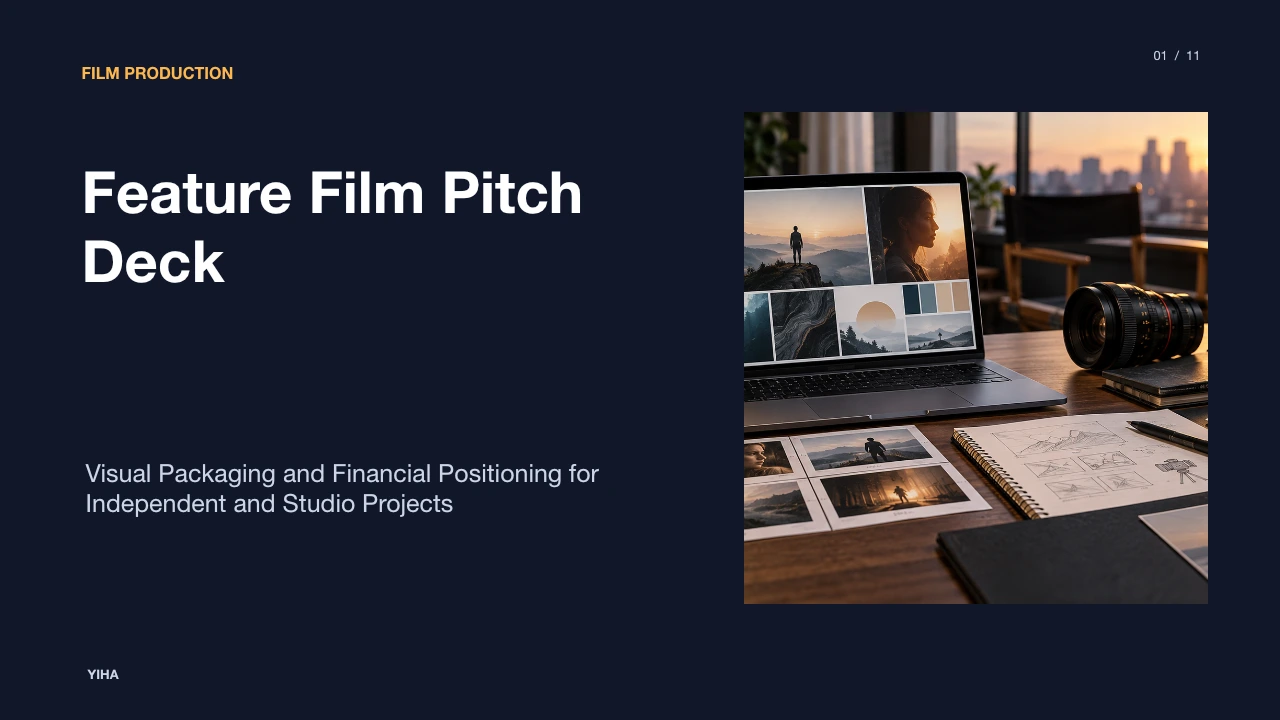
Feature Film Pitch Deck
A comprehensive guide to creating an investor-ready feature film pitch deck, bridging creative vision and financial planning to package independent and studio films.
Free download · 4.9 MB11 editable slides · PowerPoint format
Download the editable PPTX
PPTX · 4.9 MB · 11 editable slides · Free to edit and reuse with attribution to Yiha.ai
View every slide
Use ← →, Home/End, or swipe on mobile
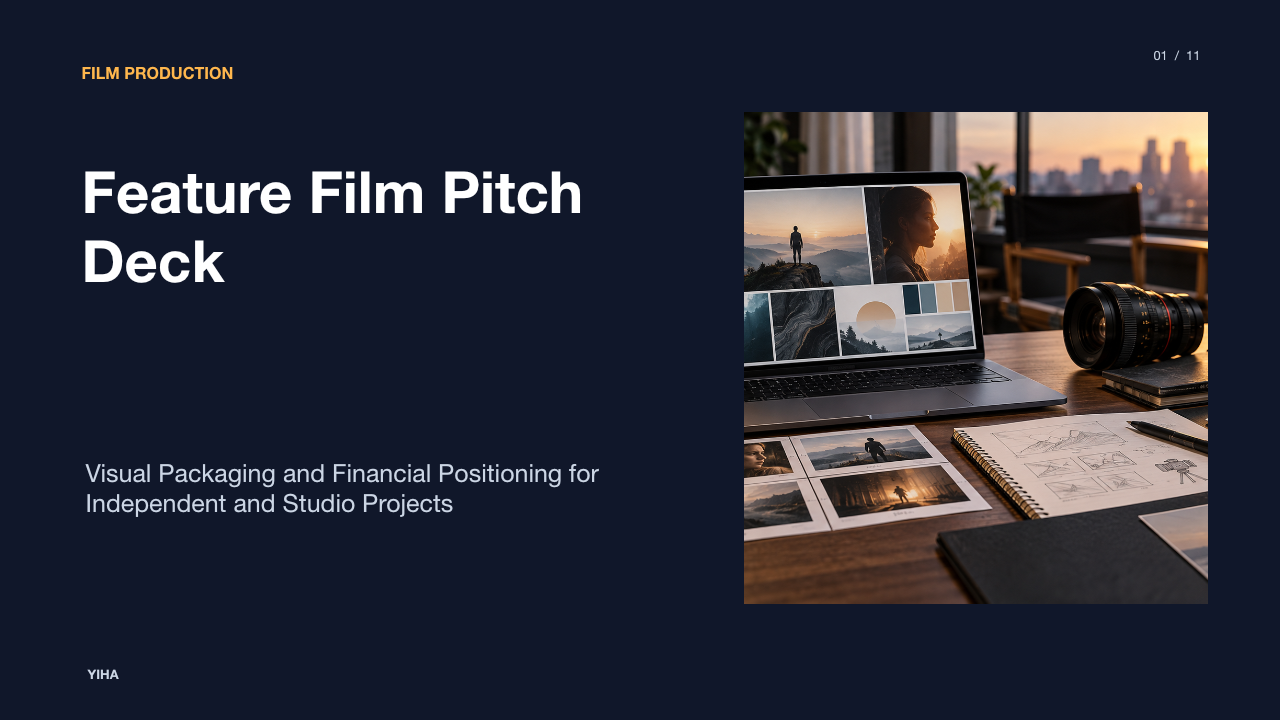
A feature film pitch deck functions as the essential visual proposal that bridges an artistic screenplay and an operational financing plan. While a script demonstrates narrative craft and a business plan details financial structures, the pitch deck allows producers, financiers, and sales agents to evaluate the tone, market readiness, and creative leadership of a motion picture in a single sitting.
Developing an effective deck requires balancing creative immersion with commercial discipline. By organizing story elements, visual style, casting profiles, market benchmarks, and top-sheet finances into a coherent document, filmmakers establish execution credibility before asking partners to commit significant production capital.
The Role of the Pitch Deck in Film Packaging
In contemporary film financing, creative ambition alone cannot secure capital. As outlined in the guide on The Complete Guide to Creating a Film Pitch Deck, a pitch deck functions as a visual presentation that communicates a project's essence, creative vision, financial requirements, and market potential. It is not an alternative to a formal script or an exhaustive business plan. Instead, it serves as the initial hook that demonstrates serious preparation to potential partners.
Financiers review hundreds of proposals each season. A well-constructed visual presentation shows that the creative team understands both the aesthetic texture of their movie and the practicalities of physical production. Programs like Sundance Catalyst specifically evaluate how effectively creative teams partner with independent financiers, requiring pitch decks, financing models, and clear production plans to assess feasibility before selection. A major limitation of a pitch deck is that it cannot fix underlying script weaknesses or substitute for completed legal agreements. Rather, it serves as proof of intentional execution, ensuring that when financiers agree to read the full screenplay, they do so with a clear mental image of the finished film.
Distilling the Story Engine into Logline and Synopsis
Every effective feature pitch deck anchors its narrative on two core elements: a high-concept logline and a tightly structured synopsis. According to The Ultimate Guide to Creating Your Film/TV Pitch Deck, leading with clear storytelling elements ensures that potential buyers and networks grasp the emotional and dramatic stakes immediately without becoming overwhelmed by excessive narrative detail.
The logline should provide a concise one- or two-sentence description establishing the protagonist, inciting incident, core obstacle, and dramatic stakes. Immediately following the logline, the synopsis must convey narrative momentum rather than an exhaustive blow-by-blow scene list. In the overview provided by Film Pitch Deck Template: A Slide-by-Slide Guide, filmmakers are advised to deliver a narrative overview of one to three paragraphs that proves the story escalates and pays off. A common pitfall in draft decks is poetic vagueness where thematic ideas overshadow concrete action. Readers need to understand what happens on screen, who drives the conflict, and how the journey resolves.
Translating Tone, World, and Cinematography
Film is an inherently visual medium, meaning abstract verbal descriptions of mood often fail to communicate directorial intent. Curating a deliberate visual tone slide establishes the film's lighting, color science, framing, and texture before production begins. Insights from Structuring a Film Pitch Deck highlight that visual references should form a cohesive package detailing color palettes, lighting schemes, locations, and cinematography.
Filmmakers often curate reference images from established films, fine art, or photography to ground their vision. For example, an illustrative neo-noir proposal might contrast practical neon lighting against brutalist architecture to communicate practical world-building. As noted by The Ultimate Guide to Creating Your Film/TV Pitch Deck, mood boards and visual references help readers grasp genre and atmosphere before digging deeper into the story. However, uncurated mood boards present significant risks. Pasting conflicting imagery without clear lighting continuity signals aesthetic confusion. Every reference image must reflect the actual camera movements, aspect ratio, and lighting setup intended for the production, demonstrating to cinematographers and line producers that the visual ambitions align with the expected shooting schedule.
Character Breakdowns and Casting Prototypes
Financiers and packaging agents assess character pages to determine casting value and dramatic vitality. As noted in the comprehensive resource from SlideGenius on Feature Film Pitch Decks, an investor deck should feature breakdowns for the top two or three roles, describing each character's psychological arc, inner conflict, and the casting prototype best suited for the part.
Character profiles must clearly define emotional motivation, vulnerabilities, and transformative arcs rather than simple physical traits. Beside each profile, filmmakers frequently include casting prototypes or realistic talent wish lists to indicate the archetypes and commercial tiers envisioned, a practice detailed across industry examples on Storydoc on Film Pitch Deck Examples. A critical limitation here is maintaining strict legal and ethical precision. Filmmakers must never represent an actor as attached unless a verified talent agreement or letter of intent is signed by their talent agency. Falsely claiming attachments immediately destroys credibility during financier background checks.
The Director's Vision and Authorship Statement
The director's vision slide functions as the creative manifesto of the pitch package. In the workflow described in How to Write a Film Pitch Deck in 2026, the director's statement is frequently the deciding factor for financing partners because investors evaluate the specific voice and execution strategy of the filmmaker alongside the concept itself.
An effective vision statement moves beyond generic statements of passion. It explains why this filmmaker must tell this story now, highlighting thematic connection, cultural access, and concrete craft decisions. For instance, an illustrative director's statement might outline a decision to shoot exclusively with wide focal lengths and natural light to reinforce thematic isolation. In The Ultimate Guide to Creating Your Film/TV Pitch Deck, presenting a defined creative vision across the deck grounds the concept in tangible craft, reassuring financiers that the director possesses the technical discipline required to guide production through physical and budgetary constraints.
Selecting Realistic Market Comparables
Market comparables, commonly called comps, provide empirical evidence that an audience exists for the project's genre, tone, and scale. According to the workflow highlighted by NuPitch for Feature Films, evaluating similar titles by release window, budget level, and box office returns helps investors evaluate the commercial viability and financial expectations of the project.
Comp selection requires strict discipline. Citing runaway cultural anomalies or multi-hundred-million-dollar studio blockbusters for a contained indie thriller is counterproductive. As explained in SlideGenius on Feature Film Pitch Decks, teams should select two to three recent titles from the past five to seven years that share comparable budget tiers and tonal elements. Alongside box office or digital performance figures, each comp should feature a concise note explaining how the proposed film aligns with or differentiates itself from the benchmark, grounding the investment thesis in measurable industry precedent.
Defining Target Audience and Distribution Pathways
A viable film pitch deck identifies who will buy tickets or stream the film and delineates how the project will reach them. The guide on The Complete Guide to Creating a Film Pitch Deck emphasizes detailing distribution strategies across theatrical exhibitions, streaming platforms, film festivals, and international sales to reassure partners that the finished asset has clear market avenues.
Filmmakers must outline core audience segments by combining demographic data with specific viewing habits, such as identifying festival genre communities or prestige arthouse demographics. As noted in How to Write a Film Pitch Deck in 2026, concise declarations of release intent, such as premiering at targeted genre festivals before transitioning through limited theatrical and subscription streaming windows, convey far greater operational maturity than claiming that everyone will enjoy the film. Clearly defining these avenues demonstrates respect for distribution realities.
Budget Top-Sheets, Finance Plans, and the Ask
While detailed line-item budgets belong in formal accounting software, the pitch deck requires an accessible financial summary. Guidance from Structuring a Film Pitch Deck advises including top-line department breakdowns across pre-production, principal photography, post-production, and contingency reserves, paired with current financing progress.
The financing slide maps out the capital structure, illustrating how equity investments, pre-sales, territorial gap financing, and regional tax credits assemble to fully fund production. Crucially, the slide must define the exact financial ask, stating the precise capital amount needed from the target investor group. The advice in How to Write a Film Pitch Deck in 2026 reinforces tying the requested budget tier directly to realistic comparables, ensuring the funding goal avoids arbitrary precision and aligns with verified production scopes.
Meeting Delivery, Deck Formats, and Follow-Through
A pitch deck serves two distinct roles: a live visual backdrop during verbal pitches and an independent leave-behind document circulated via PDF. The breakdown provided by The Complete Guide to Creating a Film Pitch Deck notes that live presentations typically run between 15 and 30 minutes, whereas written leave-behind PDFs must be self-explanatory and cleanly formatted for offline reading.
Live presentations require clean slides with minimal text to keep executive focus on the speaker, whereas standalone PDF files require self-contained context, clear captions, and accessible executive bios. Filmmakers often support their presentations with proof-of-concept shorts, director reels, or lookbook supplements. As outlined in SlideGenius on Feature Film Pitch Decks, the final slide should present an explicit call to action, such as requesting a screenplay read or scheduling a physical production review, ensuring the presentation leads directly into investor due diligence.
Research sources
- The Ultimate Guide to Creating Your Film/TV Pitch Deck | The Los Angeles Film School · www.lafilm.edu
- The Complete Guide to Creating a Film Pitch Deck: Land Your Project Funding - First Draft Filmworks Blog · firstdraftfilmworks.com
- Catalyst - sundance.org · www.sundance.org
- Film Pitch Deck Template: A Slide-by-Slide Guide + 35 Free Template Previews (2026) · www.finalbitai.com
- Film Pitch Deck Examples That Stand Out (+Templates) · www.storydoc.com
- Structuring a Film Pitch Deck: Top Examples and Templates for Filmmakers · deckflow.com
- What Should Be Included in a Feature Film Pitch Deck? Comprehensive Guide · www.slidegenius.com
- How to Write a Film Pitch Deck in 2026 (Step-by-Step) | Storyflow · storyflow.so
- Detailed guide on crafting pitch decks for feature film projects. · usenupitch.com