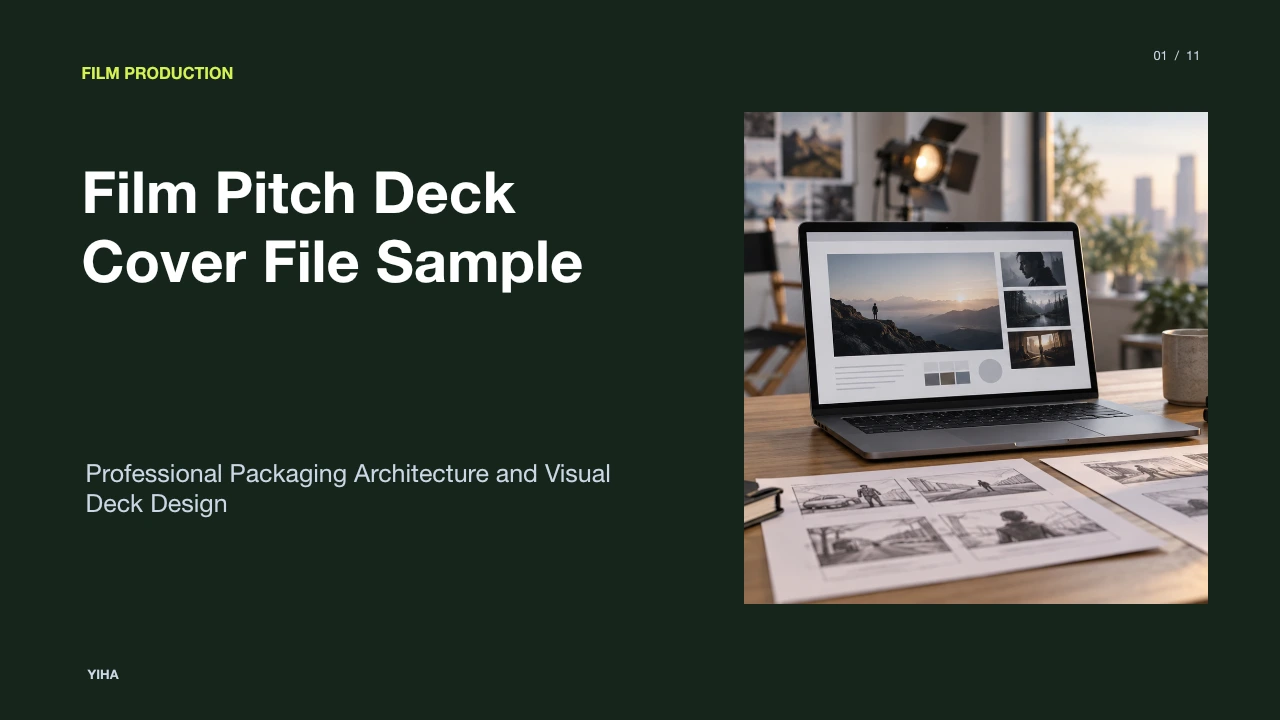
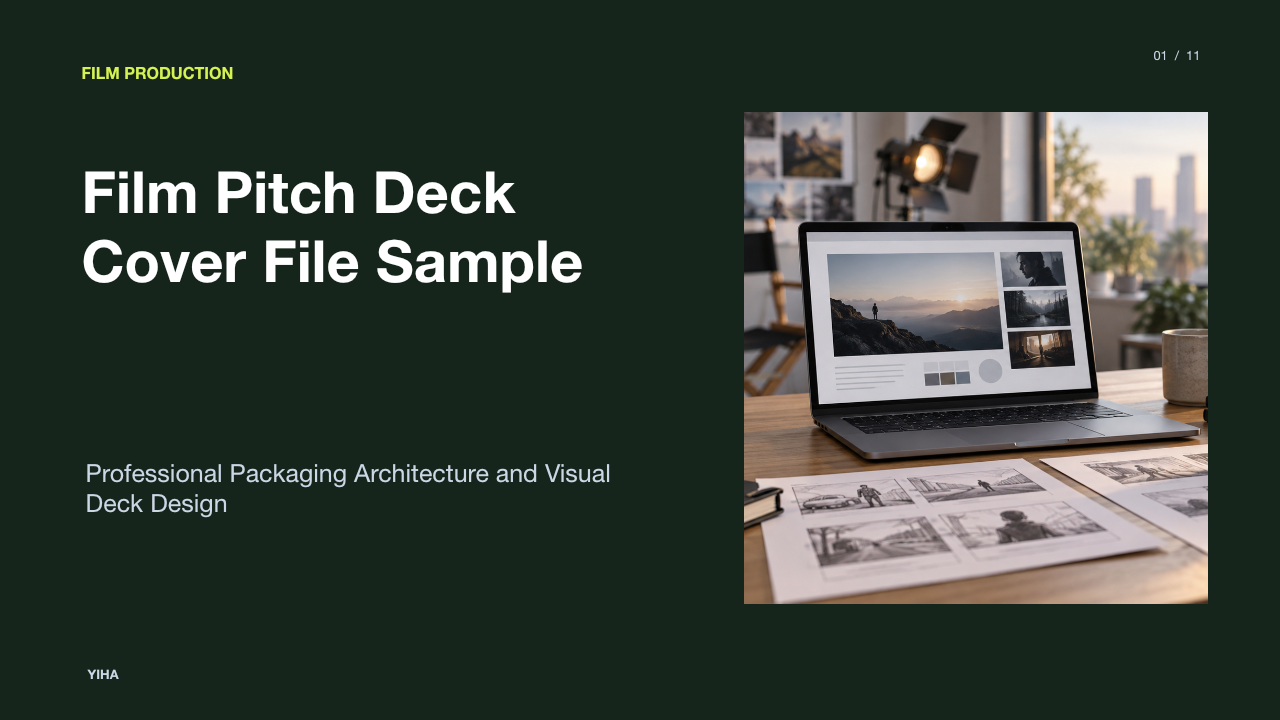
Film Pitch Deck Cover File Sample
A practical guide to structuring a professional film pitch deck cover file, lookbook elements, character attachments, market comparables, and budget summaries.
Free download · 4.9 MB11 editable slides · PowerPoint format
Download the editable PPTX
PPTX · 4.9 MB · 11 editable slides · Free to edit and reuse with attribution to Yiha.ai
View every slide
Use ← →, Home/End, or swipe on mobile
Independent film packaging requires converting an unproduced screenplay into an organized commercial opportunity. While a screenplay conveys narrative dialogue and scene action, financiers, sales agents, and talent representatives evaluate an entertainment package through its visual and financial documentation. A film pitch deck serves as this presentation format. It operates as both a visual companion during live pitch meetings and an independent leave-behind document circulated among production partners. Building a functional film pitch deck requires balancing aesthetic precision with verifiable market and budgetary realities.
The Packaging Package: Pitch Decks in Film Finance
A pitch presentation operates as the primary commercial bridge connecting narrative screenplays with external capital allocation. As noted by DeckFlow, securing financing, cast attachments, or distribution requires a visual package that translates written text into a cohesive visual style and demonstrates a professional execution plan. A screenplay alone leaves tone, production scale, and commercial positioning open to subjective interpretation. The pitch deck structures these dimensions into a clear format.
According to First Draft Filmworks, professional film decks typically range from 10 to 20 slides designed for a 15 to 30 minute presentation, while also functioning as a standalone document for investors, distributors, and collaborators. Recommendation: Feature presentations often require 12 to 20 slides to address artistic and fiscal planning, whereas short films operate as leaner decks running between 10 and 15 slides. Documentaries place specialized focus on research access and ethical frameworks rather than speculative plot mechanics. An essential limitation in film financing is that no presentation guarantees financing or eliminates commercial risk. Rather, a disciplined presentation shows that the production team understands both creative intent and fiscal risk management.
Cover File Anatomy: First-Impression Semiotics
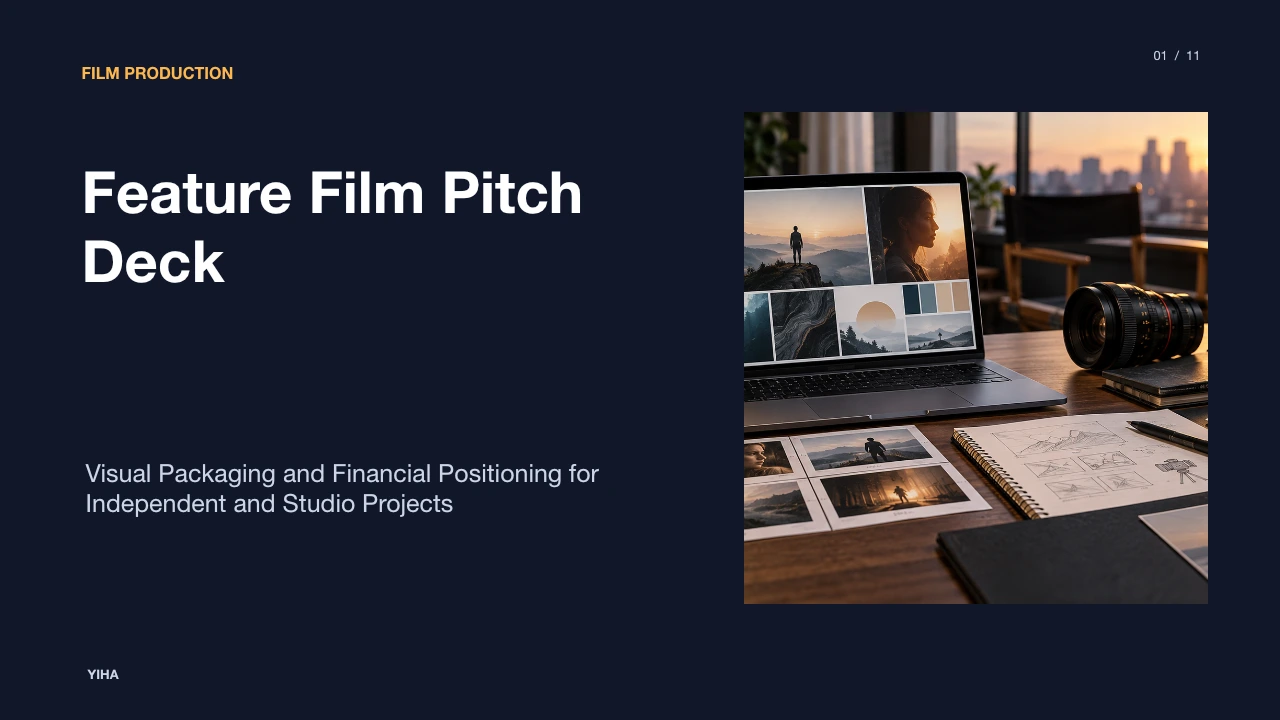
The cover slide establishes the visual tone and professional rigor of the entire package. Industry analysis from Celtx emphasizes that the title slide functions as the initial impression, requiring the project title, an evocative tagline, and a striking image that captures the atmosphere of the finished picture. The cover must communicate genre, pacing, and mood before the reader reviews a single page of story text.
A complete cover file sample contains five critical visual elements: a high-resolution hero still, bespoke title typography, project identity metadata, creative contact credits, and legal ownership disclosures. The production title should be positioned cleanly against visual art that reflects the intended cinematography. The metadata must state the project format, such as feature film, television pilot, or limited series, along with the drafting date or revision version and the primary producing entity. Production contact details, including lead producer and director names, anchor operational accountability. A clear chain-of-title or copyright line establishes that the underlying intellectual property is properly registered and legally protected.
Visual Hierarchy, Typography, and Genre Signifiers
Visual hierarchy communicates genre expectations to industry readers instantly. As highlighted by FinalBit, distinct genres demand precise visual framing, such as high-contrast typography and dark-mode framing for horror projects, or structured grid layouts and clean technical styling for science fiction narratives. A period drama requires classical serif typography and muted earth tones, while an action thriller relies on bold headers and dynamic framing.
A common limitation among emerging filmmakers is utilizing disparate reference imagery or default software templates that clash with the story. Sourcing inconsistent photography dissolves tone and confuses prospective partners. Cinematography lookbooks achieve unity by establishing strict color lookup tables, controlled font pairings, and widescreen aspect ratio framing, such as letterboxing within a standard widescreen presentation slide. When every slide adheres to a unified visual system, the package conveys intentional directorial craft.
Premise Compression: Logline and Hook Mechanisms
Slides following the cover must compress the central narrative into immediate, digestible narrative hooks. Guidelines from First Draft Filmworks point out that the logline is the most scrutinized component of the presentation, because time-constrained investors evaluate it first to decide whether to continue reading. If the premise fails to present clear stakes and fresh conflict, visual polish cannot rescue the project.
According to DeckFlow, an effective logline is a single sentence detailing the protagonist, inciting incident, core conflict, and principal stakes. Following the logline, an executive synopsis condenses the story into three structured paragraphs outlining the beginning, middle, and resolution. Illustrative example: In an independent mystery thriller pitch, the logline identifies an isolated maritime investigator facing an anomalous signal during an approaching typhoon. The narrative hook emphasizes personal survival and time urgency, establishing protagonist agency without getting lost in tertiary subplots.
Worldbuilding and the Director's Lookbook
Following narrative setup, the director lookbook articulates the physical environment, visual atmosphere, and technical execution plan of the production. As outlined in the slide-by-slide structure on FinalBit, the lookbook section is where the document transitions into a film, utilizing reference stills, concept art, and an established color palette to communicate vision faster than written text.
Directorial vision is expressed by outlining specific camera language, aspect ratio choices, and lighting plans. For instance, a neo-noir presentation might contrast soft sodium-vapor street lighting with high-contrast interior shadows, citing concrete lighting references to show technical readiness. However, relying exclusively on iconic cinema frames carries limitations. If references are applied without clear context, prospective investors may view the pitch as an imitation of past hits rather than an original cinematic experience. Director notes should explicitly state how referenced visual styles support the emotional journey of the characters.
Character Architectures and Attachment Protocols
Character slides ground narrative stakes in individual human journeys. Industry guidance on AiPPT highlights that core sections should feature primary characters alongside visual tone, director statements, creative team credentials, and target audience definitions. Each primary character profile requires a portrait, core motivations, internal conflicts, and pivotal arc transitions.
A critical distinction in film packaging involves actor attachments versus talent wishlists. A talent wishlist reflects aspirational casting targets who fit the aesthetic profile and budget tier of the role. An attachment requires an executed agreement or verified letter of interest from representation. As noted by PPTTemplate, presentations must clearly separate confirmed information from proposed plans. Overpromising talent attachments without verified paperwork damages credibility with seasoned financiers, sales agents, and completion bond companies.
Market Comparables: Calibrating Commercial Viability
Market comparables anchor artistic vision in commercial realities. Research from DeckFlow explains that investors evaluate films as an asset class, requiring evidence of audience demand through charts showing 3 to 5 existing titles matching the project's genre, tone, and production budget scale alongside their box office returns.
Selecting comps requires disciplined calibration. Packaging guidance from FinalBit recommends choosing two or three titles from the past five to seven years that share identical genre tiers, pairing an aspirational commercial hit with a realistic breakout at the project's actual budget level. Comparing a low-budget independent thriller to massive studio franchises distorts risk assessments and signals market naivety. Realistic comps demonstrate an understanding of theatrical distribution, international sales, and streaming acquisition norms for that specific budget band.
Budget Top-Sheets and Financial Ask Architecture
The financial section of a pitch deck presents the capital framework without revealing confidential operational line items. According to production documentation from FilmDrafts, a film budget top sheet provides an executive summary of production costs, presenting major account groups and total expenditures so investors and lenders can assess scope without examining hundreds of granular accounting rows.
As explained on FilmProposals, budget planning must account for critical production categories including above-the-line talent fees, prep, shoot, wrap, and dedicated post-production allocations. The pitch deck financial slide should present a clear capitalization chart showing expected funding sources, such as equity investment, regional tax incentives, and minimum pre-sale guarantees. If state or national tax incentives bridge the net capital requirement, that mechanism must be displayed transparently. Illustrative example: A project budgeting three million dollars in gross negative costs may showcase one million dollars in qualified tax credit incentives alongside two million dollars in direct equity financing, establishing a clear capital structure.
Technical Deliverables and Executive Reader Workflows
The final phase of deck preparation focuses on technical deliverable standards for executive circulation. Practical specifications from FinalBit note that producers and sales agents universally prefer high-resolution PDF files under 15 megabytes, ensuring exact layout formatting across operating systems while allowing executives to review decks offline during festival meetings and travel.
Large files sent via complex download links introduce friction into reading workflows. Standard PDF optimization preserves image resolution while compressing background payloads, embedding typography, and safeguarding formatting. When preparing digital leave-behinds, producers should remove sensitive internal financial details or attach standard non-disclosure designations where necessary. Following these deliverable parameters ensures that the packaging deck functions reliably across all professional distribution channels.
Research sources
- Film Pitch Deck Templates & Examples to Pitch Your Movie - AiPPT · www.aippt.com
- Structuring a Film Pitch Deck: Top Examples and Templates for Filmmakers · deckflow.com
- The Complete Guide to Creating a Film Pitch Deck: Land Your Project Funding - First Draft Filmworks Blog · firstdraftfilmworks.com
- How to Build a Film Pitch Deck (+ Free Checklist) · blog.celtx.com
- Ready-to-Use Film Pitch Deck Templates & Free Generator · www.finalbitai.com
- Film Pitch Deck Examples That Stand Out (+Templates) · www.storydoc.com
- Film Pitch Deck Template: A Slide-by-Slide Guide + 35 Free Template Previews (2026) · www.finalbitai.com
- Free Film Pitch Deck Templates | PPTTemplate · ppttemplate.ai
- Film Budget Template for Indie Producers with Free Top Sheet and Budgeting Tips · filmproposals.com
- Film Budget Service & Production Planning | FilmDrafts · filmdrafts.com
- Film Budget Top Sheet: Categories & Example | FilmDrafts · filmdrafts.com