Film Script
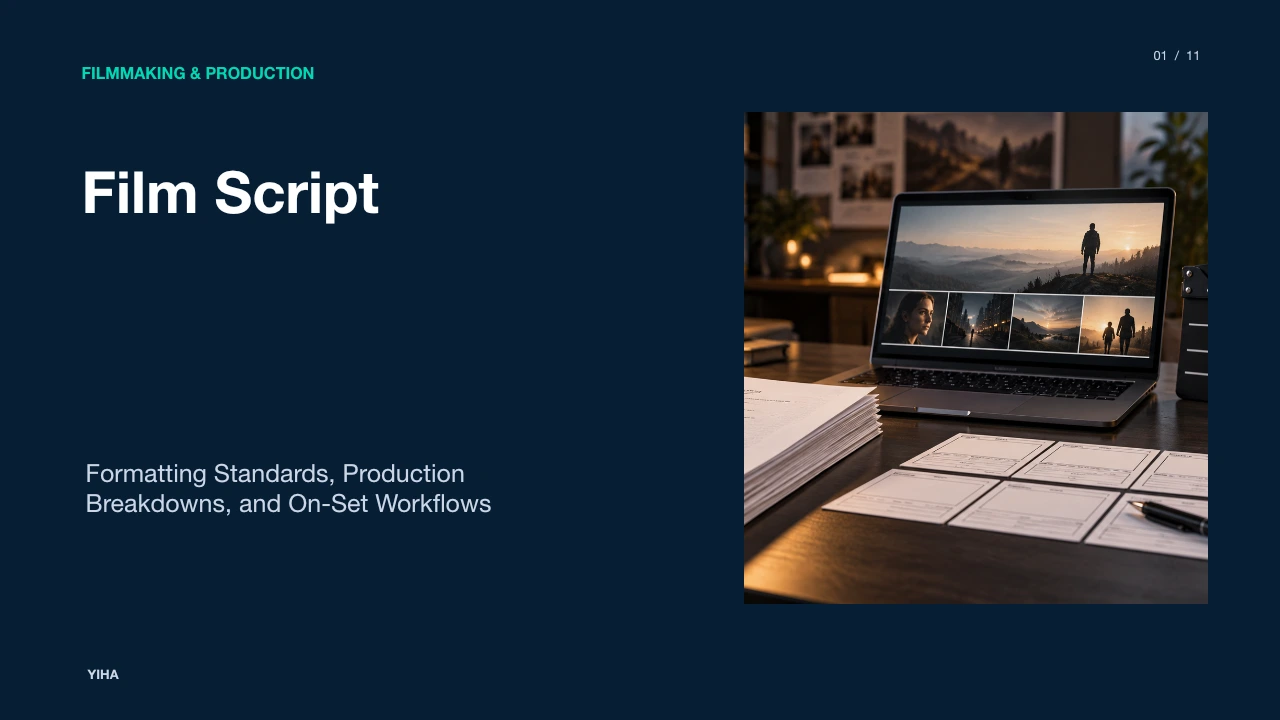
A comprehensive guide to screenplay formatting and production breakdowns, showing how film scripts serve as industrial blueprints for scheduling and continuity.
Free download · 4.9 MB11 editable slides · PowerPoint format
Download the editable PPTX
PPTX · 4.9 MB · 11 editable slides · Free to edit and reuse with attribution to Yiha.ai
View every slide
Use ← →, Home/End, or swipe on mobile
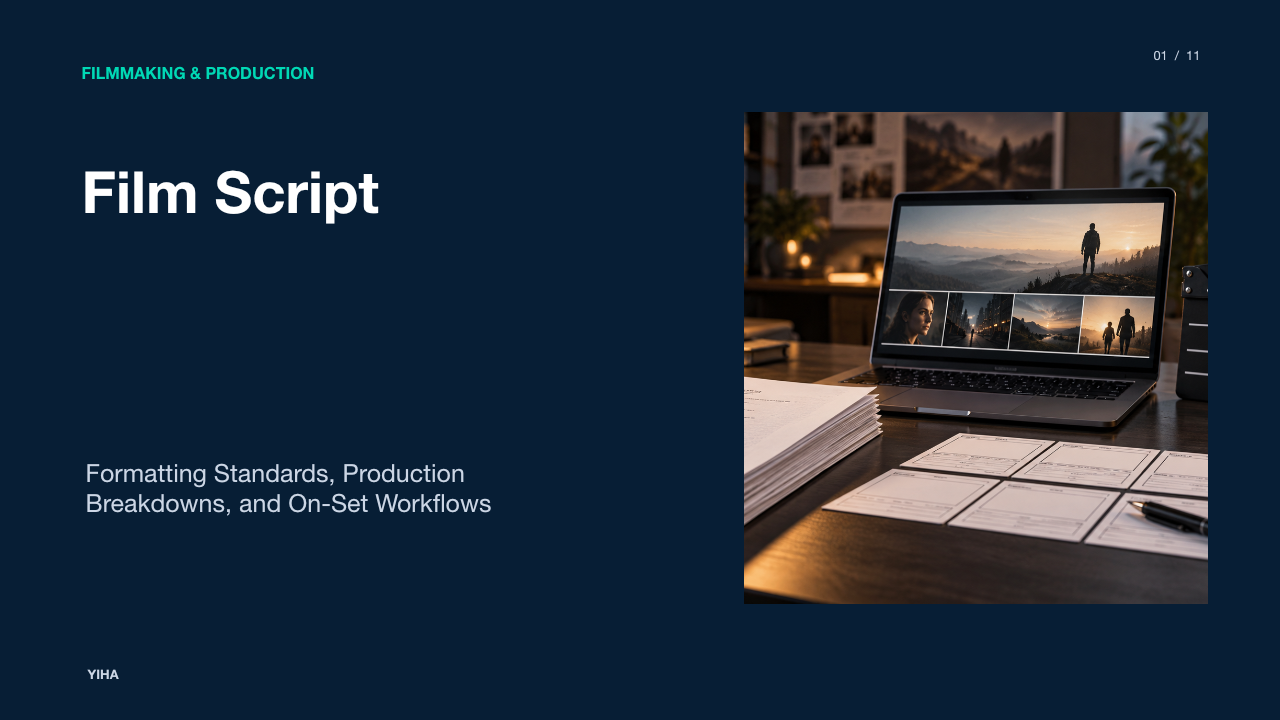
A motion picture screenplay functions as far more than a literary reading experience. In professional film production, the script operates as an industrial production blueprint that aligns creative, logistical, and technical departments around an orderly manufacturing plan. Unlike prose fiction, where interiority and fluid pacing dominate, a screenplay translates dramatic intention into physical production realities, including filming locations, daylight conditions, actor counts, and camera setups. Establishing clear formatting conventions allows line producers, first assistant directors, cinematographers, and script supervisors to extract operational data directly from the written page.
The Screenplay as an Industrial Production Blueprint
A narrative film script represents an interoperable engineering document for physical production. While a novel uses prose description to evoke emotion, a motion picture screenplay arranges dramatic narrative into discrete logistical units. According to documentation on A/V and narrative script planning, narrative film and television projects rely on a standardized single-column script layout using scene headings, action descriptions, and dialogue blocks. This structural consistency ensures that logistical departments can systematically read, schedule, and estimate budgets for every scene.
When a script adheres to established layouts, every artistic choice carries an explicit logistical counterpart. An action line describing a rainstorm signals physical special effects equipment, water trucks, weather-proofing gear for camera packages, and specific costume doubles for cast members. As detailed in the Greenshot shot list guide, a screenplay describes story events that directly feed downstream documents, such as shot lists, call sheets, and daily shooting schedules. Without standardized conventions, crew departments would struggle to parse script requirements efficiently, creating costly miscommunications during principal photography.
Typographic Standards and Page Geometry in Courier 12
The physical architecture of the screenplay relies on standardized page geometry to coordinate physical filming requirements. Production planning translates written pages into measurable units of time and labor. As noted in resources covering script breakdowns and page measurement, industry pre-production relies on dividing every page into eight one-inch segments, termed script eighths. This measurement serves as a baseline across pre-production, allowing production teams to measure scene volume and estimate daily shooting capacity.
Page eighths are tracked at the top of scene breakdown sheets, breakdown reports, Day Out of Days reports, shot lists, and shooting schedules. On a typical dialogue-heavy indie production, crews frequently plan around shooting roughly five pages per day based on standard scene pacing. When scripts are imported into digital production management software from formats such as Final Draft, Fountain, Word, or PDF, platforms automatically parse scene lengths into eighths. This spatial consistency ensures that scenes can be scheduled and budgeted with predictable physical parameters across all departments.
The Core Formatting Blocks from Slugline to Dialogue
A standard narrative screenplay is structured using distinct formatting blocks that separate visual direction from spoken performance. As outlined in AV script formatting workflows, while commercial and promotional content often utilizes two-column audiovisual formats to match visual cues with audio cues side by side, narrative cinema relies on a single-column hierarchy consisting of scene headings, action lines, and dialogue blocks.
Each block fulfills an administrative function on set:
- Scene Headings: Identify the setting and whether the environment is interior or exterior, along with lighting conditions.
- Action Lines: Describe physical occurrences, character movements, and visual events taking place within the scene in the active present tense.
- Dialogue Blocks: Isolate spoken lines, voiceover cues, and audible sound elements for cast and sound technicians.
As emphasized in shot list and script breakdown resources, scene numbers must synchronize between the script, the shot list, and the shooting schedule. This synchronization ensures that when camera teams tag specific actions, props, or dialogue lines to create shot descriptions, the entire crew works from identical reference numbers.
The Timing Mechanism: The One-Page-Per-Minute Rule
The fundamental operational premise of screenplay planning is the heuristic guideline that one properly formatted script page equals approximately one minute of screen time. This standard allows producers and directors to forecast the running time of a feature film or episodic project during early pre-production.
However, this rule represents a planning baseline with clear operational limitations. As highlighted in StudioBinder breakdown documentation, a screenwriter may write a single action line stating that a character performs a musical piece, yet that brief line can require two to three minutes of screen time. Conversely, a rapid dialogue exchange between characters may consume multiple pages of text in under a minute. On dialogue-heavy indie productions, crews frequently average around five script pages per shooting day. Production teams use page counts to forecast general running times, but assistant directors always evaluate scene complexity to calibrate accurate daily shoot schedules.
Illustrative Example: An action line states that a performer sings an acoustic song. While the description occupies only one line of script text, the performance may require two to three minutes of finished screen time and several camera angles, demonstrating why page length alone cannot dictate shooting schedules.
Departmental Parsing and Production Script Breakdowns
Once a screenplay is greenlit, the production team begins the script breakdown process. As explained in script breakdown workflows, the first assistant director or producer dissects every scene into technical categories during pre-production, tagging elements such as speaking cast, background extras, props, wardrobe, vehicles, practical special effects, and sound cues.
This breakdown directly informs the stripboard, shooting schedule, and Day Out of Days reports. In parallel, the director of photography and camera crew use the breakdown to develop a complete shot list. As documented in the Greenshot shot list analysis, a shot list breaks down every camera setup required for a scene, documenting shot sizes, camera angles, movement, lenses, and specialized gear. Assistant directors rely on these shot lists rather than storyboards to estimate scene setup times and construct the daily call sheet.
Structural Differences Between Spec and Shooting Scripts
A motion picture script evolves across development and physical filming stages. Early drafts present scenes in continuous narrative order for creative evaluation. However, when a project transitions into principal photography, the screenplay must be transformed into an actionable shooting document.
As detailed in film shot list guides, shooting scripts assign permanent sequential scene numbers to every heading, which can be formatted numerically or alphabetically. As noted in Celtx script documentation, scenes with multiple camera setups or coverage changes use letter designations, such as Scene 3A or 3B, to differentiate camera positions. Furthermore, setups are reordered on set into an efficient shooting order based on location and lighting constraints rather than original script order. While a script breakdown plans what needs to be filmed, production documentation tracks what is actually filmed each day.
The Lined Script and On-Set Continuity Tracking
During principal photography, the script supervisor maintains the production's definitive administrative record known as the lined script. As detailed in the Celtx guide to lining a film script, lining a script involves drawing vertical lines directly through the dialogue and action descriptions on the shooting script to indicate exactly which portions of a scene were captured in each individual take.
The vertical line convention uses distinct graphical cues to convey critical coverage information to the post-production team:
- Solid Straight Lines: Indicate dialogue or physical action that was captured cleanly on-screen within the camera frame.
- Wavy Lines (Squiggles): Signify dialogue or action that occurred off-screen, or moments where audio was muffled or physical action was visually obscured.
As explained in StudioBinder's guide on script supervisor workflows, the lined script works in tandem with the daily camera logs and shot lists. The script supervisor notes preferred director choices by circling approved takes, providing the editorial department with an immediate map of usable coverage and performance takes before editing begins.
Common Formatting Pitfalls and Director Overreach
Inconsistent formatting and operational oversights can severely hinder pre-production scheduling and post-production editing. As documented in Celtx script supervisor resources, mis-slating scenes or misnumbering takes causes significant confusion in the edit suite, making it exceedingly difficult for editors to synchronize audio tracks with visual coverage.
On the production planning side, technical choices within the script must remain mindful of on-set resource limits. As noted in StudioBinder shot list documentation, complex camera movements require extensive setup times and should be planned sparingly to protect daily schedules. Furthermore, formatting errors within script documents can create technical hiccups when importing files into production scheduling software like Movie Magic Scheduling or StudioBinder. Ensuring that scene numbers sync between the script, shot list, and schedule prevents logistical disconnects before physical filming begins.
Digital Workflows, Software Standards, and File Formats
Modern screenwriting relies on specialized software architectures to manage the transition from creative writing to logistical production. As outlined in shot list and software workflows, modern production tools accept various industry file formats, including Final Draft (.fdx), Fountain (.fountain), Microsoft Word, plain text, and formatted PDF files. Dedicated screenwriting formats store structural metadata, tagging character cues, scene numbers, and parentheticals as structured elements rather than raw visual text.
This structured metadata allows automated script importation into breakdown software. As described in StudioBinder script breakdown workflows, applications automatically tally scene eighths, extract cast lists, and export stripboards directly into production schedules. Modern platforms also enable version tracking, duplicate draft management, and automated call sheet creation from scheduled day breaks. By preserving syntactic uniformity from initial drafting through final on-set shooting scripts, digital pipelines keep creative visions and practical logistics aligned throughout production.
Research sources
- Shot List Template: Complete Guide for Filming · www.thegreenshot.io
- FREE Film Shot List Template and Examples | Free Software · www.studiobinder.com
- Free Two-Column Script Template | Online AV Script Creator · www.studiobinder.com
- FREE Digital Storyboard Templates for Film [2026] · www.studiobinder.com
- Breaking Down a Script (FREE Breakdown Template) · www.studiobinder.com
- How to Line a Script: A Step-by-Step Guide for Script Supervisors with FREE Template - Celtx Blog · blog.celtx.com
- Shot List Template — Free Download for Film & TV ((2026)) · www.studiobinder.com
- How to Line a Film Script — A Guide for Script Supervisors · www.studiobinder.com