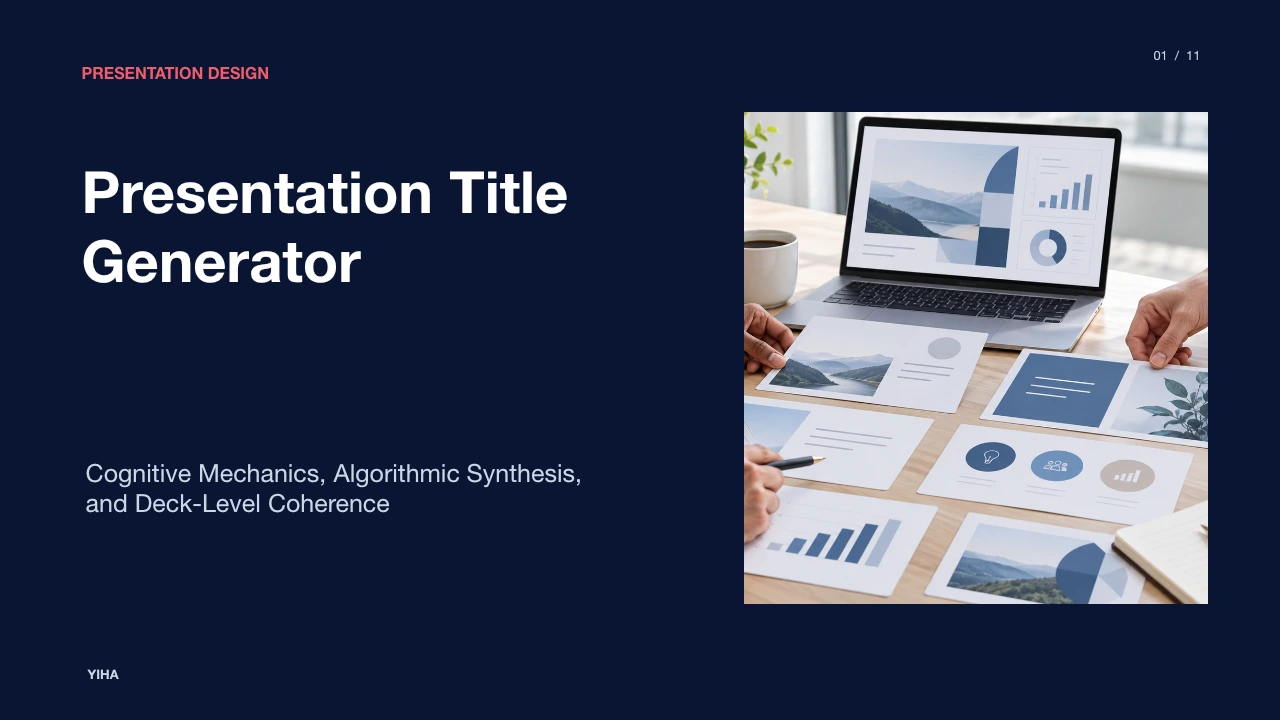
Presentation Title Generator
Discover how automated presentation title generators transform raw slide notes into structured headlines, balance audience tone, and preserve narrative consistency across slide decks.
Free download · 4.9 MB11 editable slides · PowerPoint format
Download the editable PPTX
PPTX · 4.9 MB · 11 editable slides · Free to edit and reuse with attribution to Yiha.ai
View every slide
Use ← →, Home/End, or swipe on mobile
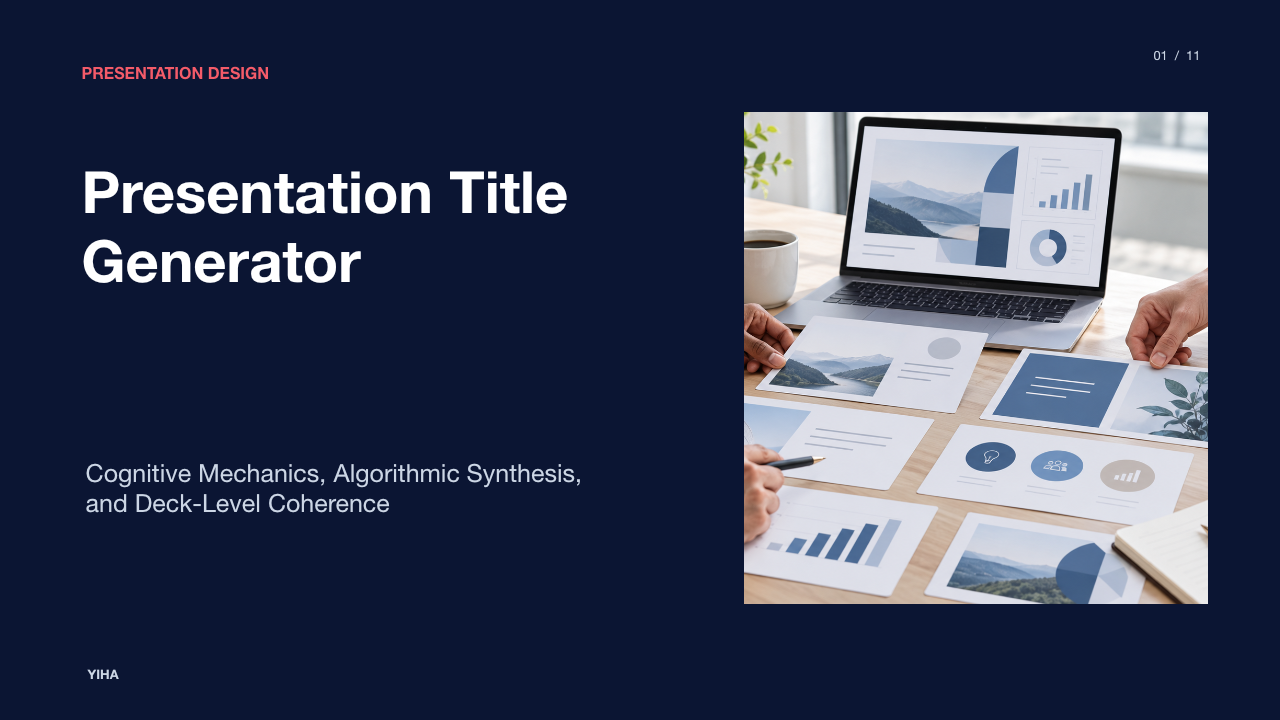
Slide titles serve as the primary navigational signposts of an executive briefing, academic lecture, or pitch deck. When listeners view a slide, the title determines how they interpret charts, data points, and narrative arguments. Automated presentation title generators use language models to extract core messages from rough outlines, speaker notes, and draft text, converting vague topics into structured headlines. Understanding the mechanics behind these tools helps presenters craft sharper slides, choose appropriate headline architectures, and maintain deck-wide narrative continuity.
Cognitive Processing and How Titles Prime Audience Attention
Audience members process presentations through two parallel channels: visual inputs and verbal explanations. When a slide appears, viewers instinctively read the headline before scanning visual charts or listening closely to the speaker. A descriptive title functions as an advance cognitive anchor that primes audience comprehension, establishing what information matters most on the page. As noted on Presentation Name Generator, the opening slide and agenda line dictate whether audience members actively lean in or turn their attention elsewhere. The guide emphasizes that titles should state an explicit outcome, highlight core tension, or pose a question that audiences actively care about, rather than settling for passive labels like "Marketing Update".
Furthermore, automated tools like Twistly Presentation Title Generator target the cognitive difficulty of initial drafting by generating alternative headline angles from rough concepts. When an audience reads an ambiguous topic label, extraneous cognitive effort is spent guessing the slide purpose. Conversely, an explicit title directs selective attention toward the key metric or visual comparison, freeing working memory to evaluate the presenter spoken rationale.
Title Structures: Topic Labels Versus Assertion Headlines
Presentation headlines generally fall into two categories: category-level topic labels and conclusion-oriented assertion headlines. A topic label merely names the subject area, such as "Regional Logistics" or "Market Trends." This approach forces the viewer to decipher supporting charts to uncover the main finding. In contrast, an assertion headline states the complete conclusion in an active format. For example, in an illustrative example explaining delivery bottlenecks, an assertion headline might state: "Regional Logistics Bottlenecks Delay Coastal Shipments."
According to Kollab Slide Title Generator, automated titling tools convert static topic labels like market trends or user feedback into conclusion-style headlines that emphasize growth, operational risks, or specific next actions. This point-first structure ensures readers understand the slide purpose immediately. Supplementary platforms such as Musely Presentation Title Generator provide formatting options including how-to structures, colon-and-subtitle combinations, and question formats. Colon-and-subtitle structures allow a punchy primary phrase to capture attention while a secondary clause establishes technical scope.
Natural Language Models in Headline and Title Generation
Automated title generation relies on natural language processing architectures to compress multi-line slide copy into concise headings. Rather than simple keyword extraction, modern tools use abstractive text summarization. These models parse the semantic relationships between bullet points, chart labels, and speaker notes, identifying the primary assertion while removing redundant phrasing.
As explained on Twistly Presentation Title Generator, systems powered by large language models analyze draft concepts to produce multiple phrasing options across distinct stylistic angles. Similarly, Musely Presentation Title Generator evaluates user inputs against extensive linguistic pattern databases to synthesize headline suggestions that balance thematic relevance with verbal brevity. The underlying models evaluate candidate words based on probability distributions, predicting headline formulations that retain core meaning while matching standard syntactic conventions.
Conditioning Outputs on Audience Context and Presentation Tone
Effective presentation titles vary widely depending on the audience and institutional setting. A casual metaphor suitable for a tech keynote may undermine credibility in a regulatory board review or academic colloquium. Automated title generators address this requirement through controllable generation, conditioning outputs on user-specified tone parameters.
As documented by Kollab Slide Title Generator, generators allow presenters to select specific tonal registers, including executive, sales, classroom, product-launch, or formal styles. This conditioning alters vocabulary selection, formality, and rhetorical directness. Furthermore, Musely Presentation Title Generator enables users to fine-tune outputs according to occasion, audience persona, and specific must-include terminology. By constraining vocabulary and phrasing patterns, the system ensures that technical pitch decks receive problem-oriented headlines while internal training decks emphasize instructional takeaways.
Managing Brevity and Syntactic Constraints in Automated Titling
Presentation design imposes severe spatial constraints. A slide headline that wraps across three or four lines crowds visual exhibits, reduces legibility, and overwhelms the audience. Title generators apply decoding constraints to keep output lengths within strict boundaries.
Recommendations published on Musely Presentation Title Generator suggest targeting concise headline lengths of 50 to 70 characters for clear legibility and visual balance. Automated systems enforce these character and word targets during generation. In parallel, Kollab Slide Title Generator shows how automated tools shorten long report headings into compact slide headlines that fit presentation layouts while preserving original core meaning. Automated decoders enforce length limits during generation, shortening long report headings into compact slide banners without truncating critical semantic clauses.
Deck-Level Narrative Coherence and Storyline Progression
While optimizing individual slide titles improves local comprehension, presentations succeed or fail based on deck-level narrative coherence. When slides are generated in isolation, the resulting deck can feel disjointed, featuring mismatched grammatical structures and contradictory narrative pacing. Structured communication models emphasize that reading every slide headline in sequence should form an unbroken, logical narrative.
According to Kollab Slide Title Generator, processing an entire deck outline at once allows the tool to verify headline length, syntactic structure, tone, and narrative order so the presentation does not appear stitched together. In dedicated investor contexts, tools like PitchGrade Title Slide Generator focus on framing opening slides around overarching market problems and investment propositions across numerous presentation modes. Maintaining uniform grammatical patterns across all slide titles preserves logical momentum from the opening premise to the concluding recommendation.
Evaluating Factual Faithfulness and Title Alignment
Automated title generation introduces the operational risk of factual hallucination or semantic distortion. Because title generators prioritize brevity and punchy phrasing, language models may inadvertently drop necessary qualifiers, exaggerate provisional findings, or misattribute causal relationships present in the underlying data.
To safeguard factual accuracy, presenters must establish rigorous evaluation criteria. As recommended on Musely Presentation Title Generator, users must review generated options carefully, verify that the chosen title accurately reflects slide evidence, customize phrasing to restore nuance, and test headlines with colleagues before public delivery. Furthermore, Kollab Slide Title Generator highlights that headline generation should derive strictly from slide evidence, preserving core factual meaning while converting raw data into conclusion-driven summaries. Presenters must reject algorithmic headlines that assert absolute certainties when supporting charts only demonstrate provisional correlations.
Human-in-the-Loop Refinement and Prompting Strategies
Algorithmic title generators function best as collaborative drafting partners rather than autonomous publishing systems. Presenters who achieve the highest headline quality use iterative prompt refinement and targeted editing workflows.
Operational workflows outlined on Musely Presentation Title Generator instruct authors to input specific topic keywords, specify mandatory terminology, review a broad candidate list, and adapt wording to match presentation objectives. In addition, Name Generator Central suggests testing title viability by reading options aloud within a standard speaker introduction sentence to identify awkward phrasing before finalizing the deck. Presenters should actively combine generative brainstorming tools like Twistly Presentation Title Generator with rigorous personal editing, pruning formulaic jargon and tailoring vocabulary to audience expectations.
Risks of Automated Titling: Cliché, Tone Mismatch, and Ambiguity
Despite their efficiency, automated titling tools exhibit notable limitations. Left unmonitored, language models tend to rely on formulaic corporate buzzwords and sensationalist phrasing. These generic constructions obscure technical precision and reduce audience trust.
As discussed on Name Generator Central, clever or rhetorical titles frequently fail when the underlying topic becomes ambiguous, noting that questions like "Is Data Important?" sound flat compared to clear inquiries such as "Who Owns the Data?". Automated generators evaluated across Twistly Presentation Title Generator and Kollab Slide Title Generator can occasionally produce tonal mismatches if prompts lack contextual detail, generating casual marketing hooks for sober financial or operational updates. Presenters must remain vigilant against exaggerated claims, ensuring every generated headline maintains professional restraint, clear subject matter, and alignment with slide evidence.
Research sources
- Presentation Title Generator - Get Creative Titles Instantly | Twistly · twistly.ai
- Free AI Slide Title Generator for Presentation Decks | Kollab · kollab.im
- Presentation Name Generator – 500+ Catchy Title Ideas · www.namegeneratorcentral.com
- Best Free Presentation Title Generator | Craft Catchy Titles - Musely · musely.ai
- Title Slide Generator · pitchgrade.com