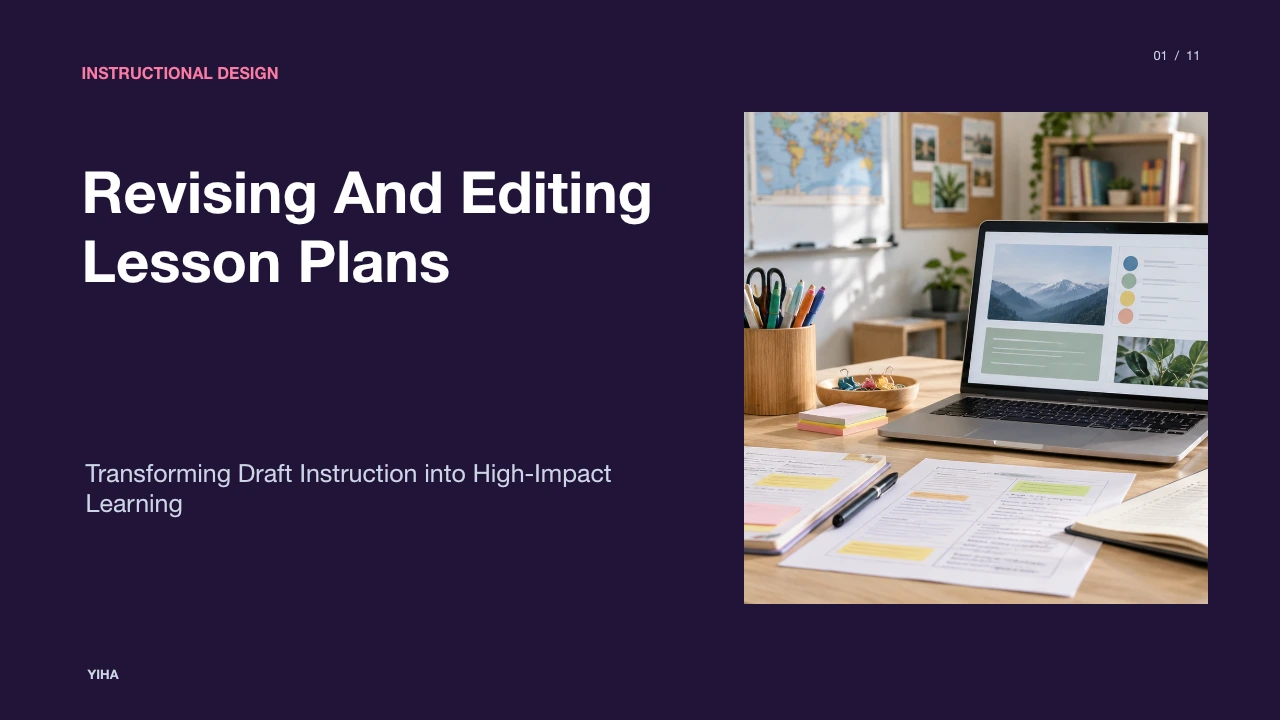
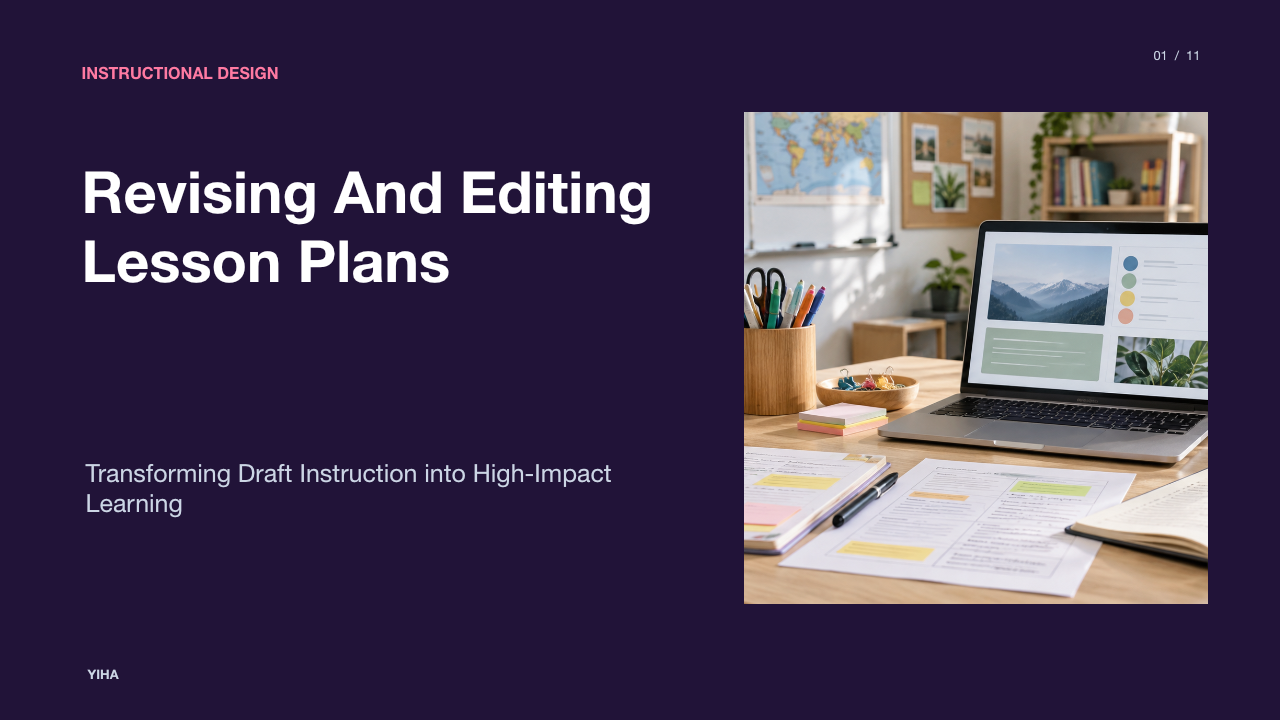
Revising And Editing Lesson Plans
A comprehensive guide on refining lesson plans through structural revision and mechanical editing, ensuring tight alignment between learning objectives and classroom execution.
Free download · 4.9 MB11 editable slides · PowerPoint format
Download the editable PPTX
PPTX · 4.9 MB · 11 editable slides · Free to edit and reuse with attribution to Yiha.ai
View every slide
Use ← →, Home/End, or swipe on mobile
Instructional design does not conclude when a teacher drafts an initial lesson outline. While preliminary drafting creates an instructional blueprint, the true caliber of classroom teaching depends on systematic post-draft evaluation. Educators often treat lesson preparation as a static, single-pass administrative obligation. However, developing high-impact learning experiences demands two distinct modes of critique: structural revision and operational editing. Conflating these complementary processes leads to superficial modifications, where teachers adjust superficial wording or slide formatting while overlooking deep pedagogical disconnects. By separating macro-level pedagogical restructuring from micro-level mechanical polishing, educators can transform static lesson plans into responsive, rigorous learning architectures.
The Core Distinction: Revising Versus Editing Plans
To refine curriculum materials effectively, instructors must distinguish between pedagogical revision and mechanical editing. In writing instruction, revision represents structural reconstruction, whereas editing targets mechanical correctness. As highlighted in writing pedagogy by Undercover Classroom, revision is the heavy lifting of adding, rearranging, or removing structural components, while editing focuses on singular technical mechanics like punctuation and formatting. Applying this conceptual division to instructional design clarifies two distinct levels of planning.
Pedagogical revision operates at the macro-structural level. It asks fundamental questions about conceptual sequencing, inquiry depth, and cognitive demand. When an instructor revises a lesson plan, they examine whether the stated objective aligns with broader curriculum trajectories and whether the instructional tasks support the desired conceptual shift. According to the Poorvu Center for Teaching and Learning, frameworks such as Backward Design prioritize student-centered learning where learners actively construct knowledge, requiring teachers to rethink whether activities truly lead toward target outcomes rather than simply delivering content.
In contrast, lesson editing operates at the operational and logistical level. Editing addresses the mechanics of classroom execution: clarifying prompt syntax, refining student-facing directions, inserting precise time allocations, ensuring digital hyperlinks are active, and polishing rubric terminology. When an educator confuses editing with revision, they might fix a confusing sentence in a handout while leaving an unaligned, cognitively mismatched activity completely intact.
Diagnostic Reflection: Auditing Classroom Evidence
Meaningful revision relies on objective diagnostic data rather than general classroom impressions. Following an instructional period, teachers frequently rely on instinct, concluding that a lesson went well merely because student behavior was orderly. However, student compliance does not guarantee learning. As emphasized by ITTT's guide on Reflecting and Revising Lesson Plans, continuous improvement requires educators to evaluate tangible student learning outcomes and systematically gather diagnostic data through regular reflection.
To conduct an evidence-based audit, educators must collect and analyze real-time artifacts. Formative assessments such as exit tickets, quick writes, and check-for-understanding prompts offer direct visibility into student comprehension. Examining student work reveals recurring patterns of confusion. For example, if half of the class misinterprets an underlying conceptual premise on an exit ticket, the lesson plan cannot simply be filed away. The teacher must audit the initial explanation, the guided practice scaffolds, and the models provided.
Pacing mismatches and uncompleted tasks also serve as diagnostic evidence. When an essential independent practice task is repeatedly truncated across class sections, the lesson plan suffers from a structural pacing flaw. A diagnostic audit logs these timing bottlenecks, noting where students stalled and identifying extraneous teacher monologues that consumed valuable student work time.
Pedagogical Alignment: Synchronizing Goals and Tasks
Curricular alignment forms the backbone of coherent instruction. A frequent vulnerability in lesson planning is the presence of high-interest activities that fail to generate authentic evidence of learning standards. In an analysis of instructional design, ASCD's study on lesson storylines observed that classrooms often default to novelty and games to boost engagement, yet these activities frequently fail to support content ideas in coherent and challenging ways. A lesson plan requires a coherent storyline where every instructional phase moves students toward explicit learning goals.
Conducting a backward-design alignment audit requires evaluating the relationship among three components: target objectives, formative assessments, and classroom tasks. The Poorvu Center for Teaching and Learning notes that backward design begins with desired learning outcomes and designs assessments and activities to meet those ends. If the learning objective specifies that students will evaluate the validity of conflicting primary sources, but the corresponding worksheet only asks students to match dates with events, a severe alignment breakdown exists.
During revision, teachers must prune extraneous instructional material. Well-intentioned activities that consume disproportionate instructional time without advancing the core standard should be modified or cut. An illustrative example of this alignment pruning involves a science lesson where students spend thirty minutes cutting and pasting paper cell models; revising this lesson replaces manual assembly with an analytical diagramming task where students trace organelle interactions, ensuring tasks directly reflect intended cognitive outcomes.
Pacing and Cognitive Flow: Restructuring Time
Poor pacing often stems from an overloaded curriculum rather than poor classroom management. When lesson plans attempt to cover excessive content within a single class period, cognitive overload occurs, degrading comprehension. In an examination of classroom realities, ASCD's critique of rigid lesson planning notes that traditional, overly rigid plans quickly fall apart in live classrooms due to student questions, unexpected hurdles, and pacing mismatches, highlighting the need for flexible, responsive design frameworks.
Restructuring lesson time requires mapping cognitive load across the entire instructional block. Bloated direct instruction represents a common structural flaw. Extended teacher explanations exhaust student working memory. Lesson plans should be revised to introduce direct instruction in manageable segments interspersed with active processing tasks and formative checkpoints.
Furthermore, lesson revisions must incorporate realistic transition buffers and dedicated closure routines. Transitioning from small-group discourse to independent writing requires explicit logistical cues and movement protocols. When lesson plans allocate zero minutes for transition management, instructional schedules collapse. A revised lesson plan explicitly reserves five to ten minutes for an intentional closure routine, ensuring students synthesize key insights before leaving the room.
Differentiating Instruction: Expanding Access and Scaffolds
Standardized, one-size-fits-all lesson plans inevitably fail diverse student populations. When revising instructional materials, educators must shift from uniform delivery toward tiered, multi-pathway architectures. In their work on integrating instructional models, Carol Ann Tomlinson and Jay McTighe establish that while backward design dictates what is taught, differentiated instruction addresses whom, where, and how we teach, ensuring that diverse learners achieve meaningful understanding.
Applying Universal Design for Learning (UDL) principles during the revision stage embeds accessibility into the plan rather than tacking on ad-hoc modifications mid-lesson. Revising for differentiation means integrating multimodal entry points: pairing academic text with visual diagrams, audio resources, and structured graphic organizers. For multilingual learners, lesson plans should be revised to include explicit sentence frames, bilingual glossaries, and structured cooperative dialogue protocols.
Crucially, scaffolding must not lower the cognitive demand of the core standard. If a standard asks students to formulate a mathematical justification, scaffolding should provide conceptual sentence starters or manipulative models, not reduce the task to simple mechanical computation. Extension pathways for advanced students should similarly focus on conceptual complexity, transfer, and open-ended inquiry rather than simply assigning additional busywork.
Mechanical Editing: Polishing Prompts, Cues, and Timing
Once macro-pedagogical revisions are complete, the plan enters the mechanical editing phase. Operational editing refines the practical language and logistical cues that guide instructional delivery. Vague or rambling teacher talk during classroom execution often traces back to unedited lesson plans. As demonstrated in foundational early childhood planning by The Schoolhouse, structured and organized plans provide clear roadmaps that keep learning purposeful and achievable across developmental stages.
Editing teacher talk involves converting loose, open-ended remarks into scripted, high-leverage questioning sequences. Instead of listing an unedited note such as "discuss the text," an edited lesson plan scripts precise questions arranged by cognitive level. For example, a plan might specify: "1. Identify the protagonist's core dilemma; 2. Contrast her decision with historical precedent; 3. Predict the societal reaction." Clear, sequenced prompts prevent hesitation and keep instructional momentum focused.
Mechanical editing also entails auditing external resources and layout legibility. Teachers must verify that digital links, video timestamps, and multimedia assets function correctly. Student-facing worksheets and digital slides must be reviewed for visual clarity, eliminating visual clutter, ambiguous headings, and confusing multi-part directions that distract from core academic tasks.
Collaborative Review: Peer Tuning and Lesson Study
Individual reflection can miss blind spots, making peer collaboration an essential mechanism for curriculum refinement. Lesson study offers a powerful framework for this collaborative work. As explored in ASCD's analysis of rough draft teaching, Japanese lesson study treats teaching as a continuous, cyclical process of study, planning, teaching, and collective reflection, freeing educators to test and refine lessons without fear of administrative judgment.
Within professional learning communities, peer review protocols allow colleagues to stress-test draft lesson plans before implementation. During a protocol session, a teacher presents an instructional draft, articulating the core learning goals and anticipated student challenges. Colleagues offer clarifying questions, analyze the alignment between tasks and assessments, and provide constructive feedback on potential pacing or conceptual hurdles.
Deprivatizing lesson planning shifts the focus from individual teacher performance to collective curriculum refinement. When educators co-design, observe, and adjust lessons together, curriculum materials evolve into shared, robust departmental resources. Collaborative review provides objective feedback, identifying unclear explanations and logistical gaps before a plan reaches students.
Leveraging EdTech and AI for Responsive Adaptations
Educational technology and generative AI platforms can accelerate routine lesson revision tasks, provided teachers maintain instructional leadership. Drafting multiple versions of a text, generating tiered rubrics, and constructing formative checks manually can be excessively time-consuming. According to Time Thrills, generative planning tools can assist educators by drafting initial variations, reducing logistical burdens, and allowing teachers to dedicate more energy to student-centered facilitation.
AI tools excel at generating varied reading Lexile levels for complex texts, translating vocabulary lists into multiple languages, and producing diverse multiple-choice distractors for formative checks. Digital tools can also convert dense narrative plans into visual pacing schedules or interactive agendas. As outlined by the Poorvu Center for Teaching and Learning, technology and instructional frameworks should serve deliberate pedagogical goals, ensuring that automated adaptations align directly with student needs.
However, teachers must treat AI outputs as preliminary drafts. Automated tools lack contextual understanding of specific classroom dynamics, cultural nuances, and individual student progress. Educators must review every generated prompt and check every factual assertion, modifying machine-generated content to match classroom realities.
Version Control: Building Living Curriculum Repositories
Without intentional documentation systems, daily lesson plan adjustments are easily lost. Teachers frequently write margin notes on paper handouts or make verbal adaptations during class, only to forget those refinements by the following school year. As emphasized in ASCD's rough draft teaching framework, viewing curriculum design through continuous improvement (Kaizen) requires treating lesson plans as evolving artifacts rather than static, one-time binders.
Instituting structured version control ensures that daily classroom adjustments enhance long-term instructional quality. Digital repositories, shared drives, and version-tracked documents allow educators to preserve post-lesson notes immediately after teaching. A standard post-lesson note logs three key data points: actual task completion times, recurring student misconceptions, and specific prompts that required re-explanation.
Departmental teams can establish annual archiving routines. Before archiving a curriculum unit, teachers integrate their annotated margin notes into the master lesson document, replacing flawed tasks and updating resources. This systematic maintenance transforms static binders into dynamic, high-quality institutional curriculum repositories that support sustainable, long-term teaching excellence.
Research sources
- Teaching and Learning Frameworks | Poorvu Center for Teaching and Learning · poorvucenter.yale.edu
- Preschool Education Lesson Plans: A Guide to Effective Preschool Activities · www.theschoolhouse.org
- The Difference Between Revising and Editing - Undercover Classroom · www.undercoverclassroom.com
- Playwriting Lesson Plans for Drama Teachers | DTA · www.theatrefolk.com
- Reflecting and Revising Lesson Plans | ✔️ ✔️ ✔️ ITTT · www.teflonline.net
- Reflecting and Revising Lesson Plans | ✔️ ✔️ ✔️ ITTT · www.teflcourse.net
- Every Lesson Needs a Storyline · www.ascd.org
- Why Teachers Shouldn’t Have to Submit Lesson Plans · www.ascd.org
- Integrating Differentiated Instruction & Understanding by Design: Connecting Content and Kids · www.ascd.org
- Free AI lesson plan generator to create impressive lesson plans in minute · www.visme.co
- Time Thrills · www.timethrills.com
- Reflecting and Adapting Lesson Plans | ✔️ ✔️ ✔️ ITTT · www.tesolonline.com
- Taking Risks with Rough Draft Teaching · www.ascd.org
- Editing and Proofreading Lesson Plans & Worksheets · www.lessonplanet.com