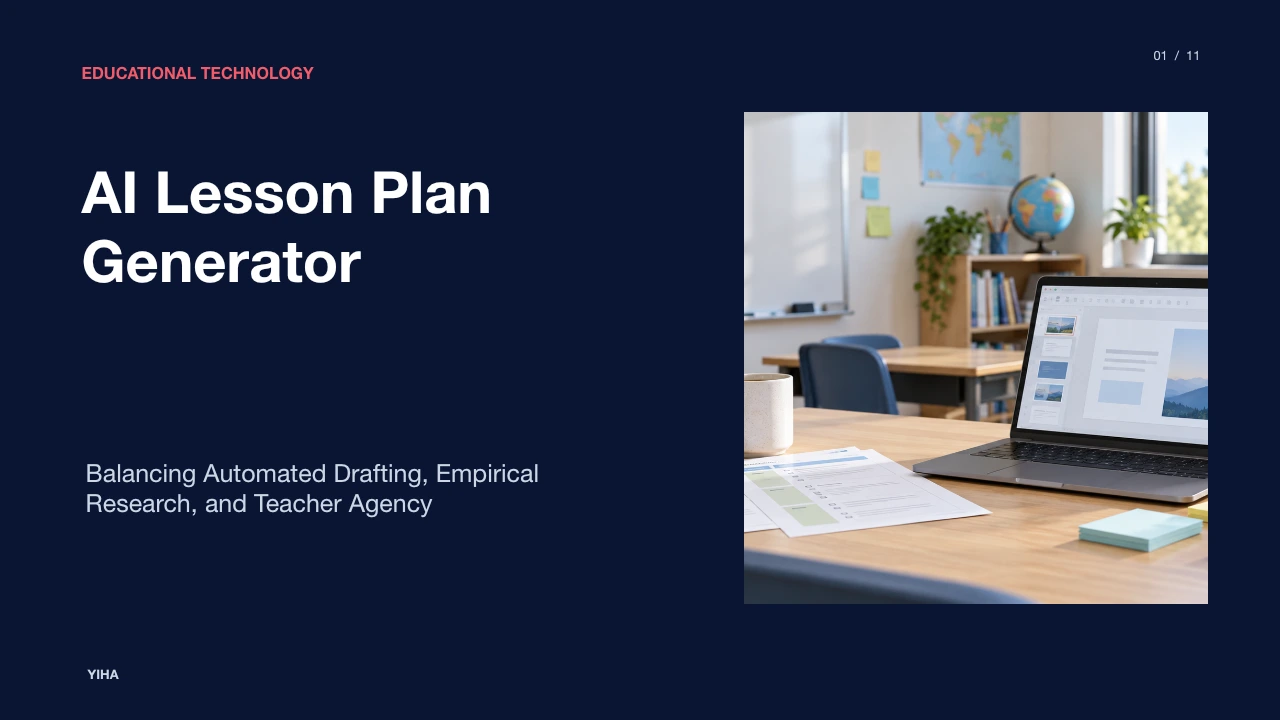
AI Lesson Plan Generator
An in-depth analysis of AI lesson plan generators examining empirical workload reductions, architectural prompting structures, multi-tiered differentiation, and essential human-in-the-loop safeguards.
Free download · 4.9 MB11 editable slides · PowerPoint format
Download the editable PPTX
PPTX · 4.9 MB · 11 editable slides · Free to edit and reuse with attribution to Yiha.ai
View every slide
Use ← →, Home/End, or swipe on mobile
Instructional preparation forms the backbone of effective classroom teaching, yet it remains one of the most demanding administrative duties educators navigate each week. The rapid evolution of generative artificial intelligence has brought automated drafting tools into the center of educational practice. An AI lesson plan generator uses natural language processing to produce instructional frameworks, learning objectives, tiered activities, and assessment rubrics in seconds. However, implementing these systems effectively requires understanding their architectural mechanisms, empirical classroom outcomes, curricular alignment capabilities, and inherent pedagogical limitations.
The Instructional Burden and the Planning Bottleneck
Lesson planning is among the most labor-intensive responsibilities in modern education. Practicing educators frequently spend between 7 and 12 hours every week preparing instructional units outside of direct instructional time, according to research documented in the Guidde Free AI Lesson Plan Generator Guide. For each single comprehensive lesson, standard preparation routines demand anywhere from 45 to 90 minutes as an illustrative baseline. Teachers must draft clear learning intentions, gather resources, formulate formative checks, and design student-centered activities across multiple daily preparations.
When administrative overhead compounds these duties, instructional planning often faces compressed timelines. Automated generators provide relief by compiling structural blueprints in a matter of seconds to minutes. Platforms such as the MagicSchool AI Lesson Plan Generator allow teachers to establish initial lesson parameters rapidly, reducing the friction of facing a blank page. The primary value of an automated planner lies in removing initial drafting friction, allowing practitioners to pivot their focus from repetitive typing toward targeted pedagogical refinement.
Architectural Foundations of AI Lesson Plan Generators
Modern lesson generators rely on instruction-tuned large language models (LLMs) that interpret user inputs through tokenized representations and specialized prompting frameworks. As outlined in Microsoft Generative AI for Beginners Prompt Engineering Fundamentals, prompt engineering operates as a programming interface where structured inputs directly dictate response relevance and consistency. Vague requests like asking for a generic science lesson typically produce shallow, disengaged text. In contrast, structured prompt architectures constrain the model to follow proven pedagogical methodologies.
Effective prompting frameworks often follow explicit structural components, such as the Role, Task, Context, and Output (RTCO) model described by Schorbit Prompt Engineering for Teachers. In this architecture, the user assigns an instructional persona, defines the exact pedagogical objective, provides student demographics along with accommodations, and specifies table formatting and timing constraints. This guided input structure enables the underlying model to generate coherent pedagogical steps rather than generic subject summaries.
Translating Standards into Structured Learning Sequences
Translating state, national, or international curriculum benchmarks into classroom execution requires intentional sequencing. Standalone tools like the 101Planners AI Lesson Plan Generator construct lesson sequences consisting of anticipatory hooks, direct instruction, guided practice, independent tasks, and summative closures. However, simply tagging a plan with a standard name does not guarantee true alignment.
To ensure academic rigor, educators must verify that generated objectives target specific cognitive levels such as Bloom's Taxonomy. The Skillshift AI Curriculum Alignment Checklist emphasizes that AI integration must deliberately map capabilities against established standards like Common Core or Next Generation Science Standards (NGSS). This involves validating that the direct instruction steps explicitly build foundational knowledge and that guided practice activities assess the exact skill specified in the curriculum mandate.
Empirical Findings on Teacher Workload and Lesson Quality
While anecdotal claims of productivity abound, randomized controlled trials offer verified evidence regarding generative tools in school environments. The Education Endowment Foundation ChatGPT Lesson Preparation Trial conducted an independent evaluation with the National Foundation for Educational Research across 68 secondary schools in England involving 259 science teachers. In this trial, teachers using ChatGPT alongside an implementation guide experienced a 31% reduction in lesson and resource planning time, averaging 56.2 minutes per week compared to 81.5 minutes for the unassisted control group, representing a weekly saving of 25.3 minutes.
Importantly, an independent expert panel reviewed resource samples without knowing their generation origin and found no noticeable difference in pedagogical quality between the AI-assisted and control groups. These findings demonstrate that structured generative assistance can reduce administrative drafting time without degrading instructional materials, provided that teachers apply professional vetting.
Multi-Tiered Differentiation and Scaffolding in Practice
Classroom rosters routinely contain wide variations in reading readiness, language proficiencies, and individualized support plans. As detailed in the TeacherPlug Best AI Differentiation Tools Guide, AI platforms facilitate multi-tiered adaptations by rewriting source texts across reading levels, providing bilingual glossaries for English Language Learners (ELL), and constructing executive functioning supports for students with Individualized Education Programs (IEPs).
Illustrative example (pedagogical mechanism demonstration): In a lesson on cellular respiration, a teacher might use an AI generator to produce three scaffolded tiers:
- Tier 1 (Foundational Scaffolding): Includes visual word banks with definitions for terms like glucose and ATP, cloze notes for direct instruction, and sentence stems for guided practice.
- Tier 2 (Target Grade-Level): Standard graphic organizer comparing inputs and outputs with short-answer explanatory questions.
- Tier 3 (Advanced Inquiry): Open-ended extension prompt investigating metabolic pathways in anaerobic environments without guiding prompts.
As emphasized by Structural Learning AI for Differentiation in the Classroom, educators must actively manage cognitive load, ensuring that scaffolds reduce extraneous friction without lowering the core conceptual challenge of the lesson.
Dedicated Platforms Versus General-Purpose Models
Schools must choose between dedicated education platforms and general conversational models. EduGenius's product comparison describes how dedicated tools embed pedagogical fields into their interfaces. This is a product comparison, not original evidence of teacher adoption or abandonment rates. General chat tools require teachers to specify learning goals, prior knowledge, timing and assessment criteria. A practical evaluation should compare how much editing each workflow needs for the same lesson rather than rely on an uncited survey percentage.
General conversational models offer substantial flexibility but lack native educational form fields, requiring educators to write multi-sentence constraints to generate clean tables or rubrics. Academic research compiled in Large Language Models for Education Survey (ArXiv) indicates that while general LLMs are capable zero-shot solvers, educational applications benefit from domain-specific conditioning, structured prompting pipelines, and external verification layers that minimize output variance.
Pedagogical Pitfalls: Low Cognitive Demand and Context Gaps
Despite their drafting speed, generative tools introduce predictable pedagogical risks when used without critical oversight. General language models tend to bias toward lower-order recall questions and predictable fill-in-the-blank activities, frequently neglecting higher-order analytical reasoning. Furthermore, models operate without awareness of local classroom dynamics, physical room arrangements, available science laboratory apparatus, or student group dynamics.
As highlighted in the TeacherTechLab AI Lesson Plan Generator Guide, AI drafts should always be viewed as provisional starting points rather than finalized classroom documents. Large language models can also hallucinate historical dates, misattribute literary quotes, or suggest impractical science demonstrations. Without rigorous teacher verification, unedited plans risk propagating factual inaccuracies and superficial learning tasks.
Responsible Implementation and Human-in-the-Loop Safeguards
Adopting automated curriculum generators safely requires strict governance protocols and data privacy compliance. Federal statutes like the Family Educational Rights and Privacy Act (FERPA) require educators to prevent personally identifiable student information from entering public machine learning models. Dedicated systems featured in TeachTools AI Lesson Plan Generator note that compliance is preserved when tools operate strictly on educator-facing prompts without collecting, storing, or processing student records.
School districts must establish a mandatory human-in-the-loop review policy before any AI-generated material enters the classroom. Under this protocol, the teacher serves as the final editorial authority. Educators must review all generated texts for factual correctness, verify that reading levels suit their specific pupils, adjust timing allocations to reflect classroom transitions, and confirm that all materials align with local district curriculum policies.
The Future of Teacher Agency in Curriculum Design
Generative technology does not replace the intricate human judgment required to teach effectively. Tools such as Guidde and MagicSchool accelerate the production of outlines and instructional media, but they cannot interpret subtle student confusion, manage collaborative classroom discourse, or build supportive mentor relationships. The true role of an AI lesson plan generator is administrative assistance, lifting the burden of clerical drafting.
By reclaiming planning time from repetitive template completion, educators gain valuable capacity for reflective teaching, personalized student feedback, and adaptive instructional responses. Placing the teacher's professional discernment at the center ensures that technology acts as a supportive drafting tool, preserving human agency and pedagogical integrity across modern schools.
Research sources
- Free AI Lesson Plan Generator: The Complete Guide for Teachers 2026 | Guidde · www.guidde.com
- AI Lesson Plan Generator | Online lesson planner · www.101planners.com
- AI Lesson Plan Generator for Teachers | MagicSchool · www.magicschool.ai
- Prompt Engineering for Teachers: Lesson Plans & AI Prompts Free - Schorbit(All in 1) · schorbit.com
- generative-ai-for-beginners/04-prompt-engineering-fundamentals/README.md at main · microsoft/generative-ai-for-beginners · GitHub · github.com
- AI Curriculum Alignment: Standards-Based Planning Guide · theskillshift.com
- AI Lesson Plan Generator for Teachers | Free for Teachers | TeachTools · teachtools.co
- ChatGPT In Lesson Preparation: A Teacher Choices Trial Evaluation Report | SCALE Initiative · scale.stanford.edu
- Teachers using ChatGPT - alongside a guide to support them to… | EEF · educationendowmentfoundation.org.uk
- ChatGPT in lesson preparation - Teacher Choices trial | EEF · educationendowmentfoundation.org.uk
- Best AI differentiation tools for the classroom in 2026 | TeacherPlug · teacherplug.com
- AI for Differentiation in the Classroom: A Guide · www.structural-learning.com
- Large Language Models for Education: A Survey and Outlook · arxiv.org
- EduGenius vs ChatGPT for Education — Why Purpose-Built Tools Win | EduGenius · www.edugenius.app
- AI Tools for Teachers: An Independent Comparison (2026) · www.structural-learning.com
- AI Lesson Plan Generator – Free Lesson Planner for Teachers · teachertechlab.com