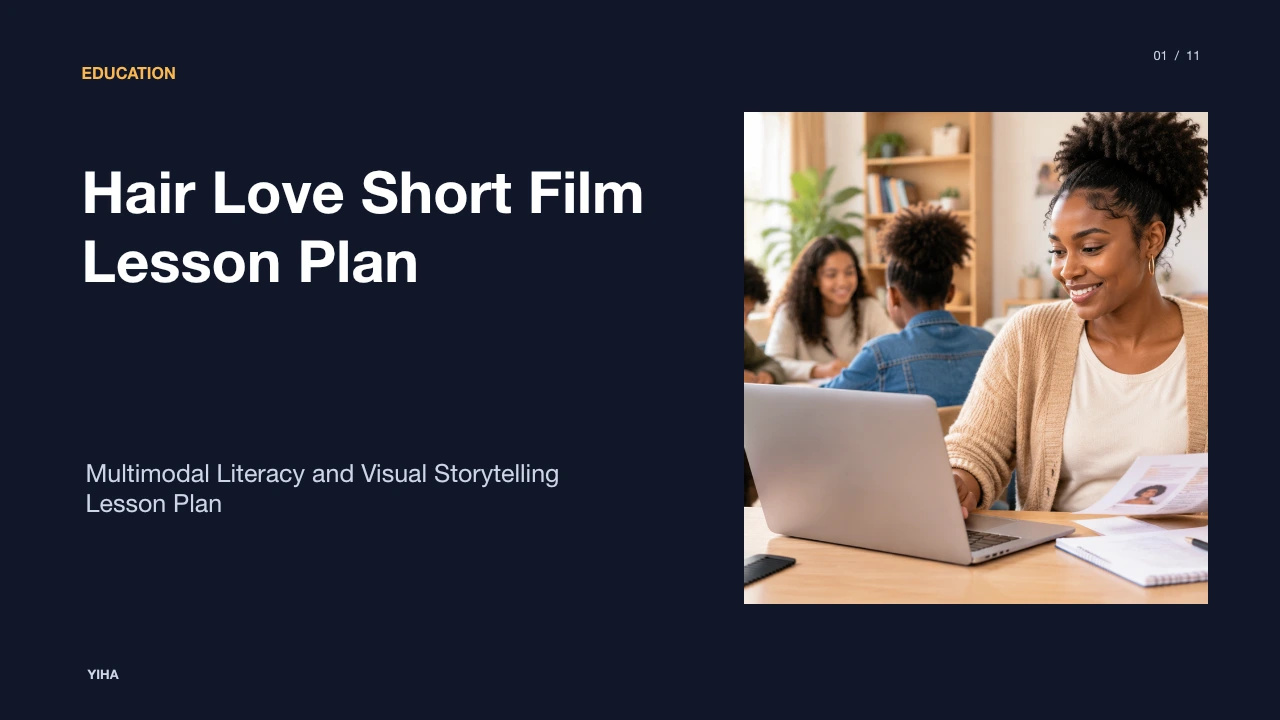
Hair Love Short Film Lesson Plan
Explore a complete instructional lesson plan for the animated short film Hair Love, integrating multimodal literacy analysis, social-emotional learning, character conflict study, and differentiated elementary classroom activities.
Free download · 4.9 MB11 editable slides · PowerPoint format
Download the editable PPTX
PPTX · 4.9 MB · 11 editable slides · Free to edit and reuse with attribution to Yiha.ai
View every slide
Use ← →, Home/End, or swipe on mobile
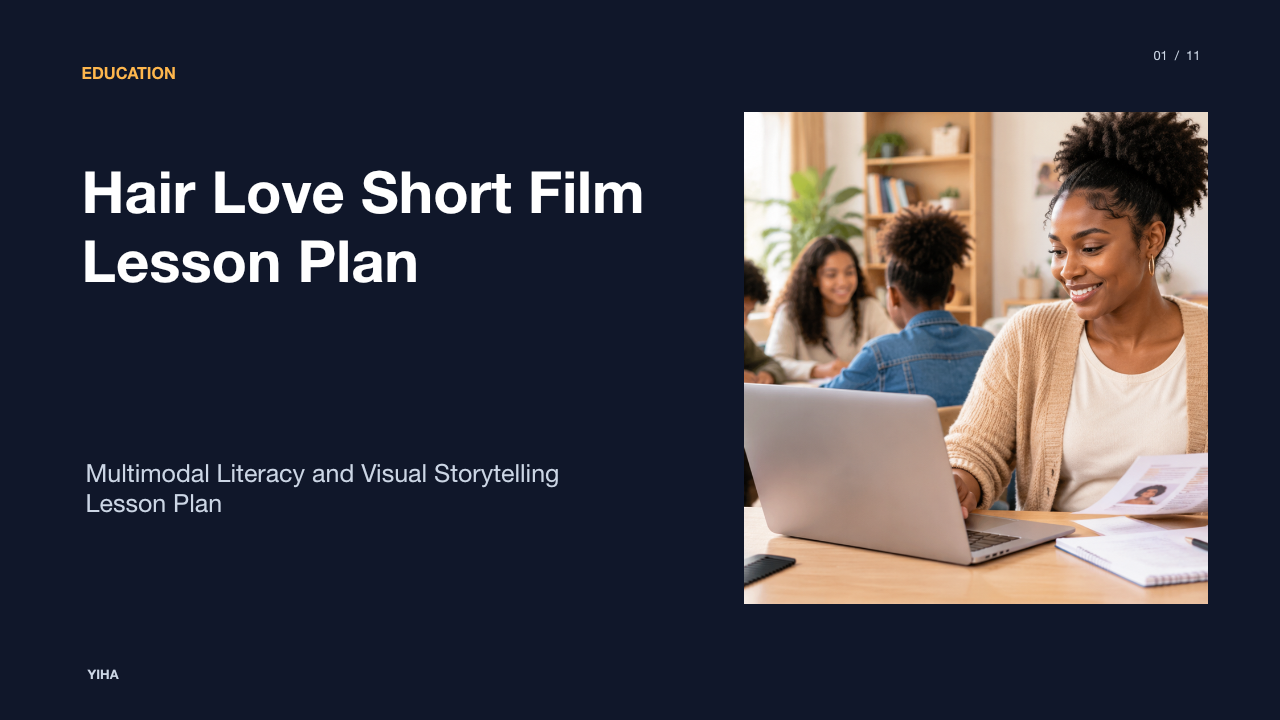
Short animated films offer educators a dynamic medium to teach narrative structure, emotional nuance, and character development in the literacy classroom. Matthew A. Cherry's story Hair Love provides a rich, accessible narrative that bridges early childhood storytelling and multimodal analysis. Centered on young Zuri and her father navigating the challenges of styling natural hair, the story combines humor, emotional vulnerability, and family affection. This lesson plan provides teachers with a structured, standards-aligned framework to explore Hair Love through pre-viewing schema activation, visual literacy deconstruction, comparative text study, and differentiated response activities.
Context and Significance of Hair Love
Understanding the background of Hair Love enriches classroom dialogue and provides critical cultural context for students. Written by Matthew A. Cherry, the work centers on affirming Black family life and natural hair traditions. In classroom contexts documented by educational organizations like the D.C. Area Educators for Social Justice, early childhood and elementary classrooms have engaged in weeklong book studies of Hair Love to explore guiding principles such as diversity, Black families, intergenerational relationships, empathy, and unapologetically Black self-expression. By integrating this narrative into early literacy curricula, educators create space for young learners to explore family routines, celebrate diverse hair textures, and recognize the importance of loving paternal care. Analysis of these classroom implementations indicates that grounding literature units in shared family experiences allows young students to build cultural respect while developing early reading comprehension.
Core Instructional Objectives and Standards
Designing a rigorous instructional sequence requires aligning media study with foundational literacy and language standards. As established in multimodal educational frameworks highlighted by Film English, teaching through animated short films supports key language skills including listening, viewing, speaking, reading, writing, and visually representing. A standards-aligned unit for Hair Love targets several measurable learning objectives across primary and upper-elementary bands:
- Story Sequence and Plot Elements: Students identify the exposition, rising action, climax, falling action, and resolution within an animated timeline.
- Character Inference and Motivation: Learners infer internal feelings and motivations by analyzing nonverbal cues, posture, and facial shifts.
- Theme and Central Message: Students articulate themes of perseverance, unconditional love, self-confidence, and teamwork supported by evidence from the story.
- Social-Emotional Competence: Children evaluate how family members support each other through emotional vulnerability, frustration, and shared problem-solving.
Recommendation: Teachers should structure these objectives to address Common Core English Language Arts standards for Reading Literature and Speaking and Listening, ensuring that multimodal film analysis operates with the same academic rigor as traditional printed text.
Pre-Viewing Activities and Schema Activation
Activating prior knowledge before showing a short film primes students to observe crucial visual details and thematic motifs. Video-based pedagogy demonstrated on Film English emphasizes predictive tasks, character descriptions, and guided discussions of daily routines before viewing. For Hair Love, the teacher introduces essential hair care vocabulary to build shared descriptive language, introducing terms such as curls, coils, afros, parting, combs, and satin sleep bonnets.
As an illustrative instructional example, teachers can guide students through a two-step anticipation exercise:
- Morning Routine Discussion: Students share one part of their morning routine that feels challenging or requires patience, connecting their daily experiences with the idea of morning preparation.
- Predictive Image Prompt: Displaying a single frozen frame of Zuri looking in the mirror wearing her bonnet, students predict what challenge she faces and how she might solve it.
This structured schema activation ensures that every learner enters the screening with concrete observational goals, ready to connect their predictions with the unfolding narrative.
Deconstructing Visual Storytelling Without Words
Because animated shorts frequently communicate narrative arcs without relying on spoken dialogue, they serve as exceptional mentor texts for visual literacy. Structured short film lesson sequences cataloged on Lesson Planet highlight how viewing short films allows students to examine character actions, appearances, and narrative pacing. In Hair Love, visual cinematic devices perform the narrative work that dialogue would typically carry in traditional prose:
- Facial Expressions: The father's transition from sleepy confusion to determined resolve illustrates internal character change through subtle eyebrow and mouth movements.
- Camera Framing: Perspective shifts capture the hair expanding dramatically, visually establishing the magnitude of the conflict from a child's viewpoint.
- Musical Score and Pacing: Instrumental audio shifts from gentle melodies to energetic rhythms during difficult styling attempts, steering student emotional engagement across narrative beats.
Analysis indicates that pausing playback at key story intervals enables elementary learners to identify nonverbal character feelings that written text conveys through internal monologue.
Conflict, Metaphor, and Character Resilience
At the center of Hair Love is a relatable narrative conflict that unfolds across physical and emotional dimensions. The story uses an imaginative metaphor where styling unruly hair resembles a boxing or wrestling match. As observed in story analysis lesson guides on Lesson Planet, examining how characters respond when faced with a challenge allows learners to analyze perseverance, trial and error, and resolution.
- External Conflict: The father encounters unfamiliarity with hair styling techniques, resulting in tangled combs and messy attempts.
- Internal Conflict: The parent fears disappointing his daughter on a special family morning.
- Metaphorical Visualization: As an illustrative narrative analysis, depicting hair styling as an athletic bout externalizes internal frustration and humorously frames perseverance.
- Resolution through Teamwork: Success occurs when the father and daughter collaborate, review a digital styling tutorial together, and patiently follow each step.
This progression teaches students that resilience is not solitary endurance, but rather an active process of learning, seeking guidance, and trying alternative strategies.
Comparing the Short Film and the Picture Book
Hair Love exists both as a published picture book written by Matthew A. Cherry and as an animated short film. Comparing both formats provides an ideal exercise in dual-medium comparative literacy. Teaching frameworks on ReelMind emphasize comparing narrative structure, character portrayal, and audience perspective across different media presentations.
As an illustrative comparative exercise, students can evaluate key medium-specific differences:
- Narrative Voice: The picture book utilizes first-person verbal narration in Zuri's voice, whereas the animated short relies on pantomime, facial acting, and orchestral score.
- Pacing of Conflict: Static book illustrations present styling attempts across discrete page turns, while animation uses kinetic timing and exaggerated motion.
- Metaphorical Expression: Picture book spreads use static metaphorical imagery, while the animated film brings the styling struggle alive through dynamic cinematic movement.
- Climactic Reveal: Printed text builds expectations through subtle verbal hints, whereas animation uses visual environmental clues such as calendar markings and hospital room settings.
Through this comparative study, students discover how visual and written storytelling tools achieve shared emotional goals.
Exploring Family Bonds and Sensitive Story Beats
Towards its conclusion, Hair Love introduces a sensitive narrative development: the father and daughter visit a hospital room, where they reunite with the mother, who wears a headscarf following medical treatment. Educational units reviewed on Film English demonstrate that addressing sensitive family realities through film cultivates empathy, emotional intelligence, and interpersonal awareness.
Teachers should facilitate this scene thoughtfully, focusing on family solidarity and care rather than distress. Recommendation: Educators should use focused discussion prompts that guide students to recognize how the family's actions demonstrate unconditional support:
- Why did Zuri care so deeply about styling her hair in a special way for this particular day?
- How does Zuri reassure her mother when her mother removes her scarf to reveal her bare head?
- What does the final family portrait tell us about what makes a family resilient?
By framing maternal illness through the lens of mutual family affirmation, students learn to recognize how compassion and shared joy provide comfort during life's vulnerable moments.
Differentiated Practice and Classroom Activities
To ensure all learners engage meaningfully with the film's core themes, teachers implement differentiated post-viewing tasks tailored to varied learning profiles. As detailed on Film English, integrating multimodal response tasks ensures equitable access for varied language proficiency levels and developmental stages.
As an illustrative differentiated instructional model, educators can implement three distinct tiers of practice:
- Tier 1: Early Primary and Developing Readers: Students arrange illustrated story sequence cards in chronological order (waking up, failed hair attempts, watching the tutorial, and the hospital reunion). Students then draw a self-portrait celebrating their own favorite hairstyle.
- Tier 2: Intermediate Elementary Learners: Students complete a character perspective Venn diagram comparing the father's initial feelings of frustration with his concluding feelings of competence. They write a short paragraph explaining the turning point in the styling sequence.
- Tier 3: Advanced Literacy Learners: Students write a first-person journal entry from the father's perspective, explaining what he learned about patience and family care, or create a storyboard illustrating an alternate daily challenge navigated by the family.
These tiered pathways provide appropriate cognitive scaffolding while allowing every student to explore character motivation and thematic meaning.
Assessment, Reflection, and Curricular Extensions
Concluding a unit requires actionable formative checks and authentic reflection methods. Practical lesson design resources from WeAreTeachers advocate embedding formative checks such as think-pair-share routines and exit tickets to verify student understanding before wrapping up instruction.
Recommendation: Educators can deploy a two-part formative exit ticket to evaluate both reading comprehension and social-emotional insight:
- Comprehension Check: What resource helped the father successfully style Zuri's hair after his initial attempts failed?
- Thematic Reflection: Describe one way someone in your family or community shows you love and patience when tasks become difficult.
To extend the unit across broader literacy goals, teachers can pair Hair Love with complementary picture books celebrating identity, family connections, and self-acceptance. By connecting animated media analysis with rich literature and reflective discourse, educators cultivate students who are both critical visual readers and empathetic community members.
Research sources
- Pip · film-english.com
- Black Lives Matter - Early Childhood and Elementary Resources — D.C. Area Educators for Social Justice · www.dcareaeducators4socialjustice.org
- Pip Short Film Lesson Plan PPT Template | ReelMind · reelmind.ai
- Alma · film-english.com
- Ian · film-english.com
- B1 ESL Video Lesson Plan: Alike · film-english.com
- B1 ESL Video Lesson Plan: Pip · film-english.com
- B1 ESL Video Lesson Plan: Alma · film-english.com
- Ian Short Film Lesson Plan PPT Template | ReelMind · reelmind.ai
- Alma Short Film Lesson Plan PPT Template | ReelMind · reelmind.ai
- Short Film Lesson Plans & Worksheets Reviewed by Teachers · www.lessonplanet.com
- 10 Lesson Plan Examples, Plus Helpful Expert Tips · www.weareteachers.com
- 8 Best AI Lesson Plan Generators for Educators · www.weareteachers.com