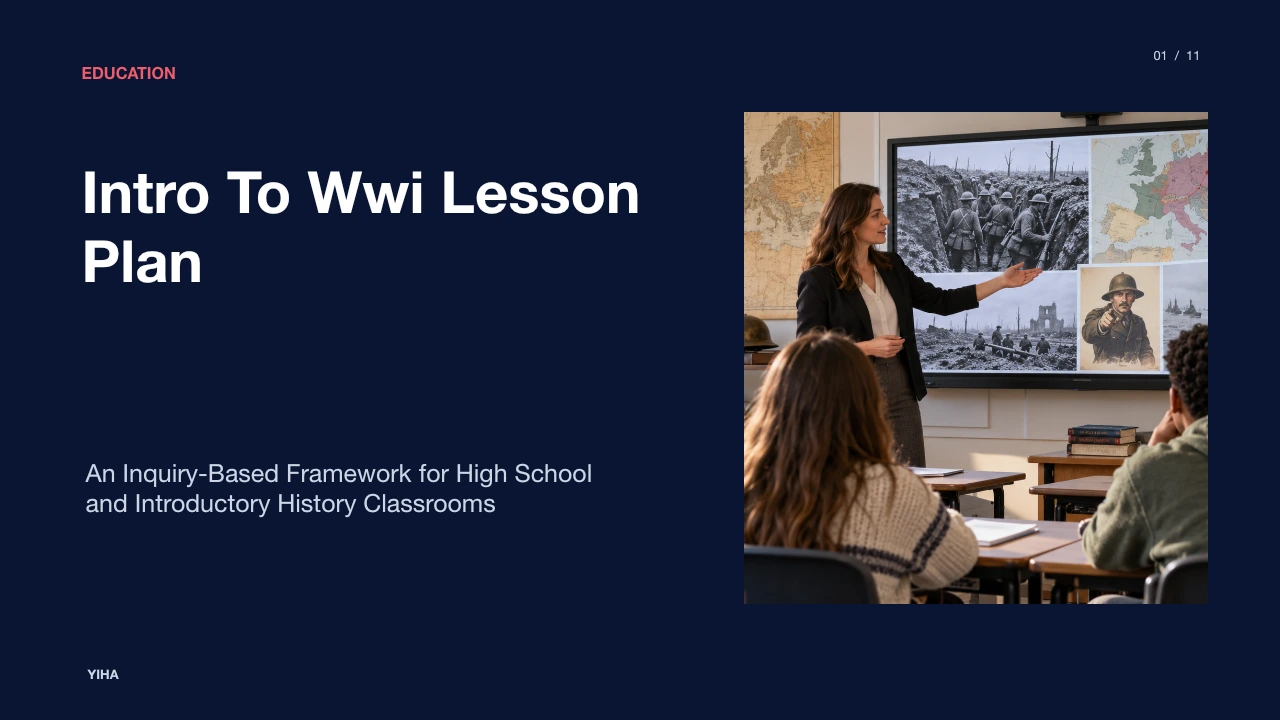
Intro To Wwi Lesson Plan
A comprehensive introductory guide for secondary educators teaching World War I, featuring inquiry-based frameworks, source analysis, and diplomatic simulations.
Free download · 4.9 MB11 editable slides · PowerPoint format
Download the editable PPTX
PPTX · 4.9 MB · 11 editable slides · Free to edit and reuse with attribution to Yiha.ai
View every slide
Use ← →, Home/End, or swipe on mobile
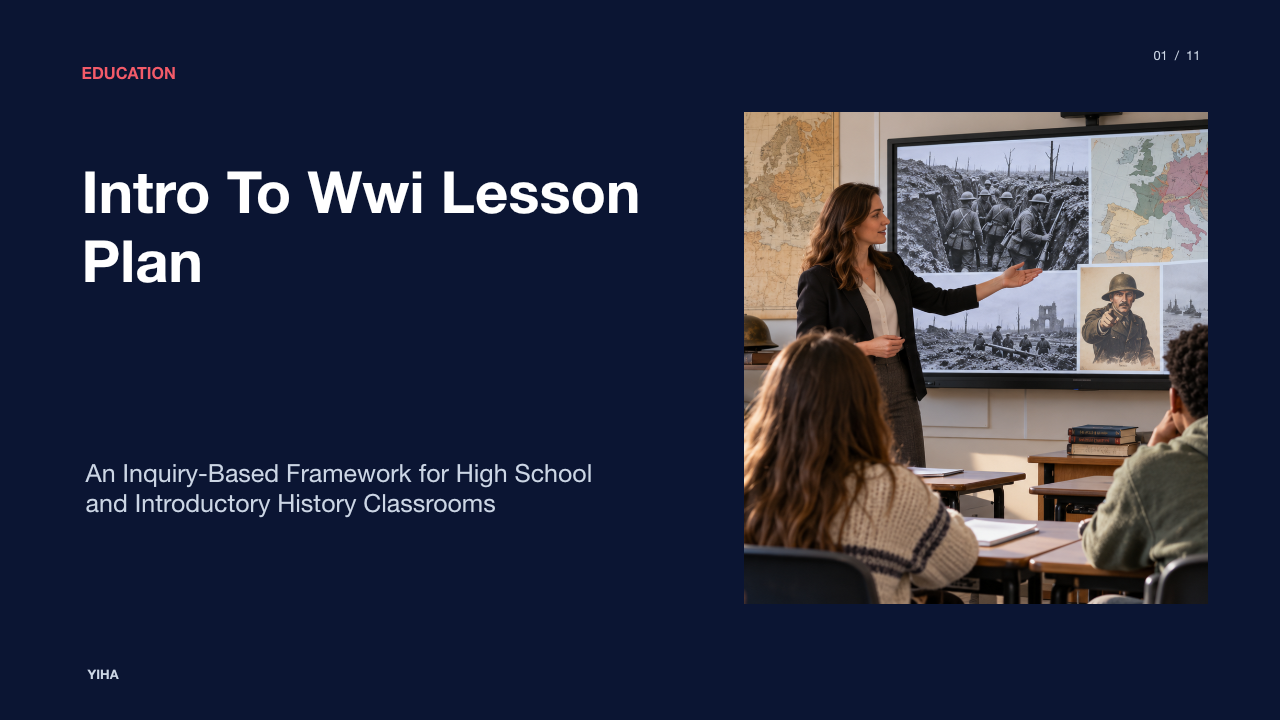
Teaching the First World War requires educators to balance intricate diplomatic networks, transformative industrial military technology, and massive civilian mobilization across multiple continents. A successful introductory unit moves beyond rote memorization of battle dates. Instead, it positions students as historical investigators who analyze structural preconditions, immediate triggers, and the long-term societal consequences of global conflict.
By grounding instruction in historical thinking skills, teachers help learners untangle complex geopolitical developments while evaluating diverse perspectives from soldiers, statesmen, and colonized populations. This lesson framework outlines a comprehensive sequence for introducing high school and introductory collegiate history students to the origins, prosecution, and international settlement of the Great War.
Curriculum Framing and Essential Inquiry Questions
Establishing a rigorous pedagogical foundation requires framing the First World War through structured inquiry. Rather than delivering a passive survey of events, educators frame the unit around compelling questions that require deep analytical synthesis. A core guiding question asks: Was global conflict unavoidable in the summer of 1914, or was it the product of discrete diplomatic failures? As noted in the curriculum guidelines from 9 Components of an Effective Lesson Plan - Teacher Strategies, an effective lesson structure requires clear standards-aligned objectives, purposeful beginning hooks, and active learning sequences that move from guided discovery to independent evaluation.
To build historical thinking skills, teachers scaffold primary source analysis by introducing students to the concepts of historical context, perspective, and corroboration. The lesson plans developed by First World War (1919-1918) Lesson Plans - Cunning History Teacher emphasize using targeted source work, vocabulary building, and structured comprehension questions to develop students' critical evaluations of twentieth-century warfare. Scaffolding questions encourage learners to examine who created a document, what biases influenced its creation, and how contemporary political tensions shaped public sentiment.
An instructional limitation in this initial phase is cognitive overload. High school students often struggle to differentiate between long-term systemic conditions and immediate triggers. Teachers mitigate this by establishing a clear graphic organizer that separates foundational tensions from diplomatic catalysts before introducing specific archival evidence.
Deconstructing Long-Term Causes: The M-A-I-N Framework
To deconstruct the systemic preconditions that destabilized Europe prior to 1914, educators frequently employ the M-A-I-N framework: Militarism, Alliances, Imperialism, and Nationalism. Rather than presenting these concepts in isolation, lessons should highlight their interconnected mechanisms. Industrialized militarism accelerated naval and land arms races, which in turn locked competing empires into defensive pacts fueled by rival imperial ambitions and hyper-nationalist press coverage.
As highlighted in the instructional design of World War 1 Lesson Plan: Causes & Impact High School | Clerna, students build geographic literacy and causal reasoning by labeling historical maps, shading rival coalitions, and predicting how geographic encirclement intensified regional friction. Meanwhile, the curriculum resources at World War I History and Lesson Plans | OER Project demonstrate how zooming out to broad historical scales enables students to analyze systems pushed to the breaking point as armed forces expanded and global alliances solidified.
For an illustrative example of classroom instruction, a teacher might present defense expenditure statistics from 1890 to 1914 alongside political cartoons depicting imperial rivalries in Africa and the Balkans. Students collaborate in pairs to annotate how mutual suspicion created a security dilemma where defensive maneuvers were interpreted by neighboring states as direct existential threats.
The Spark and the July Crisis: Escalation to Continental War
Once the structural powder keg is established, instructional attention shifts to the catalytic event: the assassination of Archduke Franz Ferdinand and his wife Sophie in Sarajevo on June 28, 1914. Archival investigations from World War One Lesson Plans - Cunning History Teacher illustrate that this assassination was not an isolated shock, but the culmination of protracted nationalist unrest and regional instability in the Balkans.
During this instructional stage, students construct chronological timelines tracking the July Crisis to observe the cascade of ultimatums and troop mobilizations. The guided timeline sequence in World War 1 Lesson Plan: Causes & Impact High School | Clerna directs learners to evaluate how Austria-Hungary's ultimatum to Serbia, backed by Germany's diplomatic blank check, triggered Russian mobilization and subsequently brought France and Great Britain into continental warfare.
A common limitation in teaching the July Crisis is deterministic thinking, where students assume the war was inevitable once the assassination occurred. To counteract this assumption, instructors guide students through diplomatic cables, demonstrating moments where mediation was proposed but abandoned due to rigid military timetables and mutual miscalculation.
Industrial Technology and the Realities of Trench Warfare
Moving from political origins to battlefield execution requires examining the clash between industrial machinery and outdated tactical doctrine. The rapid adoption of rapid-fire machine guns, modern heavy artillery, barbed wire, and poisonous chemical gases rendered nineteenth-century infantry charges obsolete, forcing armies on the Western Front into elaborate subterranean defensive networks.
Pedagogical resources from WWI Lesson Plan: Storyboard That's Guide & Activities suggest having students analyze personal narratives and primary sources to visualize the lived experiences of soldiers amidst widespread industrial destruction. In addition, the classroom activities described by World War 1 Lesson Plan: Causes & Impact High School | Clerna involve students sketching annotated diagrams of front-line, support, and communication trenches. This activity helps students explain mechanically why military technology produced a strategic stalemate that lasted years.
For an illustrative example of source analysis, students examine excerpts from soldier trench journals alongside medical logs detailing trench foot and shell shock. Learners evaluate how the sheer physical trauma of sustained bombardment transformed the psychological outlook of an entire generation of combatants.
The Global Scope: Empires, Multi-Front War, and Colonial Soldiers
An intro to WWI unit plan must resist the Eurocentric tendency to restrict analysis exclusively to the trenches of Northern France and Belgium. The conflict spanned multiple continents, engaging extensive manpower, agricultural supply lines, and raw materials extracted from colonial territories across Asia, Africa, and the Caribbean.
Curriculum materials provided by World War I History and Lesson Plans | OER Project emphasize tracing the worldwide scope of the conflict, from battlefields in Southeast Asia and the Middle East to home fronts across the British and French empires. Furthermore, materials cataloged in World War One Lesson Plans - Cunning History Teacher offer primary source accounts illustrating the diverse realities of soldiers deployed on the Eastern Front, in Gallipoli, and across imperial theaters.
Students investigate photographs, service records, and recruitment notices from colonial regiments, such as the Indian Corps on the Western Front or the West African Frontier Force. A key historical question for learners to examine is why imperial subjects fought on behalf of sovereign powers that denied them fundamental political sovereignty at home, and how their military service fueled postwar independence movements.
Total War and the Home Front: Propaganda and Mobilization
Teaching the concept of total war requires demonstrating how industrialized warfare blurred traditional distinctions between military combatants and civilian populations. Sustaining multi-year attrition demanded the complete mobilization of economic resources, domestic food production, industrial manufacturing, and popular ideology.
As outlined in the modular units from World War 1 Unit Plan for World or US History, classroom lessons examine home-front mobilization by analyzing government propaganda posters, mandatory rationing initiatives, liberty bond drives, and shifting labor dynamics that drew millions of women into munitions factories and administrative positions. The unit resources at First World War (1919-1918) Lesson Plans - Cunning History Teacher similarly highlight how states managed economic output and domestic morale through aggressive public messaging.
In this section, students decode propaganda posters using structured analytical categories: the targeted emotional trigger, the visual iconography employed, and the underlying domestic objective, such as enlistment or conservation. An important analytical limitation to discuss is the accompanying suppression of political dissent, including the passage of wartime sedition legislation and state surveillance that curtailed civil liberties.
Turning Points: The Russian Exit and United States Intervention
The strategic landscape shifted dramatically in 1917 as domestic collapse and geopolitical developments altered the balance of power among the belligerents. On the Eastern Front, profound economic exhaustion, military mutinies, and domestic deprivation sparked the Russian Revolution, culminating in the Bolshevik seizure of power and the punitive Treaty of Brest-Litovsk in early 1918.
Educational resources from Turning Points of WWI: Russia, US, and the Outcome | Free PBL Lesson Plan | MasteryMate guide students through the strategic consequences of Russia's exit alongside the catalysts behind American military entry, such as unrestricted submarine warfare and the intercepted Zimmermann Telegram. Complementary instructional strategies from World War One Lesson Plans - Cunning History Teacher allow students to examine how American entry provided critical fresh manpower, economic credits, and industrial materiel to the exhausted Allied lines.
Students conduct a comparative matrix contrasting the collapse of the Russian war effort with the rapid mobilization of American forces. By examining both developments, learners evaluate how the infusion of fresh American personnel countered Germany's 1918 Spring Offensive and accelerated the ultimate collapse of the Central Powers.
The Armistice, the Fourteen Points, and the Treaty of Versailles
The conclusion of combat operations on November 11, 1918, initiated contentious diplomatic negotiations in Paris. Instructors lead students through the stark philosophical divergence between Woodrow Wilson's idealistic Fourteen Points and the punitive security objectives demanded by French Premier Georges Clemenceau and British Prime Minister David Lloyd George.
The lesson design presented by Great War (1914-1918): Wilson's 14 Points: American Idealism and the Treaty of Versailles 1919 — Passports tasks students with evaluating why Allied delegates rejected core components of Wilsonian diplomacy while extracting heavy financial reparations and territorial concessions from Germany. Furthermore, the roleplay format found in The Treaty of Versailles: Flawed Peace (Simulation) illustrates how national delegations negotiated territorial borders, war guilt clauses, and the structure of the fledgling League of Nations.
For an illustrative example of classroom simulation, students represent different national delegates at Paris, debating Article 231 (the War Guilt Clause), reparations amounts, and the redrawing of Eastern European borders. Through this exercise, students discover how compromises produced a precarious settlement that left the Weimar Republic economically vulnerable and fueled deep political resentment across Central Europe.
Assessment Strategies and Synthesizing Historical Memory
The final phase of an introductory First World War unit integrates formative checks with summative assessments that evaluate student mastery of evidence-based argumentation. A robust summative instrument is the Document-Based Question (DBQ) essay, wherein students synthesize six to eight excerpts from letters, treaties, and speeches to formulate a defensible historical thesis.
Instructional frameworks outlined in 9 Components of an Effective Lesson Plan - Teacher Strategies emphasize incorporating ongoing formative checks, such as structured discussions, quick writes, and explicit scoring rubrics that clarify expectations for student success. In addition, the educational exhibitions developed by Classroom Materials | National WWI Museum and Memorial provide rich inquiries into how societies commemorate war trauma, construct civic memorials, and preserve public memory decades after hostilities cease.
To synthesize historical memory, students analyze the design, inscriptions, and cultural context of local and international World War I monuments. By asking whether memorials honor sacrifice, mourn catastrophic destruction, or promote national pride, educators encourage learners to recognize that historical narratives are actively constructed and continually re-evaluated by subsequent generations.
Research sources
- First World War (1919-1918) Lesson Plans - Cunning History Teacher · cunninghistoryteacher.org
- 9 Components of an Effective Lesson Plan - Teacher Strategies · www.teacherstrategies.org
- World War One Lesson Plans - Cunning History Teacher · cunninghistoryteacher.org
- World War 1 Lesson Plan: Causes & Impact High School | Clerna · clerna.org
- World War I History and Lesson Plans | OER Project · www.oerproject.com
- WWI Lesson Plan: Storyboard That's Guide & Activities · www.storyboardthat.com
- World War 1 Unit Plan for World or US History · www.studentsofhistory.com
- Turning Points of WWI: Russia, US, and the Outcome | Free PBL Lesson Plan | MasteryMate · app.masterymate.ai
- 1917 Russian Revolution Lesson Plans & Worksheets · www.lessonplanet.com
- Great War (1914-1918): Wilson's 14 Points: American Idealism and the Treaty of Versailles 1919 — Passports · www.passports.com
- The Treaty of Versailles: Flawed Peace (Simulation) · world-war-one-unit-plan.weebly.com
- Classroom Materials | National WWI Museum and Memorial · www.theworldwar.org