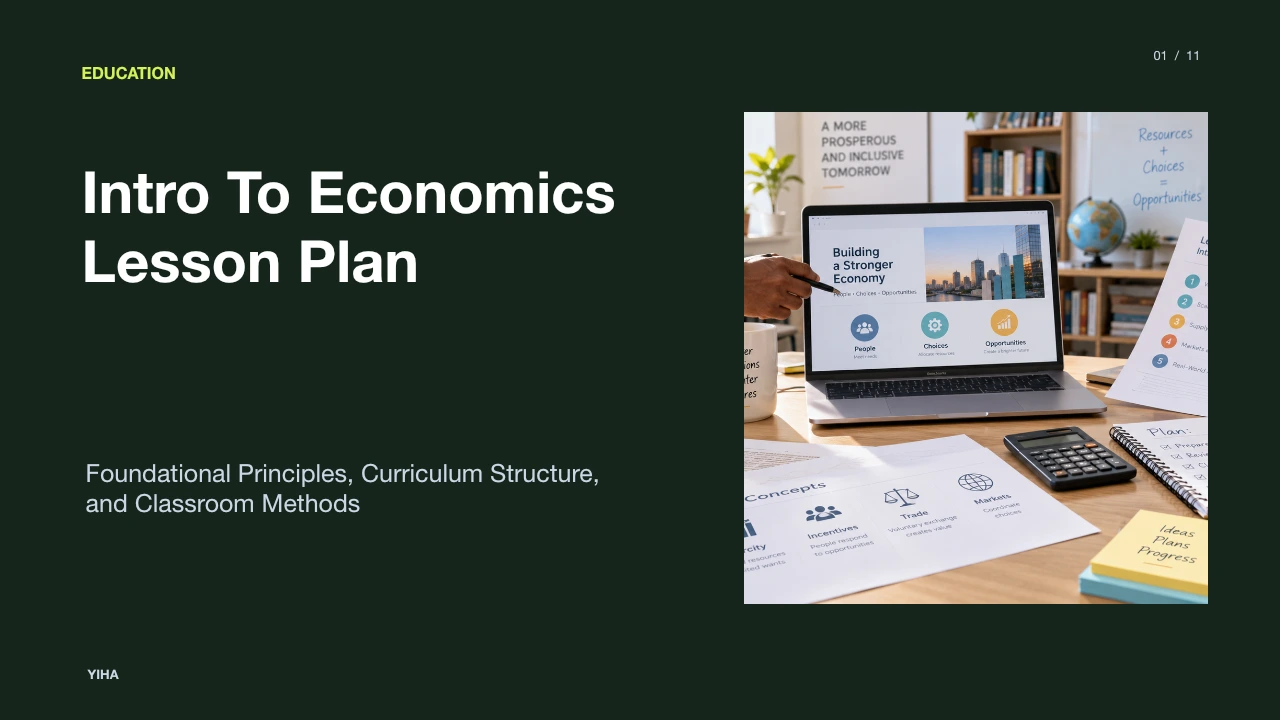
Intro To Economics Lesson Plan
A complete introductory economics lesson plan guiding educators through core economic concepts: scarcity, opportunity cost, incentives, market equilibrium, institutions, long run growth, and market failures.
Free download · 4.9 MB11 editable slides · PowerPoint format
Download the editable PPTX
PPTX · 4.9 MB · 11 editable slides · Free to edit and reuse with attribution to Yiha.ai
View every slide
Use ← →, Home/End, or swipe on mobile
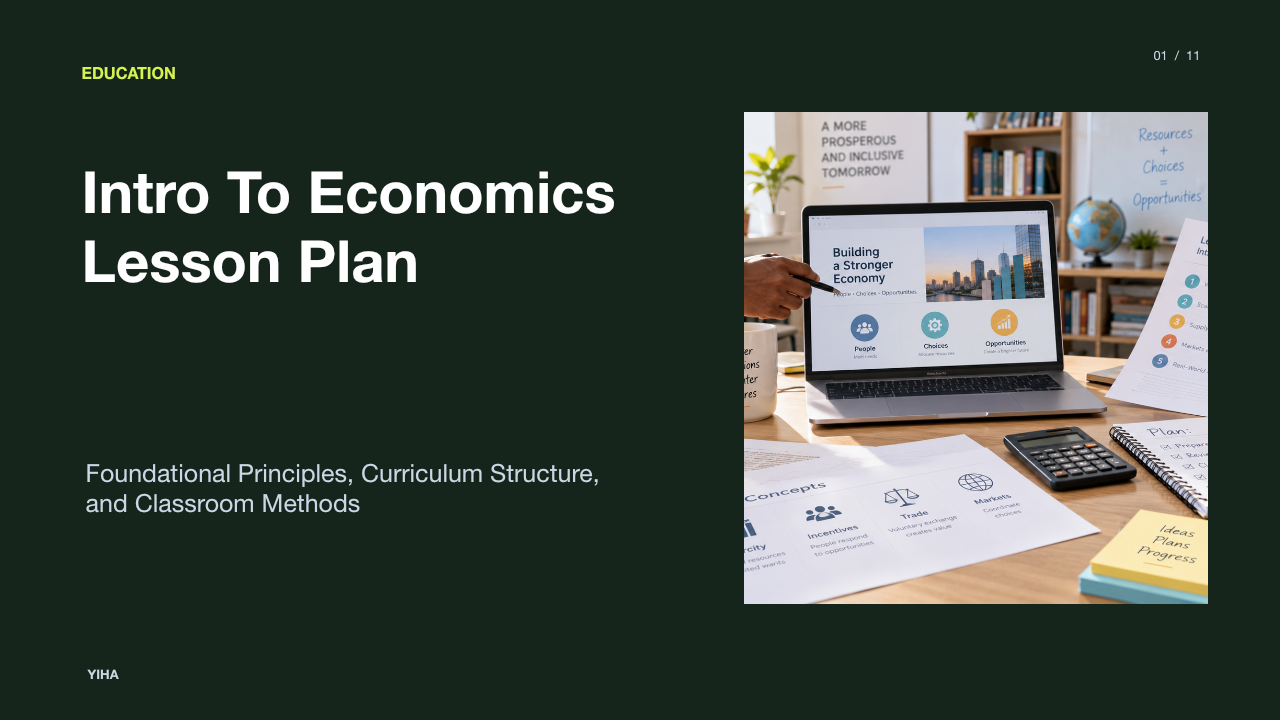
Economics examines how human societies allocate finite resources to satisfy competing wants and needs. For secondary and introductory collegiate educators, structuring a foundational economics curriculum requires balancing core theoretical principles with relatable real-world decision-making. This lesson plan outline guides instructors through nine core modules, moving logically from personal choice under scarcity to broad macroeconomic dynamics, institutional frameworks, and market failures.
Scarcity and the Fundamental Problem of Resource Allocation
The fundamental premise of economic analysis begins with scarcity. Human wants and needs are virtually limitless, yet the physical and temporal resources required to fulfill them remain strictly finite. As outlined in the What Is Economics? Lesson Plan and Worksheet, economics investigates how individuals, business enterprises, and public institutions systematically deploy limited productive resources to address competing demands.
In introductory instruction, educators must ground these abstract categories in concrete physical inputs: natural resources, human labor, and physical capital. The central lesson illustrates that scarcity affects every level of society concurrently:
- Households must allocate scarce hourly time and earned income among housing, groceries, and rest.
- Business firms must divide scarce payroll budgets and machine capacity across competing production lines.
- Governments face finite tax revenue and borrowing limits when budgeting for infrastructure, public health, and social welfare.
An illustrative example helps clarify this dynamic. Consider a municipal town council with a fixed annual revenue stream. If council members choose to allocate funding toward road maintenance, those same public dollars cannot fund municipal parks or emergency services. The existence of scarcity compels deliberate allocation choices across all economic actors.
Opportunity Cost and Marginal Decision-Making
Because scarcity prevents agents from choosing every desirable option, every choice incurs an opportunity cost. According to educational audio curriculum from Federal Reserve Education, opportunity cost is defined as the value of the next best alternative given up when making a decision. Economists emphasize that opportunity cost is not the sum of all possible alternatives, but specifically the single most highly valued alternative foregone.
Furthermore, rational economic decision-making rarely presents itself as an all-or-nothing choice. Instead, individuals evaluate choices at the margin, comparing additional benefits against additional costs. As shown in the curricular resources at Teach with Magic - Intro to Econ, students understand marginal thinking when examining everyday choices, such as whether to spend one additional hour studying or sleeping.
An important instructional boundary is teaching students to ignore sunk costs. Irrecoverable past expenditures of money or time must not dictate forward-looking marginal choices. If a firm spends money developing an unworkable product, rational choice dictates halting production if future marginal costs exceed future marginal revenue, regardless of how much capital was spent previously.
Incentives, Human Behavior, and Unintended Consequences
Human beings respond predictably to incentives. As articulated in instructional materials from the Foundation For Teaching Economics, National Voluntary Content Standard 4 affirms that individuals adjust their behavior in response to both positive and negative incentives. Positive incentives reward actions, whereas negative incentives impose penalties or costs.
When designing policies, economic agents frequently encounter unintended consequences. Policymakers often assume individuals will react passively to rules, but people actively adjust their behavior to maximize their private benefits. For example, curriculum from the Marginal Revolution University Intro to Economics Unit Plan highlights interactive classroom exercises where students make policy choices and examine secondary reactions. Perverse incentives emerge when a policy creates a reward structure that inadvertently encourages the exact behavior the rule intended to discourage.
Specialization, Comparative Advantage, and Voluntary Exchange
Trade is fundamentally a voluntary exchange where both parties expect to gain. Voluntary exchange operates on the principle that trade occurs only when each participant values the good or service received more than the item surrendered. The curricular repository at the Foundation For Teaching Economics establishes that voluntary trade creates mutual value without requiring additional physical resources.
The foundation of voluntary exchange is specialization and comparative advantage. When producers concentrate their labor on activities where their opportunity cost is lowest, total output expands. Instructional frameworks from Money Instructor demonstrate how students experience the shift from direct barter to currency exchange, illustrating how money lowers transaction costs and facilitates specialized labor across complex economies.
Market Equilibrium and the Price Mechanism
Market equilibrium describes the point where the quantity of a good demanded by consumers matches the quantity supplied by producers. Curricular guides from Money Instructor feature hands-on worksheets where students plot demand lines and supply lines to identify the exact market-clearing equilibrium price.
The price mechanism functions as a decentralized communications network. Prices convey information regarding relative scarcity and consumer desires across global markets. As highlighted in video modules from Marginal Revolution University, an everyday product like a rose grown in South America and delivered to a consumer in North America involves thousands of uncoordinated workers, farmers, pilots, and retailers. No central planning committee directs their individual actions; rather, the price mechanism coordinates decentralized decisions across global supply networks.
Economic Systems and the Foundational Role of Institutions
Societies coordinate production and distribution through economic systems, which are historically categorized into traditional, command, market, and mixed structures. In traditional economies, custom dictates production; in command systems, government planning agencies determine quotas and resource allocation. However, modern economies operate predominantly as mixed systems with differing degrees of state regulation and private enterprise.
Underlying any functioning market system are formal and informal institutions. The economic text The Economy 1.0 by CORE Econ defines institutions as the laws and informal rules that regulate social and economic interactions among people. The foundational institutions of capitalism are secure private property, competitive markets, and independent business firms. Without the rule of law and reliable contract enforcement, individuals face high risks of expropriation, which stifles long-term capital investment and economic stability.
Productivity, Technology, and Long-Run Economic Growth
For most of recorded human history, global living standards remained relatively stagnant. As documented in historical growth models from The Economy 1.0 by CORE Econ, living standards in many nations experienced a dramatic upward inflection starting in the eighteenth century, forming what economic historians describe as the hockey stick of growth. This unprecedented increase coincided with technological innovation, capital accumulation, and expanded specialization.
Productivity, measured as output produced per unit of labor input, serves as the primary engine of long-run material living standards. Curricular units from Marginal Revolution University prompt students to trace major historical innovations, illustrating that material gains stem from using capital and technology to produce goods with fewer hours of labor. However, instructors should also present the limitations of measuring material progress strictly through national production figures like Gross Domestic Product, noting environmental degradation and the exhaustion of non-renewable resources.
Market Failures, Externalities, and Government Policy
While competitive markets efficiently allocate resources under ideal conditions, market failures occur when price mechanisms fail to account for total social costs or benefits. Curriculum modules from the Foundation For Teaching Economics address market failures, externalities, and the tragedy of the commons through participatory classroom models.
Externalities represent spillovers imposed on third parties outside a direct transaction:
- Negative externalities occur when production imposes costs on society that the producer does not bear, such as industrial air pollution, resulting in market overproduction.
- Positive externalities occur when an activity creates third-party benefits, such as technological research and public health inoculations, resulting in private market underproduction.
- Public goods feature non-excludable and non-rival properties, leading to free-rider problems where private markets fail to supply adequate quantities.
Remedies include government interventions such as corrective taxes, tradable permits, and direct regulatory standards. As detailed in environmental simulations by the Foundation For Teaching Economics, introducing tradable permits allows firms to internalize pollution costs while maintaining incentives for cost-effective emission reductions.
Classroom Implementation Through Active Learning and Data
Executing an effective introductory economics course requires structured pedagogy, student-centered activities, and empirical evaluation. Modern curriculum guidelines from Marginal Revolution University emphasize interactive simulations, policy games, and structured problem sets over passive lecture models. Engaging students directly in simulated auctions or institutional design projects transforms abstract formulas into tangible experiences.
To build long-term analytical competence, instructors should incorporate regular reflection and adaptation into their lesson design, aligning with best practices documented by ITTT. Formative evaluations, including exit tickets and quick comprehension checks, provide immediate insight into student mastery. By pairing simulated market interactions with systematic reflection, educators ensure that introductory economics fosters durable economic literacy.
Research sources
- What Is Economics? — Lesson Plan and Worksheet · moneyinstructor.com
- Teach with Magic - Intro to Econ · www.mrroughton.com
- Lesson Plans - Foundation For Teaching Economics · fte.org
- Opportunity Cost | Audio Assignment | Federal Reserve Education · www.federalreserveeducation.org
- Economics Worksheets and Lesson Plans for Teachers - Money Instructor · moneyinstructor.com
- Intro to Economics Unit Plan | Marginal Revolution University · pages.mru.org
- 1. The capitalist revolution – The Economy 1.0 · books.core-econ.org
- 8 Best AI Lesson Plan Generators for Educators · www.weareteachers.com
- Reflecting and Adapting Lesson Plans | ✔️ ✔️ ✔️ ITTT · www.tesolonline.com